Get Full Government Meeting Transcripts, Videos, & Alerts Forever!
Get email alerts on the Moratorium Large Venues topic
No spam. Unsubscribe anytime.
Portland committee recommends council consider moratorium on large music venues amid transportation and neighborhood concerns
Summary
After extended public comment and hours of debate the Sustainability & Transportation Committee voted 2–1 to recommend the City Council consider a temporary moratorium on new theaters and performance halls above 2,000 seats while the city studies transportation and neighborhood impacts.
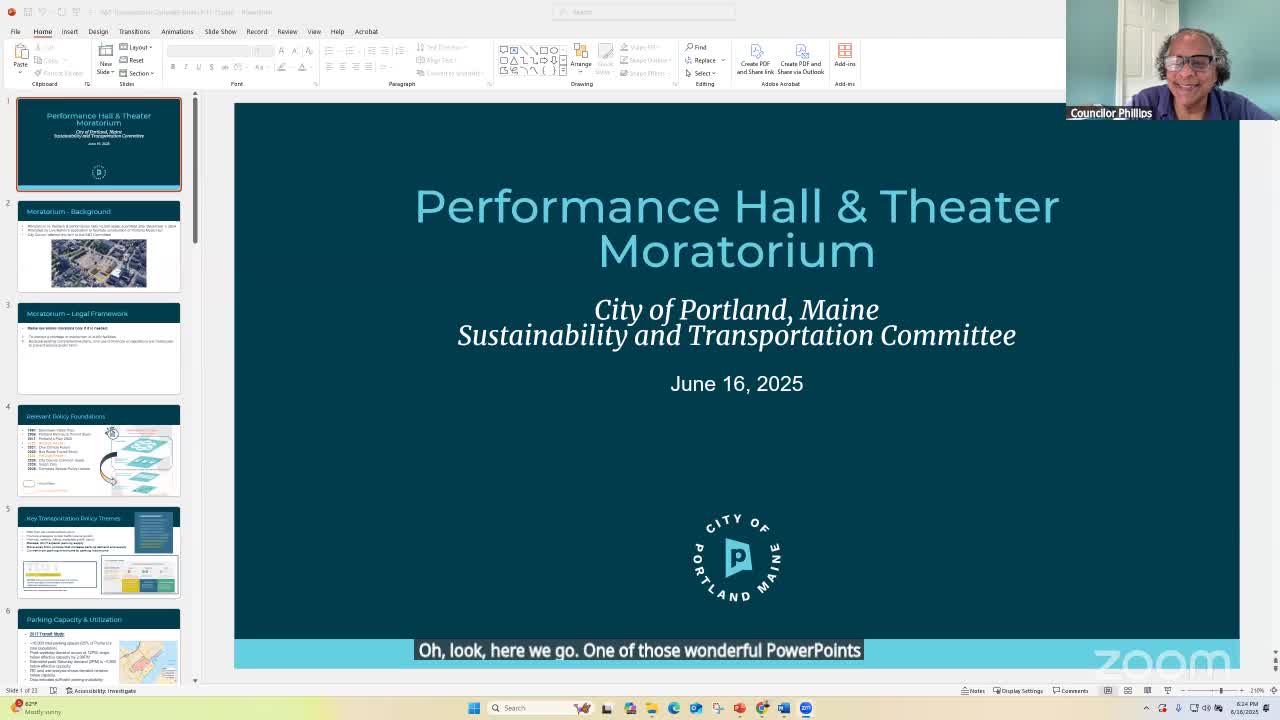
The City of Portland Sustainability & Transportation Committee voted 2–1 on June 3 to recommend the City Council adopt a temporary moratorium on theaters and performance halls with capacity greater than 2,000 seats, a move that would pause consideration of such projects while the city studies potential transportation, parking and neighborhood impacts.
Background and scope: The moratorium language under review would establish a time‑limited pause (180 days retroactive in the version discussed) on new applications for theaters and performance halls above the stated capacity threshold submitted after Dec. 1, 2024. City staff reviewed policy, regulation and data and concluded that existing site‑plan, traffic‑movement permit and impact‑fee authorities provide tools to address transportation impacts; staff recommended against the moratorium on that basis. Director of Planning and Urban Development Kevin Craft summarized city regulatory authority, parking studies and TMP practice and said recent parking counts show substantial evening parking capacity in downtown garages and lots.
Public comment and positions: The hearing drew sustained public comment. Several live‑music stakeholders and developer representatives urged that parking capacity is sufficient and argued the venue will bring jobs, tourism and restaurant business. Live Nation New England’s president, Ryan Vangel, described an event management plan and corporate safety practices, including ongoing coordination with Merrill Auditorium staff. Developer representatives said they have reached agreements with nearby garages for extended hours and discounted rates on event nights.
Opponents — including representatives of local independent venues, arts organizations and neighborhood residents — said a large corporate promoter’s downtown venue would harm Portland’s independent arts ecosystem and impose traffic, parking and safety burdens on adjacent neighborhoods. Multiple residents and neighborhood advocates described on‑street parking pressures, limited sidewalk space, narrow one‑way streets and difficulties exiting the Old Port area during concurrent events. Speakers urged more time for the city to evaluate cumulative impacts, to protect residential parking and to study venue proximity to other large performance spaces.
Staff analysis: Craft summarized relevant facts in the staff memo: a 2017 downtown parking study identified about 16,000 spaces in the study area and the city’s May 2025 evening parking inventory found roughly 3,300 spaces within a quarter mile of the proposed venue with an average evening utilization of about 19 percent. The applicant produced a map of identified nearby facilities and five garages the applicant expects would host patrons with an aggregate capacity of roughly 2,800 spaces. Staff noted the city’s impact‑fee ordinance (transportation fee category) and the state traffic‑movement permit process as mitigation tools and noted that site‑plan review routinely requires off‑site mitigation such as sidewalk, intersection and pedestrian improvements.
Committee action and vote: After more than an hour of public comment and debate among committee members, Councilor Pius Ali moved to recommend that the City Council approve the moratorium; Councilor Anna Bullitt seconded. The committee voted 2–1. The recorded roll call in committee was: - Pius Ali — yes - Anna Bullitt — yes - Regina Phillips (chair) — no
The motion carries as a committee recommendation; Council action is required to enact any moratorium.
Why it matters: A council‑level moratorium would pause applications of a particular type and give the city time to evaluate cumulative transportation and neighborhood impacts and to consider possible zoning, operational or mitigation responses. Supporters of the moratorium framed it as a narrowly scoped, temporary planning pause to allow study; opponents argued the city already has legal tools to mitigate impacts, that parking inventories show capacity and that delaying an as‑of‑right application penalizes property owners and developers.
Ending: The committee’s majority recommended the moratorium be forwarded to the full council for decision. The City Council will receive the committee recommendation and is scheduled to consider it at an upcoming council meeting; staff said more detailed traffic and mitigation materials will be available through the existing Planning Board review process for any project application.