
City Council questions DOI on outreach, training and low use of whistleblower protections
Get AI-powered insights, summaries, and transcripts
Subscribe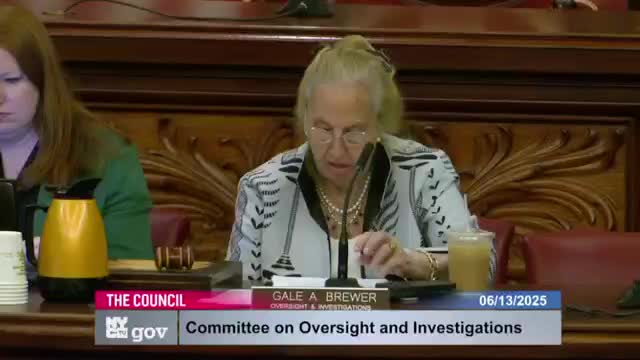
Summary
The Council's Oversight and Investigations Committee pressed Department of Investigation Commissioner Jocelyn Strauber on DOI's training, complaint handling and the small number of formal whistleblower protections granted, while witnesses urged faster, clearer processes.
The Committee on Oversight and Investigations questioned Department of Investigation Commissioner Jocelyn Strauber at a City Council hearing about DOI's efforts to encourage city employees to report suspected corruption, including the agency's training programs, complaint-processing procedures and the scope of legal whistleblower protections.
The hearing focused on whether DOI's education and outreach match the statutory obligations that flow from Mayoral Executive Order 16 and the city's whistleblower law, and whether DOI has the staffing and data to reach the city's roughly 300,000 municipal and contract workers.
Commissioner Jocelyn Strauber told the committee that DOI emphasizes both a "must report" obligation and protections under the city's whistleblower law. "City employees are integral to DOI's anti corruption mission and are fundamental to creating a culture of integrity in municipal government. DOI cannot accomplish its mission without them," Strauber said.
Strauber gave specific operational figures: DOI recorded more than 12,300 complaints in fiscal year 2022, more than 13,500 in fiscal year 2023 and over 14,600 in fiscal year 2024. She said roughly 14'16 percent of complaints in fiscal years 2022'24 came from people who self-identified as city employees, and that the agency's online and in-person training reached tens of thousands: 23,395 completed DOI's module in fiscal 2022, 29,245 in 2023 and 27,315 in 2024, with about 11,000 so far in fiscal 2025 through May.
Strauber described DOI's blended outreach model. The agency distributes an online training module through the Department of Citywide Administrative Services, added a DOI video to DCAS onboarding materials in 2024, and expanded in-person lectures: DOI delivered 72 in-person lectures in fiscal 2022, 240 in 2023 and 236 in 2024, and about 190 so far in 2025. She said tailored, in-person sessions'for example at Department of Sanitation garages'helped DOI reach employees who are not desk-bound and sometimes prompted immediate reports to DOI staff who conducted the training.
Council members repeatedly pressed DOI on capacity and reach. One member said DOI had done "a great job, particularly'going to the sanitation garages," but asked how DOI could scale training to cover the city's full workforce, including contractors and seasonal or field employees. Strauber said the training division has six staff and that expanding the unit and investigative squads would allow more in-person outreach and better monitoring of module completion with DCAS.
Committee members also sought more granular data. Strauber said DOI can report how complaints are received (email, phone, internet) and gave a high-level split for one recent year (about 7,000 complaints from the public and about 3,400 from agency employees), but she did not have an agency-by-agency breakdown available at the hearing and said the new case-management system should make such counts easier to produce.
Both council members and witnesses raised concerns about the low number of formal whistleblower protections and the pace of certain investigations. Attorney Robert Krause, representing former city official Ricardo Morales, told the committee that an investigation tied to Morales's case took 18 months and that a prior related probe was completed much faster, suggesting inconsistent timelines. Krause recommended time-bound investigation protocols and a review mechanism to detect undue delays.
Ricardo Morales, who testified as an invited witness, described his experience losing his job after reporting misconduct and disputed DOI's handling of his complaint. "If it is true that in the last 10 years, there have been 2 people who have gotten the protection, I gotta tell you that is disconcerting," Morales said, calling for clearer criteria and more audits of how whistleblower protections are granted.
Members of the public who spoke at the hearing described serious allegations they said they had reported to DOI and said they had received limited follow-up. Witnesses reported delayed responses on urgent complaints, including allegations of stalking and other threats; DOI staff suggested follow-up after the hearing.
On agency scope, Strauber confirmed that DOI's jurisdiction includes many city entities and contractors but not the New York City public schools'complaints that meet SCI's jurisdiction are referred to the Special Commissioner of Investigation for the New York City School District. She said DOI's protest-monitoring unit, created under a settlement related to the police handling of demonstrations, is staffed and preparing to begin formal compliance reviews once police policies are finalized.
Committee members asked whether trainings should be mandatory for city employees and contractor workforces. Strauber said she would not oppose mandatory training but warned that comprehensive training for contractors and subcontractors would require additional resources.
The hearing produced no formal votes or legislative actions. Committee members requested additional, agency-specific complaint counts and asked DOI to provide lists of which agencies are using the DCAS onboarding materials. Strauber agreed to provide some of that information after the hearing.
The committee left open follow-up steps: DOI will produce more detailed breakdowns as its case-management system matures, and council staff said they will consider whether statutory or administrative changes are needed to increase protections, speed investigative timelines and expand education to contractual workforces.