Get Full Government Meeting Transcripts, Videos, & Alerts Forever!
Get email alerts on the Zoning And Land Use topic
No spam. Unsubscribe anytime.
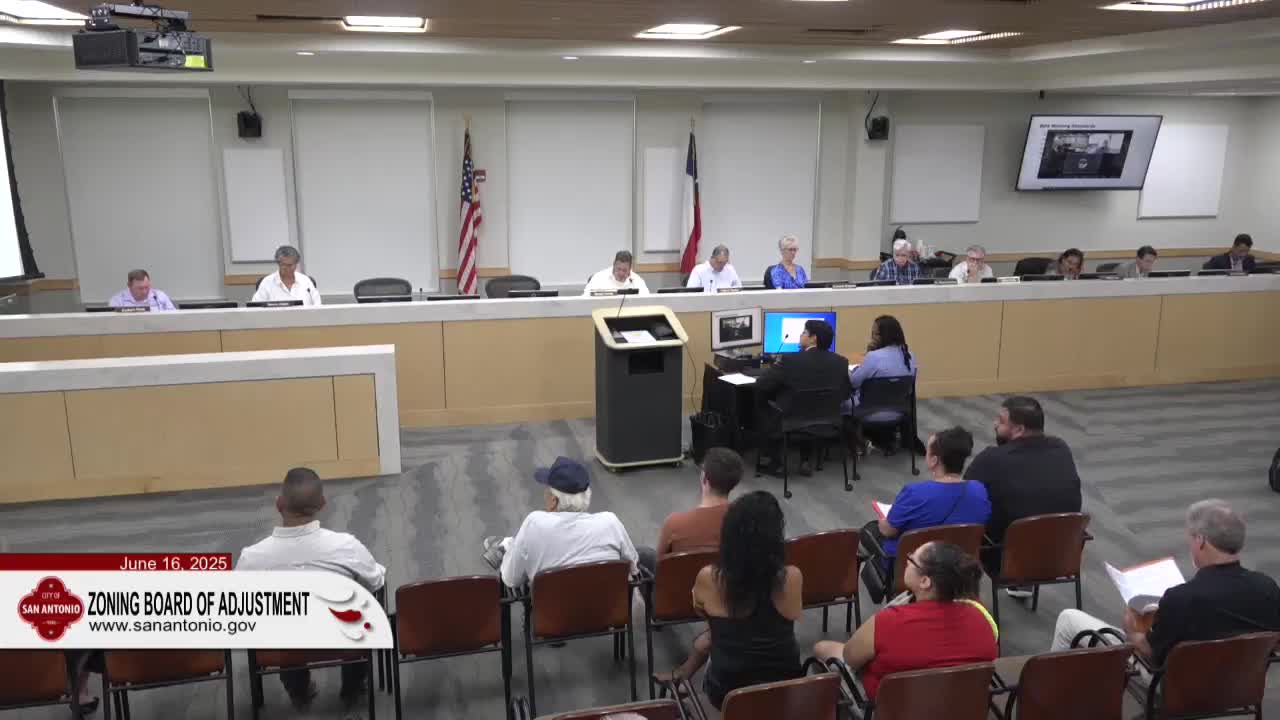
San Antonio Board of Adjustments approves and denies a mix of variances, hears short‑term rental appeals
Summary
At a Board of Adjustments meeting, commissioners granted several variances (including a fence material/height exception and sign size renewal), denied or tabled others, and rejected an appeal for a Type‑1 short‑term rental permit after questioning whether the operator lives on site.
The San Antonio Board of Adjustments on an afternoon session considered more than a dozen zoning variance and special‑exception requests, approving several with conditions, denying others and rejecting an appeal of a staff denial for a short‑term rental (STR) permit.
The most immediate public attention went to a fence variance at 2512 Southwest Loop 410 and to multiple STR and accessory‑structure cases. The board approved an exception to allow a taller, metal fence with conditions, denied a request to increase STR density on 211 Utah Street, and denied an appeal of a staff decision for a Type‑1 STR permit where staff questioned whether the operator actually resides at the property.
Why this matters: The Board’s decisions affect property owners’ ability to modify buildings, add or maintain accessory structures and operate short‑term rentals. The board also issued approvals that include conditions intended to protect neighbors’ safety and preserve neighborhood character.
What commissioners did (votes, conditions and quick context)
Votes at a glance (each item below lists the Board case ID, address, applicant when stated, the motion outcome, and key conditions):
- BOA‑25‑10300080 — 2512 Southwest Loop 410 (applicant: Eneida/Eneida Flores): Motion to allow a fence variance (metal corrugated material and taller sections) — APPROVED unanimously. Conditions recorded in the hearing: applicant amended request to include protective caps on exposed metal edges, and the approval was limited to specified lengths (amended to 24 feet along corner/side areas as presented). Staff had recommended denial because corrugated metal is not typical in the area; the board found hardship and approved the variance with the applicant’s amendment. Evidence: staff presentation and applicant testimony (“Sí, básicamente, estamos solicitando, si nos permiten, mantener la cerca como está.” — Eneida Flores). Vote: unanimous.
- BOA‑25‑10300070 — 1043 West Magnolia Ave (owner: Max/ Greg Schmidt): Request to remove or not rebuild a historic front balcony/porch under NCD‑5 rules — NO MOTION (applicant’s motion withdrawn); outcome: no action by the Board on a variance to keep the removal, meaning the owner remains subject to applicable NCD‑5 requirements and staff guidance. During the hearing neighbors and the Beacon Hill association urged retention of the front porch “appearance”; the board and staff explained that a covered porch (a pórtico) can be rebuilt without a fully accessible balcony and that restoring the porch may be required if the variance is not granted. Applicant indicated structural decay of the balcony and described safety concerns. Evidence: applicant testimony and neighbor comment (Cidya Walker / Beacon Hill subcommittee president).
- BOA‑25‑10300077 (appeal) — 125 Plan Avenue (appeal of staff denial for STR Type‑1): MOTION TO OVERTURN STAFF DENIAL — FAILED 5–6. Staff recommended denial, noting the Type‑1 STR rules require the owner/operator to use the property as a residence and that submitted evidence (listings, utilities, and other materials) created uncertainty about whether the operator lived there. Several commissioners said they were not satisfied that the applicant met the residency standard; others said applicant documents (driver’s license with the property address, authorization from owner/agent, and additional corroborating material) sufficed. Outcome: the motion to reverse the staff denial failed, so the denial stands. Evidence: staff presentation and debate on whether the applicant “lives there” (staff: “Debe ser residencia principal y el personal no piensa que estas condiciones han se han cumplido…”). Vote: 5 yes / 6 no (motion failed).
- BOA‑25‑10300085 — 211 Utah Street (special exception to allow additional short‑term rental unit beyond 25% density in block): MOTION — FAILED 11–0. Staff recommended denial based on density limits and neighborhood impacts; the applicant said they planned to use mid‑term stays and to work with neighbors. The board found the density threshold would be exceeded and denied the special exception. Vote: 11 no, 0 yes.
- BOA‑25‑10300082 — 5999 Zavala Road (KIS/Sign renewal / variance for multi‑tenant sign size): APPROVED. Applicant requested a sign face larger than code limits to renovate a multi‑tenant sign cabinet; staff recommended denial but the board found the proposed sign consistent with other large signs in the corridor and granted the variance with conditions described at the hearing. Vote: unanimous.
- BOA‑25‑10300090 — 667 Mason Street (applicant Lisa Hendrixson / historic house): Applicant requested a short‑term rental permit (Type‑2 or Type‑1 ambiguity discussed) after prior permit denials and code issues at nearby properties. Commissioners discussed the property’s renovation, local outreach and property management plan. The Board asked for additional neighborhood documentation and, after debate, moved to postpone or consider the application with neighbor outreach (applicant accepted a postponement). (No final vote recorded in transcript excerpt.)
- Several accessory‑structure and minor separation variances (examples below) — APPROVED when the board found practical constraints: the board approved multiple small‑setback and overlay‑district variances where staff found limited buildable area or the proposed work replaced an existing structure. Approvals included requirements to maintain drainage, to limit new depth beyond the existing footprint, and to secure neighbor maintenance access. Notable outcomes: - BOA‑25‑10300044 — 1603 Thieves Ave: variance to reduce required separation for a porch replacement — APPROVED unanimously (board found project largely replaces existing feature; vote recorded unanimous). - BOA‑25‑10300081 — 7523 Happy Valley Drive (owner Ruben Valadez): allowed a reduced side separation for an accessory structure after the applicant agreed to pull back and accept an amendment to provide a 2‑foot buffer for neighbor access and fire/safety considerations; motion passed 10–0 after amendment. - BOA‑25‑10300086 — 1334 Hicks Ave (applicant Seanny Cervantes): lateral/side‑yard and accessory‑structure variances approved after neighbors’ outreach and documented drainage channels; board conditioned approvals to preserve drain routing and maintenance access; vote recorded unanimous.
- Security fence for CPS substation sites (multiple BOA files, example: BOA‑25‑10300087 — 5180 Fredericksburg Rd): The board approved variances to allow higher, corrugated/metal fences and additional security measures around CPS electrical infrastructure, finding the public‑safety and infrastructure‑protection interest justified limited departures from standard fence material/height rules. Vote: unanimous on the motion to allow exceptions where staff and applicant demonstrated repeated unauthorized access to substation property.
What the board emphasized in debate
- Residency and evidence for short‑term rental Type‑1 status: Staff stressed that a Type‑1 STR requires proof the owner/operator uses the property as a residence; commissioners asked for driver’s license, utility accounts, lease documents or regular staff visits to verify occupancy (staff: “Debe ser residencia principal y el personal no piensa que estas condiciones han se han cumplido…”).
- Safety and neighbor protections: On fence and accessory structure items, commissioners repeatedly required conditions aimed at reducing risk to neighbors (caps on metal fence edges, limits on where corrugated material may be used, minimum separation for maintenance and fire access, and drainage protections).
- Historic neighborhood appearance: On NCD‑5 (Neighborhood Conservation District) matters, the board heard neighborhood association testimony asking that porch/porch‑covering treatments preserve original house appearances; staff clarified when a covered porch (pórtico) could meet code without recreating an unusable balcony.
Representative quotes from the hearing (verbatim): - Staff explanation of Board procedure and code authority: “...este es un organismo administrativo, no es una corte legal. Todos los se han asignado poderes específicos a cada 1 de nosotros por el Consejo de la Ciudad, el capítulo 35 del Código de la Ciudad…” (staff opening statement). - Fence applicant (Eneida Flores): “Sí, básicamente, estamos solicitando, si nos permiten, mantener la cerca como está.” - Short‑term rental staff summary of concerns: “Debe ser residencia principal y el personal no piensa que estas condiciones han se han cumplido en esta solicitud.”
What’s next / follow‑ups
- Applicants granted variances must meet the amendments and conditions recorded on the record (for example, fence edge caps, drainage maintenance, and limits on additional depth or height noted by the board). Staff will process permits consistent with those conditions.
- Several items were postponed or required additional neighborhood outreach (e.g., the Mason Street and other STR cases); the board set a follow‑up / postponement date where applicants asked for time to supply more neighbor letters.
- Where appeals were denied (STR Type‑1 appeal), applicants may reapply under the applicable STR procedure (for example, apply for an STR‑2 or submit supplemental evidence that they occupy the property) or request staff guidance on next steps.
Meeting context and participation
- Engagement: The docket included a large number of items (more than a dozen), several contested public comments, and extended staff presentations on code interpretation and STR enforcement experience. Multiple neighbors and association representatives spoke on porch/preservation and STR neighborhood impacts. - Implementation risk: Several approvals include conditions that require follow‑up by staff (drainage, required caps on fences, verifying STR occupancy) and therefore carry low‑to‑medium implementation risk depending on compliance.
Ending note: The Board repeatedly framed approvals as narrowly tailored to address demonstrated hardship or infrastructure security issues, and conditioned relief to reduce neighborhood impacts and safety risks. For questions about next steps or to review conditions for a specific case, applicants and neighbors were directed to meet with Planning and Development staff noted in the hearing.