Get Full Government Meeting Transcripts, Videos, & Alerts Forever!
Get email alerts on the Wastewater Plant Upgrade topic
No spam. Unsubscribe anytime.
Goldsboro hears detailed plan to upgrade aging water reclamation plant as council adopts a 7.5% utility rate increase
Summary
Goldsboro council members heard a multi‑part presentation on the Arrington Bridge Water Reclamation Facility and adopted a utility‑fee ordinance, while consultants warned the plant needs major upgrades and the city will face difficult funding choices.
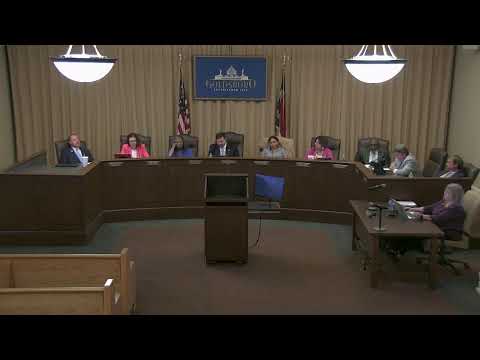
Goldsboro council members heard a multi‑part presentation on the Arrington Bridge Water Reclamation Facility on the evening the council considered utility rates and the city budget.
Hazen & Sawyer engineers and city utilities staff described the plant’s condition and needs, saying parts of the plant date to the 1960s and the last major upgrade was in 2003. Colin Beck of Hazen & Sawyer summarized the project scope and timeline, noting that state regulations and capacity limits (the plant is permitted at 14.2 million gallons per day, and North Carolina DEQ flags projects that reach 80% of permitted average annual flow) make upgrades urgent for future sewer extensions and economic growth.
The presentation reviewed historical flow data, the DEQ “80/90” trigger (80% triggers an engineering evaluation; at 90% construction is expected to start), and options for phased expansion. City staff and consultants said the design‑phase work (basis of design report and preliminary cost estimate) would narrow a previously stated budget range and allow the team to propose a guaranteed maximum price during design‑build procurement.
Why it matters: The city’s wastewater limits have already constrained new sewer extensions in previous years. If flows hit the 80% threshold again, DEQ restricts further sewer service until evaluations or expansions proceed. Council members said they want capacity to support job announcements and private development.
Key technical and cost points presented by staff and consultants: - The plant’s original works date to the 1960s; upgrades occurred in 1980 and 2003 and some equipment remains from those eras. - Sand‑filter underdrain systems and other treatment equipment are deteriorated; replacing all four sand filters was estimated by staff at about $12 million. - The UV disinfection system and dewatering belt presses are reaching the end of their useful lives (a combined replacement estimate discussed in the presentation was in the low millions; staff cited a $2.4 million DCIP grant request aimed at UV system components and a roughly $3 million estimate for presses in current condition assessments). - A preliminary, high‑level construction cost range cited earlier to council was $80 million to $140 million; consultants said this wide spread reflects scope uncertainty pending design work. - Hazen & Sawyer proposed early‑start services leading to a basis‑of‑design report; staff noted a proposed basis‑of‑design fee around $825,000 to get to a preliminary cost estimate and 75% design.
Funding and rates: Consultants and the city’s rate adviser presented possible funding paths. The city has applied several times for Clean Water State Revolving Fund (SRF) low‑interest loans; SRF can include limited principal forgiveness for qualifying communities (consultants described up to about $500,000 of principal forgiveness as possible under some criteria). The consultants said the only near‑term federal/state loan program that fits the project is the Clean Water SRF; other direct appropriations would be discretionary and are not guaranteed.
David Heider of Stantec presented preliminary rate modeling. He said the magnitude of the wastewater project means the city likely will need multi‑year, potentially double‑digit rate increases in future years unless substantial grant or appropriation funding is secured. Consultants and staff emphasized that the chosen project scope and the timing of construction drive how large future rate changes must be.
Council action and debate: After discussion the council adopted an ordinance to amend water and sewer rates that staff presented alongside the budget. The council vote on the utility fee ordinance was recorded as adopted by a narrow margin (4–3). Several council members said they favored tying targeted lifeline or tiered rates to protect low‑volume users, but staff said the city’s billing and ERP software must be updated first (staff estimated implementation of a tiered/lifeline billing system would take roughly 12 months, after which targeted relief could be applied).
What’s next: Consultants said the city’s immediate next technical step is the basis‑of‑design report and a more detailed cost estimate; staff will continue SRF applications and the city will evaluate regionalization options that might affect plant sizing. Council members asked staff to bring the topic back for more discussion at the council retreat and to provide updates on SRF results and any award decisions.
Ending: Council members repeatedly framed the issue as a generational reinvestment: the plant benefited from decades‑old capital investments and will require significant new capital to continue serving the city and support growth.