Lifetime Citizen Portal Access — AI Briefings, Alerts & Unlimited Follows
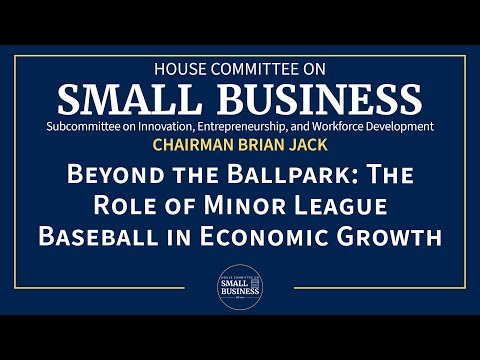
House Small Business subcommittee hears how minor league baseball boosts local economies
Loading...
Summary
Witnesses at a House Small Business subcommittee hearing told lawmakers that minor league baseball teams act as local economic anchors by creating affordable entertainment, jobs and business opportunities, and by supporting downtown development through public-private partnerships and stadium-led projects.
At a hearing of the House Small Business Subcommittee on Innovation, Entrepreneurship and Workforce Development, industry executives and team owners described how minor league baseball teams generate economic activity for small and mid-sized communities across the country.
Pat Battle, executive chairman of Diamond Baseball Holdings, told the panel that minor league teams are “in the memory making business” and stressed affordability as a defining feature: “Minor League Baseball exemplifies the best in America,” and the average ticket price is still under $15, he said. He added that stadiums often host concerts, graduations and other nonbaseball events that extend their value to communities year‑round.
The hearing focused on three recurring themes: how teams support local small businesses through sponsorships, vending and vendor contracts; how ballparks can anchor downtown redevelopment; and the operational and financing challenges teams face. Witnesses described partnerships ranging from long‑standing vendor relationships to multi‑hundred‑million‑dollar mixed‑use development proposals tied to stadium ownership.
Reid Ryan, chief executive officer of Ryan Sanders Baseball, said ballparks often spur adjacent investment, citing Round Rock and Corpus Christi as examples where hotels, restaurants and entertainment venues clustered after stadium development. “In every instance, the ballpark has revitalized or spurred growth in the surrounding areas,” Ryan said.
Joe Chamberlain, CEO and managing partner of the West Michigan Whitecaps, described the franchise’s locally funded stadium and said ownership intentionally kept pricing family friendly. Chamberlain told lawmakers his organizations employ dozens of year‑round staff and more than 1,000 seasonal workers across their teams. He estimated the Whitecaps contribute over $40 million annually to the West Michigan community and said the club’s outfield signage and hospitality offerings intentionally make space for small business advertising and client entertainment.
Lou Champy Jr., president of Independent Graphics, a long‑time vendor for the Scranton/Wilkes‑Barre RailRiders, provided a vendor perspective: the RailRiders partnership has provided steady, time‑sensitive work and visibility for his family business for decades. He described producing game programs and promotional prints under tight deadlines and credited the team relationship with helping the company survive and grow after a major flood.
Lawmakers on the panel asked witnesses about financing, public‑private partnerships and how municipal partners can help teams remain affordable. Battle said owners use common technologies and shared best practices across holdings to reduce costs; he also highlighted planned investments such as a $250 million mixed‑use project tied to the Louisville Bats that DBH said would create jobs and additional downtown activity. Witnesses described common financing approaches including local bank debt, naming‑rights agreements and municipal partnerships.
No legislative actions or votes were taken at the hearing. Members concluded by thanking witnesses and noting the congressional baseball game scheduled for the next day.
The hearing record includes examples and figures offered by witnesses: DBH’s portfolio includes 44 affiliated clubs; Synovus Park in Columbus, Georgia, drew more than 100,000 fans in its first weeks and was projected by a witness to generate about $10 million in annual economic impact; DBH described a planned $250 million mixed‑use investment in Louisville; the Whitecaps estimated more than $40 million annual local economic activity for West Michigan; and individual clubs cited event usage beyond baseball (concerts, graduations, holiday events) as a way to extend community value.