Get Full Government Meeting Transcripts, Videos, & Alerts Forever!
Get email alerts on the Municipal Budget Public Safety topic
No spam. Unsubscribe anytime.
Muskegon City managers present tight FY2026 budget; public safety staffing and beach parking draw focus
Summary
City staff outlined a proposed fiscal year 2026 budget that keeps the general fund balanced but leaves limited room for new staffing or capital projects. Commissioners pressed staff on public safety staffing, grant prospects, fleet management and how beach parking revenue is used for parks and operations.
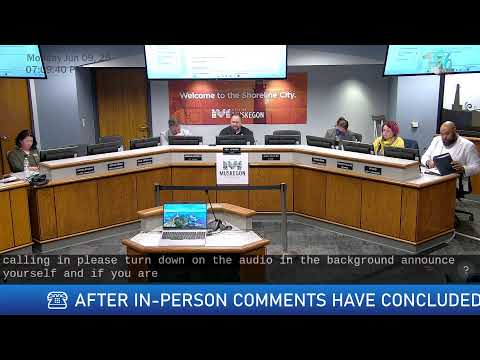
City Manager (role) presented a proposed fiscal year 2026 budget on June 9 in a Muskegon City Commission work session, saying the draft keeps the general fund “in the black” but will be a “tight year” with no proposed new permanent staffing beyond a half-time ranger position and constrained capital spending.
The proposed general operating millage is capped at 10 mills by statute; the manager said Muskegon’s current levy effectively is about 9.3916 mills because of Headlee rollback effects and rising taxable values. The manager said staff is exploring targeted voter questions such as a public safety millage or a parks/quality-of-life millage and is working with Michigan State University Extension and Grand Valley State University to survey resident support, but emphasized no formal proposal has been made.
Why it matters: the commission is weighing public safety needs and deferred capital work against a constrained revenue outlook. The manager noted income tax supplies roughly 30% of the city’s budget—about twice the share of property tax—so property-tax limits interact with other revenue sources when considering new spending.
Major policy and finance items discussed
- Public safety staffing and grants: Director Tim Kozel, public safety, briefed commissioners that the fire department currently has 27 frontline firefighters and 29 total positions including the deputy director and fire marshal; the police department has 71.5 sworn positions when part-time officers are counted and a total department headcount of 88, including civilians. Kozel said two sworn officers were on extended leave and that about 26 officers are “on the road” regularly for patrol duties. Kozel and the manager said the city is applying for federal staffing grants including the SAFER grant to add three firefighters and a separate competitive police staffing grant; both grants require local matching funds and are not 100% funded.
- Grant timelines and sustainment: The manager said the SAFER application is due in July and, if awarded, typically covers three years; the city would need to plan for the full ongoing cost when the federal funding ends. Kozel and the manager both emphasized grant competitiveness improves if the city can demonstrate ability to sustain added positions after grant expiration.
- Overtime, recruit program and training: The manager and Kozel said overtime would likely decline only modestly with moderate staffing increases because of training, vacation and reports coverage. The city has a recruit reimbursement program and has retained about 85% of recruits from that program over the last 17 hires.
- Fleet and vehicle maintenance: Director Dan Vanderheide, public works, said the city operates a fleet maintenance team of five mechanics who handle police vehicle outfitting and maintenance; staff are exploring fleet-management options to reduce age and maintenance costs and to improve vehicle rotation and uptime.
- Beach parking revenue and parks spending: Commission discussion cited projected beach parking revenue of about $1.3 million. The manager said beach parking income flows to the general fund (not a separate parks-only account) and historically the city has dedicated about $400,000 of that revenue to parks. The city now operates a beach shuttle system (est. $70,000 annually) that the manager said is offset by parking revenue. The overall general-fund parks budget is roughly $3.3 million across recreation, park maintenance and forestry. The manager explained that because the general fund pools revenues, increases in one line do not automatically translate to proportionate increases to a single department’s budget.
- Deferred maintenance and capital priorities: The manager told commissioners there is over $2 million in deferred maintenance not funded in FY2026 and highlighted two immediate concerns that together total about $900,000: replacement of the Central Fire station roof and replacement of body-worn cameras for police. The city is pursuing external funding, including congressional-directed funding requests and grant applications, to address those needs.
- Fund balance and short-term forecast: The manager warned that a budget amendment scheduled for the next meeting would increase transfers out for arena and other items and likely drop the city’s unrestricted general fund below a 13% fund-balance threshold for the current fiscal year. Including the budget stabilization fund raises combined reserves closer to 20% of expenditures, but staff flagged ongoing pension liabilities (MERS) and non‑general-fund subsidies as constraints on longer-term flexibility.
Commissioner comments and next steps
Commissioners pressed for timelines and details on the grant applications and on any future millage proposals. The manager said staff hopes to begin pulse surveys with MSU Extension in the fall and to meet with pension and bond advisors this summer, with preliminary bond decisions expected before the end of the first quarter of the fiscal year (by Sept. 30). Staff said a six-month budget amendment process is the typical vehicle to incorporate midyear grant awards and would be used if grants are received.
The session closed with staff and commissioners reiterating the need to balance public-safety staffing goals with long-term sustainability and to continue pursuing external grant funding to reduce immediate capital pressures.