Get Full Government Meeting Transcripts, Videos, & Alerts Forever!
Get email alerts on the Juvenile Justice Shawano Closure topic
No spam. Unsubscribe anytime.
Northern Michigan officials say Shawano Center closure worsened juvenile bed shortage
Summary
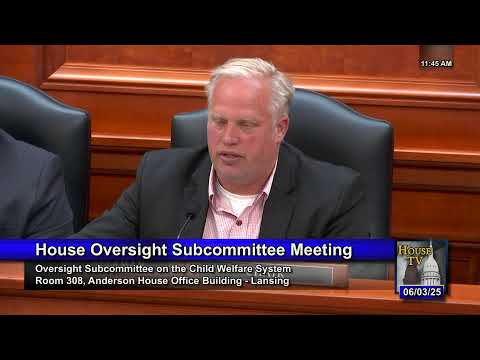
Local officials from Northern Michigan told the Michigan House oversight subcommittee on child welfare system that the state’s January 24, 2025 announcement to close the Shawano Center in Grayling has left a critical gap in secure residential placements for violent and high-risk male juveniles.
LANSING, Mich. — Local officials from Northern Michigan told the Michigan House oversight subcommittee on child welfare system that the state’s January 24, 2025 announcement to close the Shawano Center in Grayling has left a critical gap in secure residential placements for violent and high-risk male juveniles.
The decision by the Michigan Department of Health and Human Services to transfer the Shawano Center’s remaining 17 juveniles to a Macomb County facility — a site committee witnesses said was privately owned and not ready to accept youth — has forced counties to seek more expensive private placements or return juveniles to communities before programming was complete, witnesses said.
Roscommon County Prosecutor Michael Edwards said the closure “simply lacks honesty, foresight, and transparency,” and warned that removing the state-owned Shawano Center eliminates a centrally located facility that previously served Northern Lower Michigan and other parts of the state. “Closing existing facility for a more expensive facility is certainly not the answer,” Edwards said.
Edwards and other witnesses described the Shawano Center’s services, citing MDHHS material: segregated housing “pods” for different offender types, cognitive-behavioral treatment, addiction services, on-campus education, medical and psychiatric care, and extracurricular and outdoor programming they said the Macomb facility cannot match because of location and amenities.
Roscommon County juvenile referee Jake Collini told representatives that Shawano offered a necessary “top end” of the juvenile continuum. “When you take the top end of that continuum off and it no longer exists, that continuum becomes a house of cards,” Collini said, adding that the loss reduces the deterrent effect of possible residential placement and shrinks options for counties with high needs and limited private providers.
Otsego County Court Administrator Jamie Fietak described individual cases she said exemplify the gap: a youth who completed Shawano’s program and now holds steady employment, and another violent youth she said private providers would not accept. “Without Shawano, he did not have a chance,” Fietak said.
Witnesses gave the committee a series of specific details: the Shawano Center had a licensed capacity of 40 beds but was typically staffed for about 25; it housed 25 juveniles the month before the department’s announcement and held 17 at the time of the January 24 notice; Roscommon County had three juveniles on a waiting list when the closure was announced. Edwards testified the Macomb site had 60 beds in total but only 20 were available immediately and that roughly $14 million would be needed to open remaining beds — a cost he said would fall to Macomb County, the property owner.
Committee members pressed witnesses about staff availability, safety concerns and prior investigations. Representative Rick McDonald cited press reporting that MDHHS faced a December 2023 $40,000 fine from the Michigan Occupational Safety and Health Administration after an investigation found staff injuries and incomplete incident records; McDonald asked witnesses what changes had been made to improve safety. Edwards said statewide policy changes limiting staff use of restraint followed an earlier death at a separate facility and that some safety policies and staffing constraints made managing violent juveniles more difficult.
Witnesses and members also raised process and transparency concerns. Edwards said staff received internal messages that any email sent outside the facility should also be sent to the department’s legal office, which several witnesses said had a chilling effect on staff willingness to speak publicly. Representative Regas described employees being told they had only weeks to relocate for new positions at Macomb.
The subcommittee did not take formal action on the Shawano closure at the hearing, but members said they will request further information from MDHHS. Earlier in the session Representative Regas moved to approve minutes from the May 20 meeting; with no objection the minutes were approved.
The committee plans to invite MDHHS to testify at a future meeting to explain the department’s rationale, timeline and transition plans for placements and staffing. Members said they will also seek documentation on staffing postings, the 2025 budget line items witnesses referenced, and the whereabouts or placements of juveniles moved after the Shawano closure.
The testimony highlighted tension between safety and capacity: witnesses urged the legislature to consider reopening or fully re-staffing Shawano or otherwise increasing Northern Michigan capacity to avoid what they called more costly private placements and risks to community safety.
No representatives of MDHHS attended the hearing to respond to the witnesses’ assertions.