Get Full Government Meeting Transcripts, Videos, & Alerts Forever!
Get email alerts on the Higher Education topic
No spam. Unsubscribe anytime.
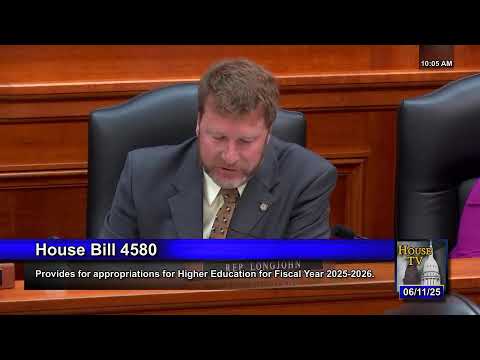
Subcommittee reports H‑1 substitute for HB 4,580 after debate on campus investment funds and $1.1B scholarship deposit
Summary
The House Appropriations Subcommittee on Higher Education and Community Colleges voted to adopt and report the H‑1 substitute for House Bill 4,580 after a detailed House Fiscal Agency briefing on campus investment funds, endowment adjustments and large one‑time scholarship deposits.
The House Appropriations Subcommittee on Higher Education and Community Colleges voted to adopt the H‑1 substitute for House Bill 4,580 and reported the substitute with a recommendation that it pass.
Perry Zylak of the House Fiscal Agency presented a detailed summary of the higher education package. Zylak corrected an error in the printed summary, saying the correct gross total for the House bill should be $2,000,000,400,800,000; he said the package represents a 3.4% gross increase overall when measured against the current fiscal year with notable structural shifts.
Key elements Zylak described include: removal of $1,650,000,000 gross in ongoing operations grants for universities; the creation of a campus investment fund limited to infrastructure, technology, equipment, maintenance, safety and capital debt reduction; and a redistribution formula based on fiscal year 2024 resident full‑time equivalent students. The H‑1 substitute applies endowment‑based reductions to campus investment fund allocations (institutions with endowments between $1 billion and $5 billion lose 50% of funds, $5–10 billion lose 65%, and above $10 billion lose 75%), a change Zylak said would affect Michigan State University and the University of Michigan Ann Arbor.
The House H‑1 also includes large one‑time deposits into scholarship funds. Zylak said the House adds a $1,100,000,000 SAF one‑time deposit into the Postsecondary Scholarship Fund and a $170,600,000 general fund one‑time deposit into a new Postsecondary Scholarship Private Institution Fund. The Michigan Achievement Scholarship would be revised to award up to $5,500 to resident students attending a four‑year public or private university and up to $2,750 to residents attending a community college; Zylak described sector caps of $828,100,000 for public universities, $170,600,000 for private institutions, and $276,400,000 for community colleges. Zylak also described changes that would limit award year eligibility and define full‑time enrollment as 15 credits per semester.
Representative Longjohn expressed concern that the House Fiscal Agency summary in the packet did not match bill language and asked how long the one‑time scholarship funding could be sustained; Longjohn said the discrepancy made it “hard to know ... what we're even voting on.” Chair Markkanen and other members said the numbers would be subject to negotiation and that the H‑1 was a basis for further bargaining.
Representative Rogers criticized the change to the full‑time student definition, noting the traditional definition of 12 credits and contending that a 15‑credit definition could be burdensome for students juggling work and family obligations. Rogers said: “it does seem a little bit burdensome in a time where students are facing a lot of different stressors.” Chair Markkanen said negotiations would continue.
The procedural record shows Representative Jenkins Arno moved to adopt the H‑1 substitute; the motion to adopt and the subsequent motion to report the H‑1 substitute for HB 4,580 were adopted on roll calls the clerk recorded as five yeas and two nays. The transcript also records submitted opposition from Sean Hammond (University of Michigan) and Katie John (Michigan State University) who did not wish to speak but registered opposition in the hearing record.
Ending: The subcommittee reported the H‑1 substitute to the full House; members flagged numerous items for negotiation, including the sustainability of one‑time scholarship deposits, campus investment fund formulas, and tuition restraint conditions.