Get Full Government Meeting Transcripts, Videos, & Alerts Forever!
Get email alerts on the Community Colleges topic
No spam. Unsubscribe anytime.
Subcommittee adopts H‑1 substitute for HB 4,579; House Fiscal Agency outlines community college cuts and new restrictions
Summary
The subcommittee adopted the H‑1 substitute for HB 4,579, which reduces community college operations funding by about 1% (largely by removing one‑time appropriations) and adds boilerplate restricting DEI spending, athletic participation policies, and salary spending caps.
The Michigan House Appropriations Subcommittee on Higher Education and Community Colleges voted to adopt the H‑1 substitute for House Bill 4,579 and reported the substitute with a recommendation that it pass.
Perry Zylak of the House Fiscal Agency summarized the H‑1 community college package. The house recommendation shows a gross appropriation of $456,700,000, all from restricted School Aid Fund (SAF) sources, a $5,600,000 gross reduction (about 1.2%) from the current fiscal year. Zylak said the net decrease for community college operations is $3,600,000 SAF (about 1%) and that projected funding decreases across individual community colleges would range from roughly 0.8% to 1.3%, primarily because the proposal removes one‑time operations funding.
The H‑1 substitute also modifies multiple boilerplate provisions. Zylak said the House deletes language that encouraged purchases from geographically disadvantaged businesses and removes preferences for veteran‑owned firms in Michigan goods and services preferences. The substitute adds reporting requirements for tuition and fee restraint, revises the tuition restraint for FY26 to the greater of 3% or $149, and removes DEI spending from operations allocations (reducing community college operations by the amount spent on DEI). Other new provisions limit non‑instructional salary spending (a 10% cap on staff who do not teach, maintain facilities, or provide law enforcement) with penalties tied to operations allocations, and add language restricting participation in female sports to biologically defined females, authorizing the state budget director to withhold 5% of monthly operations payments until an institution complies. The H‑1 substitute also deletes language supporting the state goal commonly known as “60 by 30.”
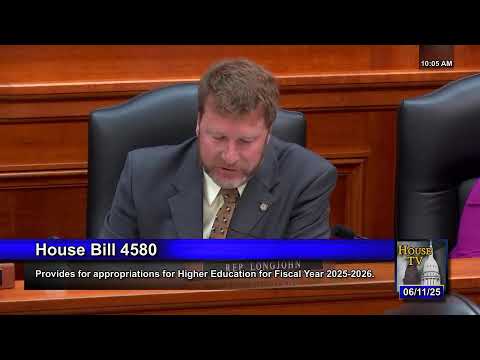
Representative Longjohn asked how the lack of an operations increase would affect colleges’ ability to avoid passing costs to students; Representative Longjohn said, “Without some form of operations increase, how do you plan on keeping the cost of college for families low enough that students and families aren't priced out?” Chair Markkanen and other members responded that further negotiations with the Senate and governor were expected.
Representative Rogers raised concerns about removal of veteran supports and asked why preferences for veteran‑owned businesses and an in‑state residency treatment for veterans were removed; the chair said the items would be negotiated.
Procedural record: Representative Roth moved to adopt the H‑1 substitute for HB 4,579; the substitute was adopted on a roll call that the clerk recorded as five yeas and two nays. A subsequent motion to report the H‑1 substitute with a recommendation that it pass was also adopted by a 5–2 vote.
Ending: The subcommittee reported the community college H‑1 substitute to the full House for further consideration; members said the specifics of tuition restraint, veterans preferences and other boilerplate provisions remain subject to negotiation.