Get Full Government Meeting Transcripts, Videos, & Alerts Forever!
Get email alerts on the Health Telemedicine Optometry topic
No spam. Unsubscribe anytime.
House committee hears competing views on online contact-lens renewals in bill requiring 2-year in-person exam
Summary
Lawmakers heard pro- and anti-telemedicine testimony on House Bill 45 58, which would allow online renewals of contact lens prescriptions if the patient had an in-person eye exam within the past two years. Supporters cited access and convenience; optometrists warned of safety and verification gaps.
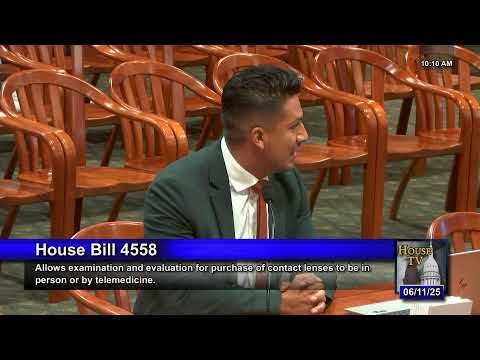
The House Health Policy Committee heard more than two hours of testimony Thursday on House Bill 45 58, a measure that would allow patients to renew contact lens prescriptions online provided they had a valid in-person prescription within the past two years.
Representative VanderWaal, the bill sponsor, said the measure would "allow for a person to renew their prescription provided that they have received a valid prescription from an in person visit within the last 2 years." She described the change as expanding convenience and lowering costs for patients.
Supporters including David Gunther of the Mackinac Center and Jack Baum of Americans for Tax Reform argued the bill would expand access, especially in rural areas, and increase consumer choice. "By voting yes on House Bill 45 58, you have the opportunity today to bring our state out of the century in vision care practices and expand the availability of vision care to more Michiganders," Gunther said.
Eric Castaneda of 1-800 Contacts (testifying for Express Exam) described the online renewal process as a triage that screens out patients with concerning symptoms and forwards images and questionnaire results to a licensed physician for final review. He said about 30% of patients seeking online renewals are screened out and referred to in-person care. "There is a physician making every medical determination behind every patient who receives a renewal through these type of services," Castaneda said.
Opponents from the Michigan Optometric Association and practicing optometrists urged amendments to require stricter verification of existing prescriptions and to preserve parameters beyond refractive power — such as base curve, diameter and lens brand — that affect contact-lens fit and eye health. Dr. Whitney Genrich, vice president of the Michigan Optometric Association, said the bill as written could permit online renewals that change aspects of a prior prescription without an in-person fitting. "Changing any aspect of the prescription without the in person fitting could be incredibly dangerous," Genrich said.
Witnesses and lawmakers discussed existing federal requirements for contact-lens sales, including the Fairness to Contact Lens Consumers Act and enforcement by the Federal Trade Commission, which require providers to give patients a copy of their prescription. Several optometrists described cases of patient harm or near-harm under current verification and online-seller practices and asked the committee to require firms offering online renewals to obtain a copy of the patient’s existing prescription from the prescribing provider.
Nut graf: The bill’s core provision — allowing online renewals when a patient has had an in-person exam within two years — drew pro-competition supporters and optometry groups that want statutory guardrails on verification and prescription components that affect lens fit. No committee vote on the substance of HB 45 58 was reported during the hearing.
Committee members asked for additional data from other states and for proposed language from optometrists. Representative Meerman and others pressed witnesses on whether existing state experiences show measurable harm; optometrists said large-scale studies are limited and reporting may be inconsistent, while vendors cited FDA clearances for some renewal technologies and the FTC’s role for sales verification.
Ending: Lawmakers instructed stakeholders to submit proposed amendments and data; the committee did not record a final vote on HB 45 58 during this session.