Get Full Government Meeting Transcripts, Videos, & Alerts Forever!
Get email alerts on the Criminal Justice Resentencing topic
No spam. Unsubscribe anytime.
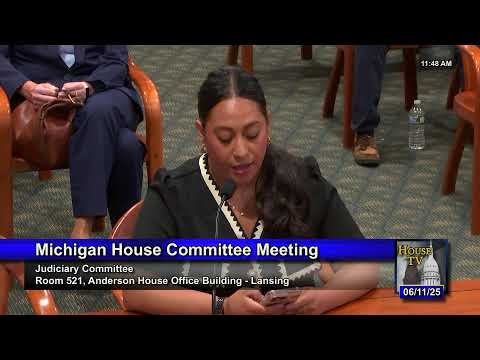
Committee hears divided testimony on bills to change resentencing for 19- and 20-year-old homicide defendants
Summary
Lawmakers heard hours of testimony for and against a package of bills (HB4506–08) that would change resentencing rules for people who committed murder at ages 19–20, including allowing consecutive terms and preserving life-without-parole as an option; witnesses raised victims’ rights, constitutional concerns and implementation questions.
The Michigan House Judiciary Committee on Wednesday heard extended testimony on House bills 4506, 4507 and 4508, a package that would change how judges resentence people convicted of degree murder for crimes committed at ages 19 or 20.
The bills would preserve life without parole as an available sentence, create a presumptive structure for long minimum-and-maximum terms when courts decline life without parole, and allow multiple murder sentences to run consecutively in some cases. Committee chair Representative Le itner introduced the package and said it is meant to address what she described as "the worst of the worst" cases and to give victims and prosecutors clearer options during resentencing.
Supporters, including county prosecutors and some victims, said the bills restore victims’ voices and public safety protections after recent Michigan Supreme Court decisions that prompt resentencing.
"This package of bills importantly continues to allow for life without parole as an option in these cases," said Jeff Getting, Kalamazoo County prosecuting attorney, who also spoke for the Prosecuting Attorneys Association of Michigan. Getting said the bills "center victims" and add structure for sentencing when life without parole is not imposed, describing proposed minimums of 35–50 years and maximums starting at 80 years as a way to keep punishments proportional to particularly violent offenses.
Other witnesses — including public defenders, appellate counsel and criminal-justice reform groups — opposed the bills, arguing they raise constitutional problems and will prompt prolonged litigation. Maya Menlo of the State Appellate Defender Office and Criminal Defense Attorneys of Michigan said long mandatory minimums would, in many cases, amount to de facto life sentences and run afoul of U.S. Supreme Court and Michigan Supreme Court precedents requiring individualized youth-sensitive sentencing.
"The committee is likely familiar with cases like Roper, Miller, and Montgomery," Menlo said. "These cases require that courts engage in an individualized sentencing proceeding where youth is considered at that sentencing hearing. ... The statute you are considering would authorize sentences that, for many youth, would be disproportionate and raise serious constitutional problems."
A number of victims and survivors urged the committee to support the bills. Roberta Gartley, who identified herself as a mother of a murder victim, said reopening and resentencing cases has exposed families to additional trauma and, in her view, risks public safety: "We're protecting the violent offenders and abandoning the survivors," she said.
Speakers with reentry and restorative programs urged judges retain discretion. Joshua Puckett, who counseled from lived experience and runs intervention programs used inside Michigan prisons, told the committee that judges and prosecutors need discretion to identify rare cases of true rehabilitation.
Committee members asked questions about the bills’ interaction with existing precedent and sentencing law. Representative Hope raised whether long consecutive terms would be functionally indistinguishable from life and noted the Oxford High School shooting case and prior Miller hearings were factually different because they involved juveniles. Minority Vice Chair Carter asked how many resentencings were the result of trial verdicts versus plea agreements; Getting replied that most murder convictions come after trial, and plea deals that produce life sentences are rare.
Witnesses also emphasized logistics: Getting and others estimated hundreds of cases statewide will be affected and urged lawmakers to set procedural timeframes so victims and prosecutors can prepare for retroactive resentencings. Getting said the package includes provisions to prioritize hearings and to give prosecutors a realistic window to decide whether to seek life without parole.
The committee took testimony from dozens of organizations and individuals, including Crime Survivors for Safety and Justice, ACLU of Michigan, Michigan Collaborative to End Mass Incarceration, Citizens for Prison Reform, Safe & Just Michigan, the Prosecuting Attorneys Association, the State Appellate Defender Office and local prosecutors.
No formal vote on the resentencing bills occurred during the meeting; the committee scheduled further discussion at a later date.
Ending: Lawmakers on both sides signaled additional committee negotiations and legal review will be necessary if the bills move. Supporters said they hope the package provides victims and prosecutors greater clarity and preserves the option of life without parole for extreme cases. Opponents cautioned that the bills risk constitutional challenges, extended litigation and budget impacts if litigation proceeds.