Get Full Government Meeting Transcripts, Videos, & Alerts Forever!
Get email alerts on the Immigration Raids topic
No spam. Unsubscribe anytime.
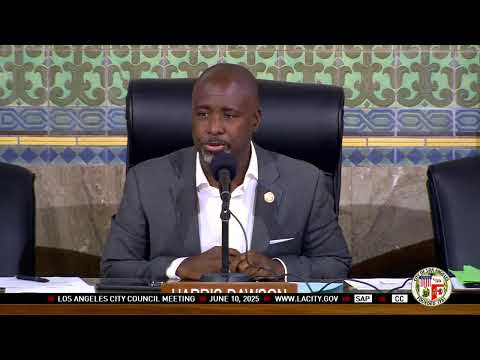
Angelenos, immigrant-rights groups and council demand halt to federal raids as thousands protest; council hears legal, police briefings
Summary
Angelica Salas, leader of the Coalition for Humane Immigrant Rights Los Angeles (CHIRLA), told the Los Angeles City Council on Tuesday that broad federal immigration enforcement over the previous week had resulted in mass arrests across the region and denied detainees access to counsel.
Angelica Salas, leader of the Coalition for Humane Immigrant Rights Los Angeles (CHIRLA), told the Los Angeles City Council on Tuesday that broad federal immigration enforcement over the previous week had resulted in mass arrests across the region and denied detainees access to counsel.
“This is warrantless arrest,” Salas said. “We estimate that well over 300 people have been detained in the past week.”
Nut graf: The council convened a special session and public comment period after a surge of federal immigration enforcement actions in the Los Angeles region. Witnesses, faith leaders and immigrant-rights organizations described multiple workplace raids, arrests at day-labor centers and large-scale detentions that they say included family members and children; CHIRLA and allied legal groups said attorneys and relatives were repeatedly denied access to detainees. The Los Angeles Police Department also briefed council members on crowd-control operations after large downtown demonstrations and incidents of property damage and looting that followed some protests.
What CHIRLA and witnesses reported
Salas told the council that CHIRLA’s rapid-response network confirmed at least seven enforcement operations in the Los Angeles region and that “approximately 35 workers” were taken at two related worksites at Ninth & Stratford and 15th & Santa Fe. She said day-labor centers were targeted — including a Union & Wilshire site adjacent to a school — and that witnesses and video documented immigration officers stopping people on sidewalks and at businesses.
“Attorneys were told to return at 8 a.m. on Saturday,” Salas said of attempted legal access to detainees. She and her legal partners said they repeatedly were denied entry to federal detention processing locations and saw detainees shuttled into vans. Salas said legal observers confirmed multiple detainee buses and that attorneys were in many cases allowed to see only one client after long waits.
Salas described trauma among family members and estimated that hundreds of calls came into CHIRLA’s hotline: “On Saturday, we received over 2,000 calls on our hotline and our front desk of sightings of immigration.” She told the council that family members and community volunteers were trying to track detainees but that many people were not listed in federal detainee locators.
Council discussion and requests
Several council members thanked CHIRLA and other advocates and asked practical questions about how the city and community could help. Councilmember So to Martinez urged that the council keep “families together” and act within its authority to protect residents; Councilmember Padilla asked about racial profiling and legal remedies; Councilmember Price noted schools and asked what guidance had been given to Los Angeles Unified School District. Salas said CHIRLA and partners were providing “know your rights” trainings to schools, parents and students and urged the council to use its bully pulpit and legal tools to demand an immediate halt to the raids and to press for access to detainees.
CHIRLA’s concrete requests included: (1) public calls for the Department of Homeland Security to stop warrantless workplace and community arrests in the region; (2) ensuring access to counsel and due process for detainees; (3) clear information from federal agencies about where detainees are being held; and (4) continued city coordination with legal and rapid-response networks.
Law enforcement briefing
The Los Angeles Police Department briefed the council on public-safety operations connected to the protests that followed the enforcement actions. LAPD officials described crowds that assembled outside the federal detention facilities and said some groups later threw projectiles at law enforcement, used commercial-grade fireworks, and in several instances formed organized groups wearing dark clothing and using radios.
Police said they deployed mobile field forces and declared tactical alerts as needed. Chief remarks noted that officers used less-lethal munitions and CS gas during episodes when projectiles and improvised weapons were directed at officers and federal assets; the department also reported dozens of arrests related to disorder over the weekend (LAPD raw figures provided to council: arrests in the multi-day period included failure-to-disperse counts, looting counts and related public-order charges). The chief told the council the department does not participate in civil immigration enforcement and that it seeks to coordinate when possible with federal partners, but that advance notice from federal agencies has not been consistent.
Public comment and faith leaders
Faith leaders opened the special session with prayers and public comment filled the council chamber for several hours. Multiple callers described witnessing arrests at worksites, day-labor centers and other public places; some callers described violent tactics by federal agents and criticized federal agencies for failing to identify themselves. Others demanded city action and legal support for families. Several speakers urged disciplined, nonviolent protest and highlighted the trauma families face when a parent is detained.
What the council did
The council adopted two expedited special motions (motions introduced and seconded by council members and adopted by supermajority vote) to allow immediate consideration of related items; those special motions were adopted by the council as posted (determination votes recorded at the meeting: Special Motion 1 — adopted, 14 ayes; Special Motion 2 — adopted, 14 ayes). The council also recessed the regular meeting to convene the special meeting and took extensive public comment as part of that special session.
What remains unresolved
CHIRLA and legal partners said they still lacked full access to many detainees and that federal detention records were incomplete or delayed. Salas asked the council to use every available tool to press for detainee access and to notify the public about available legal resources. Council members repeatedly pressed the city attorney and city departments for the quickest possible ways to help families and to coordinate with member offices and the rapid-response network.
Why this matters
Advocates and council members said the raids have broad practical effects: they can remove breadwinners from families, trigger lengthy detentions, make it hard for family members to find legal representation, and dramatically increase fear in communities where many Angelenos have relatives with uncertain immigration status. The combination of federal enforcement and large public demonstrations has also raised immediate public-safety concerns about property damage, the safety of protesters and the ability of the city and police to protect residents and businesses.
Ending: next steps and resources
Council members asked city staff to report back with specific options the city can legally pursue, and several members encouraged residents to use CHIRLA’s rapid-response hotline and the city’s public resources. CHIRLA and allied legal groups said they will continue to document arrests, press for access to detainees and provide legal help. The council scheduled follow-up briefings and indicated it would consider additional actions in both open session and closed session, where legal strategy and certain intergovernmental issues will be discussed.
Votes at a glance (select items from the meeting record)
- Items 2, 4–11, 18–27, 30, 31, 32, 34 and 35: adopted as listed on the agenda (roll calls recorded as unanimous or by majority; the meeting record shows 15 ayes on that block of items). - Item 3 (amendment considered and circulated as Motion 3a Hernandez/Bloomfield): approved (roll call recorded: 15 ayes). - Item 28 (substitute motion introduced by So to Martinez): substitute and final motion approved (roll call recorded: 15 ayes). - Item 29 (substitute approved after separate vote): approved (roll call recorded: 14 ayes, 1 no). - Item 33 (called special for separate vote): adopted (roll call recorded: 13 ayes, 2 no). - Special Motions 1 and 2 (emergency determinations to consider matters added after agenda posting): determinations adopted (Special Motion 1 — 14 ayes; Special Motion 2 — 14 ayes); motions then adopted by council (14 ayes). - Items 37–51 (budget and finance committee settlements): council record lists recommended settlement expenditures and rejections as presented; several settlement approvals with amounts were read into the record (examples read by the clerk include: item 37 — settlement recommendation up to $730,269; item 38 — up to $700,000; item 39 — up to $500,000; item 40 — up to $400,000; item 41 — up to $495,000; item 42 — up to $675,000; item 43 — up to $150,000; item 44 — up to $200,000; item 45 — up to $190,000; item 46 — up to $480,000; item 47 — up to $200,000; items 48–51: plaintiffs' offers rejected as noted). See the official council file for precise executed language and adopted amounts.
Sources and attribution
This article is based on the Los Angeles City Council public meeting and special session on June 2025 (transcript), public commenters whose remarks were recorded for the meeting record, testimony from Angelica Salas (Coalition for Humane Immigrant Rights Los Angeles), and remarks by Los Angeles Police Department leadership during the council briefing. Direct quotations are attributed to the speakers shown in the meeting record.
Ending note: Council offices and CHIRLA provided resource guidance during the meeting; residents seeking legal assistance were directed to CHIRLA and local legal aid partners and the council asked staff to return with legal and operational options the city may take next.