Get Full Government Meeting Transcripts, Videos, & Alerts Forever!
Get email alerts on the City Budget topic
No spam. Unsubscribe anytime.
Agoura Hills presents balanced biennial budget with small surpluses; public safety remains largest cost
Summary
City staff presented a proposed biennial budget for fiscal years 2025–26 and 2026–27 that forecasts modest surpluses, maintains a large reserve, and keeps public safety as the largest single general-fund expense.
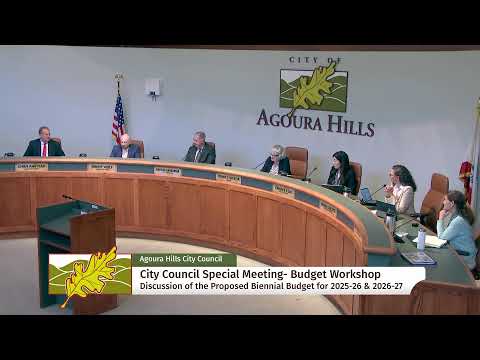
City Manager Nate Hamburger and finance staff presented a proposed biennial budget for fiscal years 2025–26 and 2026–27 at a city council budget workshop, showing conservative revenue forecasts, limited new spending and small projected surpluses.
Director of Finance Mr. Ibanez told the council the city’s general-fund revenue is projected at $20,861,987 for 2025–26 and $21,542,416 for 2026–27, with taxes and assessments the largest revenue source. “We have budgeted conservatively and have arrived at a an amount of $16,523,303 for fiscal year 2526 and $17,070,398 for fiscal year 06/27,” Mr. Ibanez said. Staff also forecast charges for services at $1,395,023 in 2025–26 and $1,496,518 in 2026–27 after a fee study scheduled to take effect July 1, 2025.
The proposed general-fund expenditures for 2025–26 are $20,853,895, leaving an initial projected surplus of $8,092; after council-directed adjustments discussed during the workshop staff reported a revised projected surplus of about $2,946. Finance staff said public safety was the single largest general-fund appropriation, representing roughly 27% of general-fund expenditures in the budget presentation; the FY25–26 public-safety appropriation was presented as $5,649,409.
Staff described a conservative forecasting approach that factored in tariffs and a higher interest-rate environment, and said departments were asked to identify expense reductions and postponements. The presentation listed a number of staff recommendations discussed by subcommittees, including freezing two positions (one in finance and one in public works) and not funding the city beautification account for the year. A previously discussed termination of the Bodeo Creek contract was noted as funded from a special fund after further review.
The city reported 27 special funds in the presentation (gas tax, traffic safety, Proposition A, capital projects, Measure R and Measure M among them) and said the special-fund budget for 2025–26 is $25,000,383. Staff also reported the city’s reserves are expected to be approximately $13.87 million at the end of the current year and remain around $13.88 million through the end of 2026–27; staff cautioned that those committed reserve amounts are not immediately liquid for other uses.
Council members generally praised the conservative approach and asked for a mid-cycle review to reassess revenues and potential additions. City Manager Hamburger said staff will bring a final iteration back to council for adoption after a mid-cycle review if warranted.
No formal adoption of the biennial budget occurred at the workshop; council direction was limited to adjustments to community grants and sponsorships discussed in the meeting and to staff follow-up on remaining questions.