Get Full Government Meeting Transcripts, Videos, & Alerts Forever!
Get email alerts on the Apprenticeship Regulation And Enforcement topic
No spam. Unsubscribe anytime.
OAH hearing on Hierarch Barbering & Cosmetology Academy focuses on jurisdiction and disputed apprentice completion forms
Summary
An administrative hearing on June 2 before the Office of Administrative Hearings examined a notice to show cause against Hierarch Barbering and Cosmetology Apprentice Academy and owner Jason Robert Lee, focusing on whether the Board of Barbering and Cosmetology has jurisdiction over apprenticeship completion certificates and on board allegations that the academy submitted inconsistent, sometimes stamped or photocopied, completion-form signatures and hours totals.
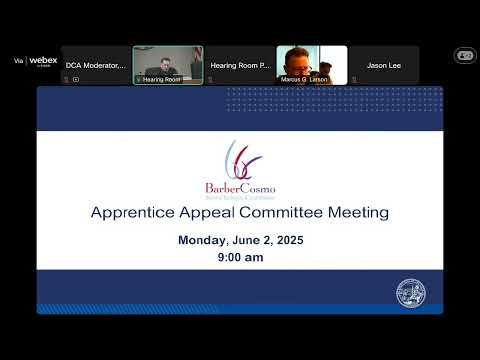
An administrative hearing over a notice to show cause for Hierarch Barbering and Cosmetology Apprentice Academy and owner Jason Robert Lee opened June 2 before an Apprentice Appeal Committee of the State Board of Barbering and Cosmetology (BBC) and an Administrative Law Judge from the Office of Administrative Hearings (OAH). The committee heard competing arguments over whether the BBC has authority to enforce rules for apprenticeship completion forms and heard testimony the academy submitted multiple completion forms with inconsistent hours and signatures.
The BBC, represented by Deputy Attorney General Jeff Stone, said the board brought the hearing under California Code of Regulations, title 16, section 9913.1 and Business and Professions Code provisions governing unprofessional conduct. Stone said the enforcement record shows “respondent has committed acts of unprofessional conduct through multiple and ongoing violations of section 924,” and described repeated deficiencies in completion forms, stamped signatures in place of original signatures and inconsistencies in dates and hours across multiple submissions.
The academy’s attorney, Marcus Larson of Grant Genovese & Baratta, made a threshold jurisdictional objection and asked the committee to dismiss the BBC proceeding. Larson argued the Division of Apprenticeship Standards (DAS) within the Department of Industrial Relations has statutory primacy over apprenticeship programs and certificates of completion, citing labor code sections discussed in filings and asserting the BBC lacks a statutory predicate to enforce the DAS-issued completion certificate. Larson told the panel: “We are respectfully disputing jurisdiction of the BBC over this particular apprenticeship program and this enforcement action in particular.”
Addison Beach, the BBC’s enforcement chief, testified for the board about how completion forms are processed and the specific problems found in Hierarch’s paperwork. Beach described multiple completion forms submitted for the same apprentices with conflicting totals, inconsistent dates and program-sponsor signatures that appeared as stamped or photocopied copies. He testified that for a particular apprentice the board received several versions of the same completion form with differing total on‑the‑job training (OJT) hour tallies (examples discussed in the hearing included figures such as 3,200 and 4,362 hours) and that the licensing unit issued deficiency notices when forms lacked required fields or had mismatched dates.
Beach explained the board’s normal workflow: licensing staff flag deficient completion forms, the licensing unit issues a deficiency notice and the matter is escalated to enforcement if discrepancies persist. He said the board requested contemporaneous OJT logs and payment proofs from the academy to substantiate reported hours; for one apprentice those logs were not produced promptly and the board received an email and text-message excerpts in which the academy’s staff appeared to instruct an apprentice about how to complete forms to meet board expectations.
Jason Robert Lee, the academy’s owner and program sponsor, also testified. Lee acknowledged there were problems with some forms and described steps he said he has taken to reduce errors: micromanaging apprentice records, contacting trainers more frequently, implementing spreadsheet tools to calculate hours and increasing one‑on‑one tutoring to raise pass rates on licensing exams. Lee said he uses an electronic signature workflow and testified that some earlier signature uses were the product of an employee whom he later said “hijacked” access to his saved signature; he acknowledged some signature dates were entered incorrectly and said he has corrected many deficiencies after receiving deficiency notices.
The hearing record shows the parties offered documentary exhibits and the committee ruled on admissibility during the session. The committee admitted certain board exhibits for jurisdictional purposes only and admitted other evidence for all purposes; other proffered items (including a public bulletin the respondent referenced) were excluded or held inadmissible for lack of foundation. The parties placed the matter and the jurisdictional briefing into the OAH record; OAH case number for the proceeding is 2025040867.
Committee members asked whether the form and signature issues reflected broader failures that would endanger consumers. Beach said the board’s interest is assuring apprentices meet training standards and that the board relies on program sponsors and trainers to verify hours; members pressed Lee about what steps he is taking to ensure accuracy going forward, and Lee described steps to increase site visits and improve training, especially for English-language learners. Members also discussed passing rates: board materials shown during the hearing listed a low pass rate for 2024 (reported at roughly 34% in testimony) and a higher short-term rate provided by the academy for a recent three‑month period (the academy provided a document showing a 50% pass rate for Jan–Mar 2025, based on a small number of test takers).
The committee took the jurisdictional objection and the evidentiary record under submission and announced it would decide the matter in closed session. No final action or vote was taken on the record. The OAH judge closed the public hearing and indicated the committee would deliberate in closed session to resolve the jurisdictional threshold and the notice to show cause.
Why it matters: the hearing turned on two related but distinct points—(1) whether the BBC has authority under California law and its regulations to enforce completion-form requirements for cosmetology apprentices, and (2) whether the academy engaged in conduct (stamped or photocopied signatures, inconsistent hours totals, incomplete trainer and apprentice attestations) that warrants withdrawal of the board approval of the apprenticeship program. The committee’s decision will determine whether enforcement steps against the program proceed and may shape how state agencies coordinate oversight of apprenticeship programs that intersect licensing and workforce regulation.
What to watch next: the committee’s written decision resolving the jurisdictional objection and any recommended sanctions or corrective orders. The record shows the committee received written submissions and multiple exhibits (the record includes board deficiency letters, multiple completion-form versions, email/text message excerpts and correspondence); the committee said it would deliberate and issue its determination in closed session following this hearing.
Sources: testimony and exhibits introduced at the June 2, 2025 apprentice appeal committee hearing before the Board of Barbering and Cosmetology (OAH No. 2025040867). Quotes in the body are taken from on‑the‑record testimony by Deputy Attorney General Jeff Stone, counsel Marcus Larson, Enforcement Chief Addison Beach and respondent Jason Robert Lee.