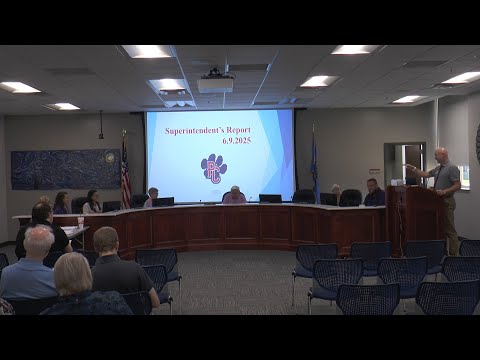
Ponca City schools prepare policies as several new state laws take effect
Loading...
Summary
School leaders described multiple new state laws and said the district will present policies and procedures this summer on cell-phone restrictions, employee reporting requirements, SRO authority, teacher pay programs and graduation/attendance rules.
The Ponca City Public Schools superintendent told the school board that several new state laws will require the district to adopt or revise policies before the 2025–26 school year, including a statewide student cell-phone restriction, new reporting requirements for employee misconduct and changes affecting school resource officers and teacher compensation programs.
District leaders said they will present a cell-phone policy next month to comply with the new law and that the policy will include only two exceptions — emergencies and documented medical devices such as diabetes monitors. The superintendent said the law places enforcement responsibility on building administrators and asked principals to align procedures pre‑K through 12 to avoid inconsistent enforcement across grade transitions.
The superintendent said the new “Protect Our Kids” provisions require the district to prepare a written factual basis whenever an employee is accused of wrongdoing, and to submit that material to the board and the Oklahoma State Board of Education even if the employee resigns. The district leader said that practice will change longstanding local workflows and could extend the role of the state board in certificate suspension or review.
Other legislative changes discussed included House Bill 1412, which the superintendent said treats contracted school resource officers and other security guards as school employees for disciplinary purposes; a teacher-empowerment program the superintendent described as converting certain incentive pay from base salary to a stipend-like payment (the district estimates potential added contract days and stipend formulas, with caps on eligible staff); and Senate Bill 711, which the superintendent said removes chronic absenteeism from the school report card while still allowing bonus points for improved attendance and for providing at least 180 days and 1,080 hours of in-person instruction.
The superintendent noted other bills under consideration or awaiting the governor’s signature: an Oklahoma Learning Access/tuition bill for educators’ children (referred to in the meeting as the "OLAP bill"), and House Bill 1521, which the superintendent said would add half a unit of personal financial literacy to graduation requirements and remove alternate diplomas for some students. The superintendent said the district will continue to track which measures are signed, vetoed, or pocket-vetoed and will return with recommended local policies.
District staff also flagged potential grant opportunities tied to the cell-phone rules (a state appropriation the superintendent said could fund pouches or lockers), and opioid-abatement grants the district intends to explore with a staff lead if the board wishes to pursue an application.
The superintendent emphasized these were implementation items for the board’s attention and possible future action: policy drafts, alignment of administrator enforcement duties, and cost analyses to decide whether to pursue grants or modify school calendars or contract days to pursue bonus points tied to attendance reporting.