Get Full Government Meeting Transcripts, Videos, & Alerts Forever!
Get email alerts on the Landowner Licenses topic
No spam. Unsubscribe anytime.
Game and Fish landowner-license rewrite draws sharp debate; joint committee deadlocks on letter
Summary
Wyoming Game and Fish proposed tightening landowner-license eligibility — raising acreage and days-of-use minimums and adding ownership thresholds — prompting heated testimony from landowners, sporting groups and legislators. A motion by the ag committee to send a letter opposing those changes tied the vote and failed.
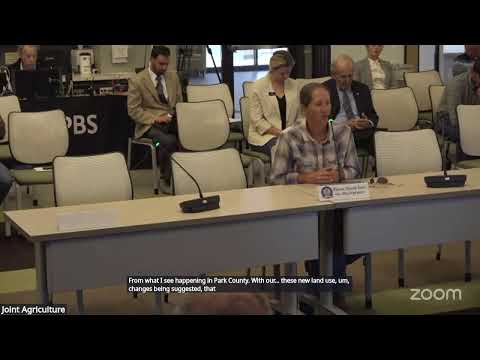
Wyoming Game and Fish proposed changes to the state's long-standing landowner-license program sparked hours of testimony, technical briefing and sharp disagreements at a June 11 joint Agriculture committee meeting.
Clayton Caldwell of the Legislative Service Office summarized the separate classes of complimentary and landowner tags and historical issuance totals. Director Angie Bruce and Dan Smith, chief of wildlife for the Wyoming Game and Fish Department, told the committee the commission had requested public input after the department and a governor-appointed wildlife task force examined whether the landowner program's eligibility rules remain appropriate in the face of changing land ownership patterns and shifts in big-game populations.
The department proposed several substantive changes in commission regulation (chapter 44, section 8) for public comment: - Increase minimum qualifying acreage from 160 contiguous acres to either 160 contiguous acres of cultivated land or a minimum of 640 contiguous acres of range land; the proposed text would still allow qualification if a property has 160 acres of cultivated ground even when total acreage is between 160 and 640. - Raise the days-of-use eligibility metric from 2,000 to 3,000 animal-use days (calculated as animals × days on the property in the prior 12 months). - Require a "significant interest" for applications by corporations, partnerships, trusts or LLCs — the proposal described a 20% ownership threshold for those entities to qualify family members or employees; the commission asked for feedback on the percentage. - Expand the definition of "immediate family" to include step-parents, step-grandparents, step-children and step-siblings and clarify documentation responsibilities.
Director Bruce said the commission values private land's contribution to wildlife and emphasized the statute and regulation are meant to provide landowner opportunity, not to require hunting on private parcels. The department noted landowner licenses have existed since 1949; since 2020, the department reported 17,883 landowner licenses were issued. Gun and bow-hunt quotas are first allocated to residents/nonresidents, then to qualifying landowners, and only thereafter to the general public; in a handful of hunt areas, the department said, landowner licenses can comprise a large share of available permits.
Public comment revealed deep divisions. Large and multi-generation ranchers — citing forage provided to elk and other big game and the economic costs of wildlife on private land — argued for grandfathering and for allowing landowners to transfer or market landowner licenses (to family members, long-term employees or third parties) as partial compensation to keep ranches viable. Several industry witnesses suggested a narrow, controlled ability to transfer tags or a modest surcharge as a compromise.
Sportsmen's and conservation organizations — including the Wyoming Wildlife Federation and Backcountry Hunters & Anglers — strongly opposed transferable landowner licenses on principle, saying state wildlife belong to the public and should not be marketed for private profit. They urged the commission to protect public hunting opportunity and pointed to examples in other states where transferable systems reduced resident opportunities.
Committee members debated next steps. Representative Banks proposed that the joint committee send a letter to the Game and Fish Commission opposing the department's proposed acreage and days-of-use changes and requesting grandfathering for current landowners. The motion was seconded and then put to a show-of-hands vote; the chair counted seven hands in favor and seven opposed, resulting in a tie and failure of the motion. Committee members discussed whether to wait for the commission's July 15 meeting and for the department and commission to review the public comments before taking committee action.
Ending — The commission will receive written public comments, consider testimony and is scheduled to discuss the proposals at its July meeting. The committee did not adopt a committee-endorsed position by vote on June 11; members and stakeholders indicated the debate will continue through the commission process and likely in the legislature if statutory changes are proposed.