Get Full Government Meeting Transcripts, Videos, & Alerts Forever!
Get email alerts on the Appointments topic
No spam. Unsubscribe anytime.
Senate Rules Committee advances three governor nominees after hours of questions on unemployment appeals, broadband and health services
Summary
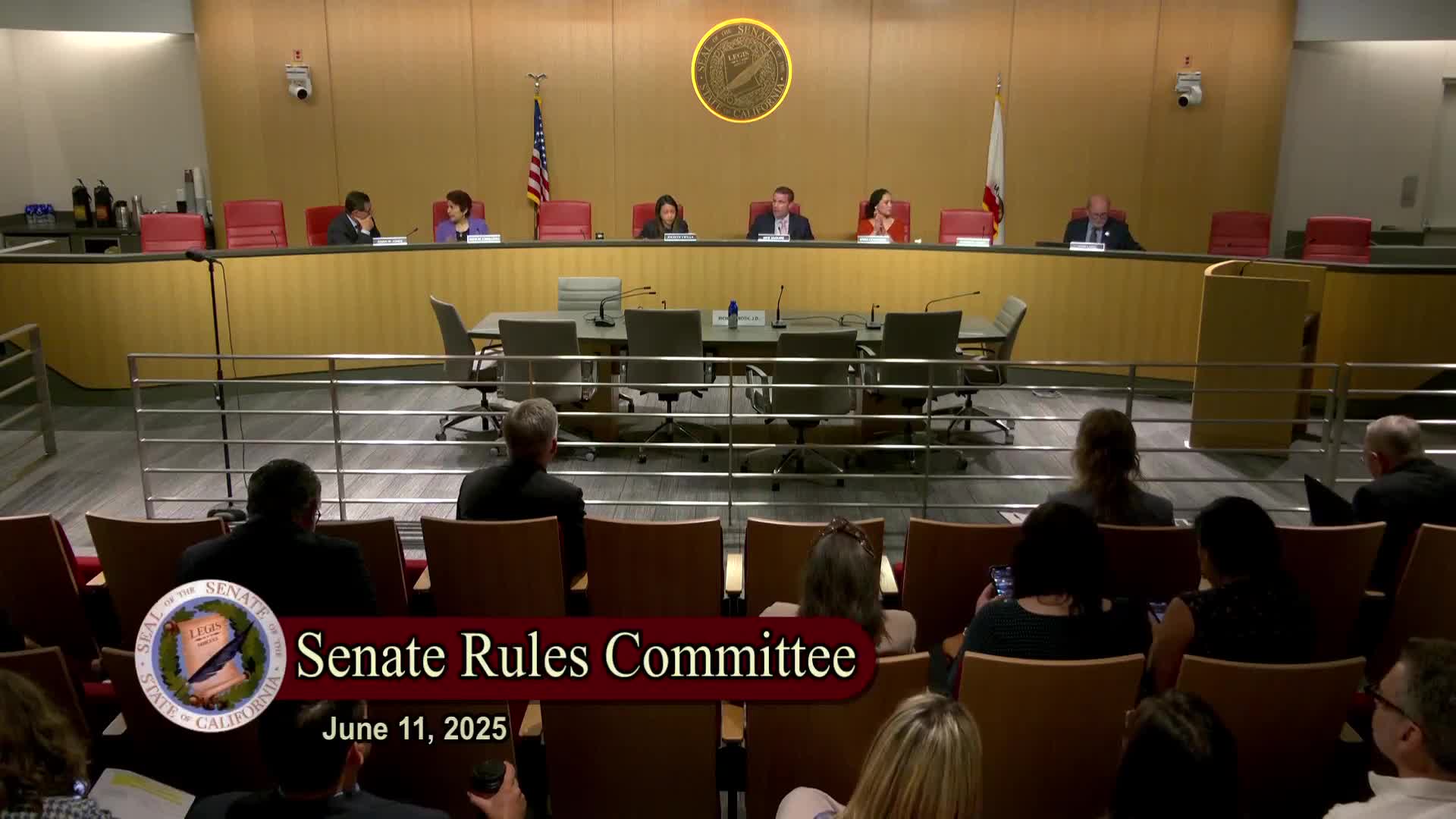
The California State Senate Rules Committee voted unanimously June 11 to forward three governor appointees to the full Senate after questioning nominees about the unemployment appeals backlog, middle-mile broadband permitting and implementation of health and social services programs.
The California State Senate Rules Committee voted unanimously June 11 to advance three of the governor’s nominees to the full Senate: the governor’s nominee to the Unemployment Insurance Appeals Board (referred to in the hearing as Senator Roth), the governor’s nominee for Secretary of Government Operations (Nick Maduro), and the governor’s nominee for Undersecretary at the California Health and Human Services Agency (Undersecretary Buchanan). Each motion was approved by roll call, 5-0, and the committee said the nominees will next appear on the Senate floor for a full confirmation vote.
Why it matters: Committee members used the hearings to press nominees on concrete operational problems — the appeals backlog from the Employment Development Department, permitting and NEPA complications in the middle-mile broadband project, and delivery challenges across health and human services including homelessness, foster care and the Master Plan for Aging. The exchanges produced detailed statistics and commitments for follow-up from nominees and committee leaders.
The committee first approved grouped “governor appointees not required to appear” items in several batches by roll call (each motion recorded as 5-0) before taking up the three nominees who appeared and answered questions. Chair McGuire and members called and recorded each roll call vote in the public record.
Unemployment appeals nominee questioned on caseload, backlog
The committee advanced the nomination of Senator Roth to the Unemployment Insurance Appeals Board after about 20 minutes of questions and comments from committee members. Senator Roth described the board’s role as independent from the Employment Development Department and outlined case volumes and staffing: "The EDD takes in about 2.2 or 2,300,000 claims a year," he said, and "about 10 percent or so of those are appealed to the level" handled by field administrative law judges. He said roughly 4 to 5 percent of those are appealed up to the board itself, which amounts to about 12,000 appeals a year and “about a thousand appeals that come to the board, the board members a month."
Roth told the committee the system is reducing backlog: “In fiscal year 02/23–24 the backlog was about 84,000 cases. Today in fiscal year 24–25 the backlog is 40,000 cases.” He added that the appellate operation’s case aging is “down to … 32.6 days” compared with a national average he cited of about 153 days. Committee members thanked Roth and moved his confirmation to the floor by a 5-0 roll call.
Government operations nominee pressed on tech projects and middle‑mile broadband permitting
Committee members advanced Nick Maduro’s nomination for Secretary of Government Operations after a hearing that focused on state technology projects, procurement and the middle‑mile broadband initiative. Maduro said his priorities include improving state HR and procurement systems and supporting large projects such as the state payroll replacement and broadband middle‑mile build-out. "Government technology projects have historically been very challenging," he said. "They frequently take too long and cost too much."
Maduro described specific permitting hurdles on the broadband middle‑mile portion, saying federal NEPA requirements and Caltrans rights-of-way had proven the most difficult constraints and that some federal digital equity grants tied to the initiative had been canceled. He told senators the middle‑mile route had been reduced from about 10,000 miles to roughly 8,000 miles for cost reasons and said he was working with CalSTA, Caltrans and the Department of Technology to resolve outstanding permitting issues. He committed to follow up with the committee if local permitting problems are identified.
Maduro also said the state is working on the central payroll project and a “middle mile broadband initiative,” and promised to push for a mindset shift in support agencies so they act as partners to operational departments. The committee forwarded his nomination to the Senate floor by a 5-0 vote.
Health and Human Services undersecretary hears questions on audits, aging, foster care and homelessness
The committee approved the nomination of Undersecretary Buchanan to the California Health and Human Services Agency and heard extended questioning about agency execution on complex programs. Buchanan described her background in county-level systems change and emphasized coordination across CalHHS’s 12 departments and five offices. "I bring an eye to the realities of on-the-ground implementation," she said.
Senators pressed Buchanan on several topics. On the Office of AIDS and an audit authorized by the Joint Legislative Audit Committee, Buchanan said CalHHS and the relevant departments would work with the state auditor to implement recommendations and strengthen financial controls. On aging and the Master Plan for Aging, she pointed to local innovations, shared‑housing models and the Community Care Expansion Program as steps forward while acknowledging continuing resource gaps. On foster care and children with complex needs, she described interdepartmental technical assistance and MOUs to strengthen local coordination.
Committee votes and procedural actions
Before and between the three nominee hearings, the committee approved multiple administrative items and grouped appointee batches by roll call (all recorded 5-0). The committee also approved joint committee appointments and a set of “floor acknowledgements” by the same vote margin.
The committee adjourned the public portion of the meeting after the votes and moved into executive session as recorded in the public minutes.
Ending
All three nominees will proceed to the full Senate for a floor vote. Committee members asked for follow-up briefings and additional documentation on several topics — chiefly the unemployment appeals backlog progress metrics, the middle‑mile broadband permitting timeline and any remaining federal funding risks, and actions the health agency will take in response to forthcoming audit findings — and nominees committed to provide those updates to the committee.