Get Full Government Meeting Transcripts, Videos, & Alerts Forever!
Get email alerts on the Grading Policy Review topic
No spam. Unsubscribe anytime.
Calvert County schools launch formal review of grading procedures, including 50% floor
Summary
The Board of Education authorized a committee to review district grading procedures after months of community concern over the district's 50% floor policy; the committee will include a majority of teachers, administrators and IT and student-services staff, and return recommendations by March 2026.
The Calvert County Board of Education on Wednesday agreed to a district-led review of grading procedures, including the system's 50% floor policy and alternatives to the traditional 100-point scale.
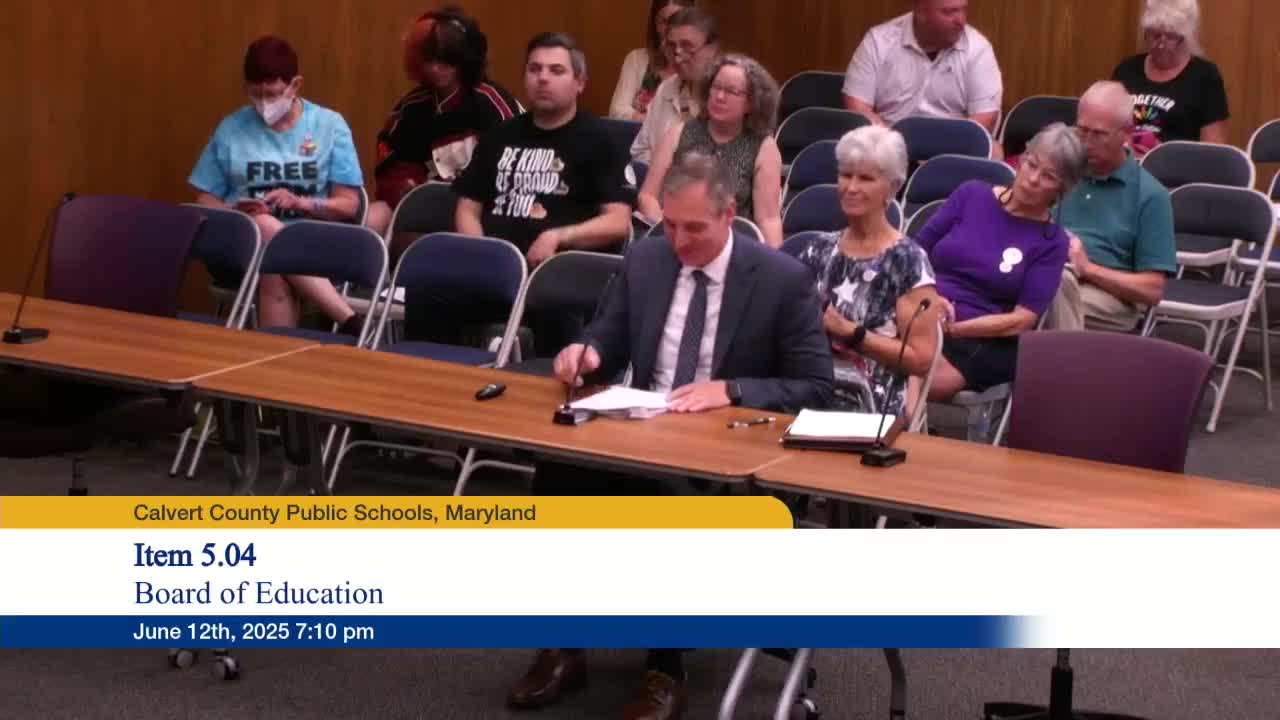
District Director of System and Instructional Performance Scott McComb told the board the review will be conducted by a committee of teachers, principals, central-office staff and technical experts and will present recommended changes by March 2026. "The key focus of the committee's work will be to determine how to maintain a fair and equitable grading scale while possibly approaching it in a different way," McComb said.
McComb outlined the district's rationale for the existing 50% floor: on a 100-point scale a failing grade covers a broad range and can disproportionately lower a student's term average. "The 50% floor 'establishes that the increment of a failing grade is no more or no less than any other grade," McComb said. He emphasized he was not proposing a specific alternative at the meeting and described the committee's planned timeline: literature review and collection of other Maryland grading procedures this summer, committee work beginning in September, baseline review through winter, drafting in December'January and board consideration in March so changes could be implemented for the 2026'27 school year if adopted.
Board members pressed on research, consequences for students who turn in no work, and operational impacts. Board member Edward Harrison questioned the policy's fairness to students who do not submit work, saying, "The 0 treats everybody the same." McComb and district staff said the committee will examine current research (the district will focus on literature from roughly 2015'2025 but will not be limited to those dates), reassessment and reteaching procedures, and technical implications for the district's gradebook and reporting systems if a new scale is adopted.
McComb described the committee's planned composition: roughly 60% classroom teachers (selected by application and lottery) and about 40% administrators and CASA bargaining-unit members, with a small number of hand-selected technical and student-services staff (for example, staff responsible for gradebook programming and IT changes). He said the district will collect grading procedures from Maryland districts (all of which must comply with COMAR) and review relevant national literature.
The board directed the district to proceed with the review and formation of the committee; McComb said materials will be organized over the summer to allow committee work to start quickly in the fall. The district noted that any recommended changes that alter grade reporting or GPA calculation would require vendor work and additional time for reprogramming.
The district did not vote on a specific grading scale at the meeting; the board's action was to authorize and support the committee and timeline described by staff. The committee's final recommendations will return to the board for review and any formal vote.