Get Full Government Meeting Transcripts, Videos, & Alerts Forever!
Get email alerts on the Internal Investigations topic
No spam. Unsubscribe anytime.
Special investigator finds failures in handling of June 2024 family-violence call; board approves findings
Summary
An independent investigation found Dallas officers did not adequately document injuries or fully investigate a June 13, 2024 family-violence incident involving Tiffany Zaharco Guanajuato. The Community Police Oversight Board voted to accept the investigator's findings and recommended policy clarification for Internal Affairs.
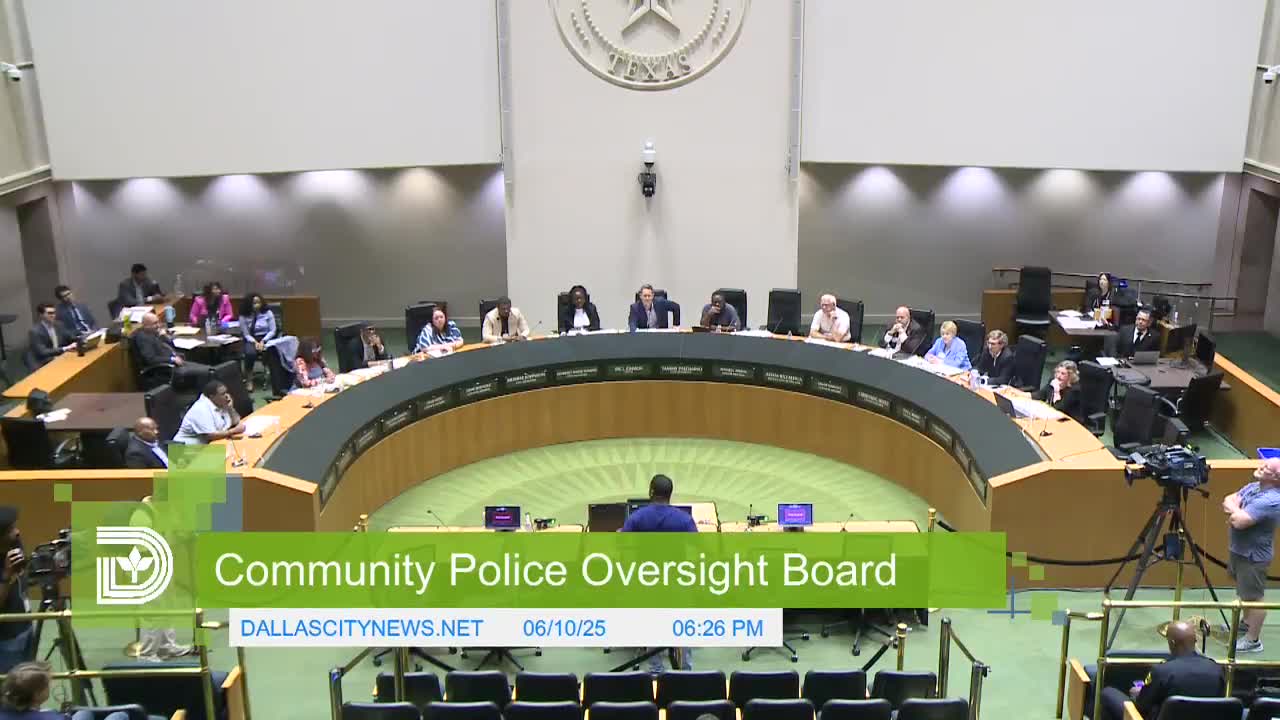
An independent review by the Office of Community Police Oversight (OCPO) found that officers responding to a June 13, 2024 domestic incident did not document reported injuries or take a statement from the complainant, Tiffany Zaharco Guanajuato. The OCPO special investigator presented findings to the board on June 10; the board voted to accept the report.
What the investigator found: Special investigator Greg Huff reported that the original police report—written by Officer Mullenkopf—contained a statement from the male party and photographs of the male and blood in the apartment but did not include a recorded statement from Zaharco Guanajuato. Photographs taken at the hospital documented a bite mark on her abdomen, lacerations on her forearm and other injuries that were not described in the police report, Huff said. A review of body-worn camera footage and hospital records indicated officers had not captured a contemporaneous statement from the complainant while she was at the scene or at the hospital.
Huff recommended sustained findings for three officers: failure to describe injuries and failure to investigate (sustained) for Officer Mullenkopf; failure to describe injuries (sustained) for Officer Zeifers and Officer Vega. Huff told the board that Internal Affairs had initially declined to investigate the complaint, treating it as a matter of guilt or innocence; OCPO urged that the division apply a narrower interpretation that would allow investigation when there is credible evidence suggesting illegal or malicious conduct.
Board action: A motion to accept the special investigator’s findings was made and seconded; the board adopted the findings by roll-call vote (motion passed). The board asked that OCPO and Internal Affairs discuss policy language and procedures to ensure credible allegations of improper conduct are investigated rather than automatically categorized as questions of guilt or innocence.
What this does not conclude: The board’s acceptance of the investigator’s findings is an oversight determination; the transcript and investigator’s report note that criminal charges and the prosecutorial disposition affected timing of the complainant’s follow-up internal report. The OCPO did not recommend specific disciplinary penalties in its presentation; it recommended policy revision to clarify when Internal Affairs should investigate allegations that could be more than a contested guilt-or-innocence determination.
Ending note: Board members asked OCPO and IAD to coordinate on potential language changes to Internal Affairs procedures and requested notification if policy or disciplinary actions result from the finding.