Get Full Government Meeting Transcripts, Videos, & Alerts Forever!
Get email alerts on the Buildings Energy topic
No spam. Unsubscribe anytime.
Sedona sustainability staff report home retrofit success and steady solar co‑op uptake
Summary
City staff said the Home Energy Retrofit program has completed work on 92 homes, with 20 this year and a small wait list; Solar United Neighbors co‑op has helped 42 Sedona households go solar, producing an estimated 748,600 kWh annually.
City sustainability staff reported progress on two building‑energy initiatives — a local home retrofit program aimed at reducing household energy use and a continuing partnership with the nonprofit Solar United Neighbors that organizes group solar purchases.
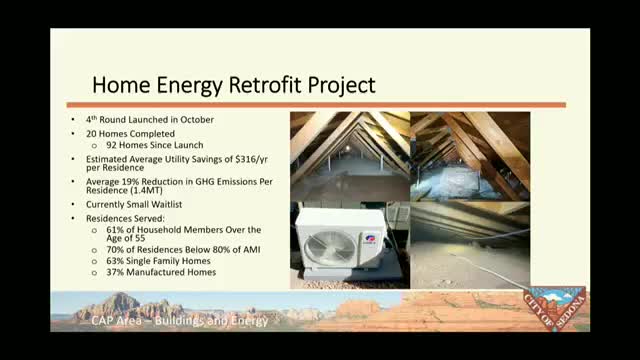
Bryce (sustainability staff) told the council the Home Energy Retrofit project, launched in spring 2022 with contractor Cozy Home of Flagstaff, has completed upgrades on 92 homes overall and 20 homes in the current program year. The city reported a small waiting list of four households because the program had reached its contracted funding allocation. "We have a very small wait list of 4 people, and each one of the people on the wait list, their funding allotment was higher than the amount that left that we had left on the contract," Bryce said.
Staff said the retrofit work typically includes LED lighting, weatherstripping, insulation repairs and, for manufactured homes, mini‑split installations to avoid ductwork losses. The city provided summary measures of program reach: roughly 70% of participating households fall below 80% of area median income for their household size, about two‑thirds are single‑family homes and the program averaged about $320 in utility savings per household. Staff said manufactured homes made up a majority of recent applications and that mini‑split systems were the predominant measure for those homes.
Zach (sustainability staff) described the city’s fourth year working with Solar United Neighbors (SUN), a national nonprofit that organizes regional solar co‑ops at no cost to participating municipalities. SUN runs education sessions and solicits bundled bids from installers. Zach reported Northern Arizona and Sedona results: the city hosted two Solar 101 workshops this year (one at Lehi Springs and one at the Sedona Public Library) and 13 Sedona residents used the co‑op this year, including eight from Lehi Springs. Since the city began partnering with SUN, 42 Sedona residents have gone solar through the co‑op. Staff said those 42 installations equate to about 748,600 kilowatt‑hours of annual generation and an estimated 4,365 metric tons of CO2e avoided over 25 years — roughly equivalent, staff said, to removing about 101 average U.S. passenger vehicles from the road for one year.
Council members pressed staff on program funding and sustainability of the retrofit work. Bryce said the program’s annual budget has remained similar year‑to‑year and that Cozy Home must balance service across a large rural area, which constrains the number of additional homes they can serve. On broader solar support, staff described uncertainty in the availability of state and federal incentives: some state programs (the governor’s Office of Resiliency’s Solar for All effort) and federal funding streams exist but have been inconsistent, staff said.
City staff said they will continue outreach to increase program participation and coordinate with Community Development to report solar permit counts for the broader, citywide picture.