Get Full Government Meeting Transcripts, Videos, & Alerts Forever!
Get email alerts on the Capital Improvement Plan topic
No spam. Unsubscribe anytime.
Eau Claire Council holds public discussion on 2026–2030 Capital Improvement Plan; $255 million proposed
Summary
Eau Claire City Council President Preston Bergey opened a June 9 public discussion of the proposed 2026–2030 Capital Improvement Plan, which staff said would total about $255,000,000 and includes proposed work on the downtown parking ramp, water‑system redundancy, parks repairs and an $8,000,000 flexible‑housing initiative using city‑owned land.
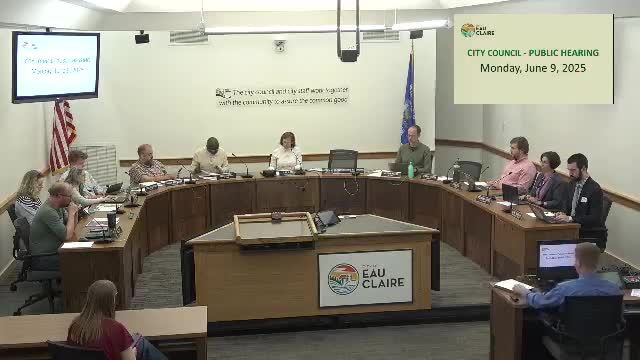
Eau Claire City Council President Preston Bergey opened a public discussion June 9 on the proposed 2026–2030 Capital Improvement Plan, which staff presented as a roughly $255,000,000 package of capital projects and investments spanning transportation, water, sewer, storm, parks and municipal facilities.
Director Winters told the council the CIP is a multi‑year plan driven by department priorities and aligned to council strategic goals. "Proposed spending by year, we have $255,000,000 in projects and investments over the proposed CIP," Winters said, and added that an average annual investment without large one‑time projects is about $42,000,000.
The plan as presented focuses largely on maintenance and replacement rather than net expansion. Highlight projects mentioned in the presentation include a potential demolition ($2 million–$3 million) and replacement (estimated around $14 million) of the downtown parking ramp; repairs and mechanical replacement at the Hobbs Ice Center; repairs and slide/retaining‑wall work at Fairfax Pool; an $8,000,000 flexible‑housing initiative using land the city already owns; continued water‑utility investments including a Chippewa River crossing for redundancy; standard playground and sport‑court replacements; investment in the Owen Park bandshell; and tax increment district projects such as a Water Street retaining wall and a TID‑funded multimodal overpass in the southern part of the city.
Winters described the plan's funding mix: enterprise funds (water, sewer, storm) cover roughly 28 percent of the total; a mix of federal and state grants, local fees and an about $22,000,000 loan for a large sewer project were also cited. Winters said roughly 53 percent of planned funding in the proposal would be financed with promissory notes (borrowing). He noted the city can issue debt up to five percent of equalized value under state statute and cited a city equalized value figure used in staff calculations. Winters also noted a beginning balance of carryover funds from prior years and about 2 percent of the CIP coming from one‑time savings.
Council Member Mbowa asked about a referenced settlement related to utility litigation and whether that money would affect the CIP. Winters said the city has begun receiving settlement proceeds and that staff — including the accounting manager and auditors and, where applicable, the Public Service Commission — are reviewing a multi‑hundred‑page settlement document to determine how proceeds should be applied. Winters said the settlement review is not complete and that any such funds are not reflected in the CIP as presented.
On RDA funding, Director White (RDA staff present at the meeting) said the RDA has requested $1,000,000 in the CIP for land acquisition and that the RDA can focus such funds on affordable housing if council directs that priority once the RDA's new focus map and any new TIF area work returns to council for approval.
Neighborhood comment at the public hearing included a request from Andrew Niesa, president of the Northside Hill Neighborhood Association, asking council to study pedestrian access and a connector between Upper and Lower Mount Simon Park as part of park improvements tied to a previous Jane Hahnadel estate donation. Niesa said residents had voted to use that donation for playground replacement and a pavilion but that a separate, budgeted investigation into pedestrian safety and a connector would make the park safer and more usable.
Staff outlined the schedule: a work session on the CIP process and related issues is set for June 13, amendments to be published for public review should be filed by June 13, and council will consider adoption of the CIP at its June 24 meeting. Winters told council that amendments submitted by the June 13 deadline will be published for public review prior to the June 24 vote.
Why this matters: the CIP sets multiyear priorities for the city's physical assets and determines which capital projects the city will fund, borrow for, or defer; it also guides grant applications and capital budgeting that can affect rates for utility customers and debt levels for taxpayers.
Remaining items and next steps: staff will continue technical review of settlement proceeds and of proposed amendments; the council will take formal action on adoption on June 24. Details on individual project schedules, design work, grant awards and borrowing authorizations will be addressed in subsequent staff reports and, where required, separate ordinance or contract items.