Get Full Government Meeting Transcripts, Videos, & Alerts Forever!
Get email alerts on the Police Leadership topic
No spam. Unsubscribe anytime.
New Dallas police chief greets oversight board; city attorney limits policy questions under Open Meetings Act
Summary
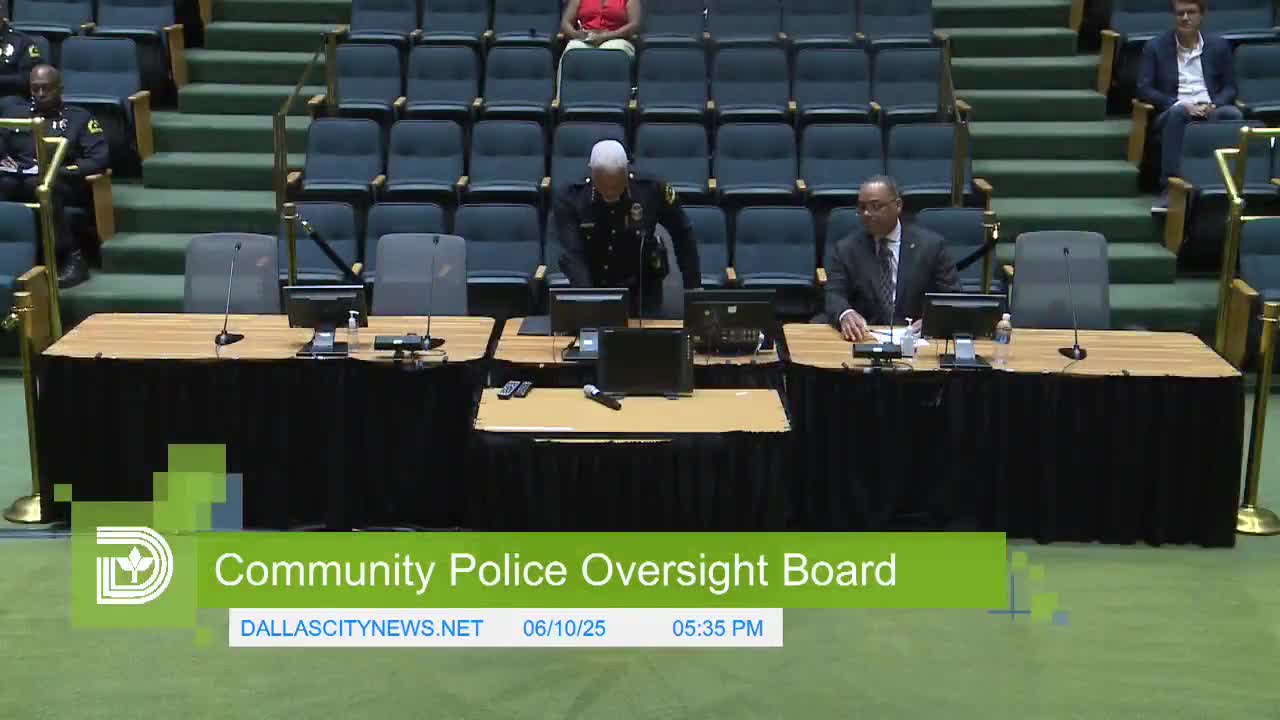
Chief Daniel D. Como introduced himself to the City of Dallas Community Police Oversight Board at a June 10 meeting and said his top priority is public safety and following the law.
Chief Daniel D. Como introduced himself to the City of Dallas Community Police Oversight Board at a June 10 meeting and said his top priority is public safety and following the law. The board had scheduled time for an introductory conversation; after a brief opening statement the board and members of the public attempted to ask him policy-level questions about immigration enforcement, crowd response and department priorities but were blocked by the city attorney’s interpretation of the Open Meetings Act.
Why it matters: The exchange left board members and some community speakers frustrated and asking for a follow-up meeting. Board members said they had prepared questions and a letter for the chief and expected the chance to seek substantive answers in public. The city attorney’s ruling narrowed what the chief could answer in the posted “introduction” item, a limitation the board said it will press to resolve.
Como, who took the podium after an introduction by Dominic Artis, Dallas’s chief of public safety, described his approach to policing and recent protests. "The law is not discretionary. The law is the law," Como said, adding he would "look, listen, and learn" during his first 90 days and that he was "proud" of officers' restraint during a protest the night before in which he said officers endured rocks, bottles and fireworks and made one arrest.
Board members tried to use the session to ask specific questions about DPD collaboration with federal agencies, response times and surveillance technology. City Attorney Daniel Moore advised the panel that the Texas Open Meetings Act required the board to give public notice of subjects to be discussed, and that an introductory item limited the chief’s remarks to generalized matters such as his background and vision. Moore told the group more specific policy questions would need to be noticed for a subsequent meeting so the public could attend.
That ruling produced immediate disagreement on the board. "If you want to talk about immigration, that is beyond the scope," Moore said; District 14 board member Brandon Friedman replied that the board needed to hear the chief's general philosophy on immigration enforcement. Vice Chair Ozzie Smith and others urged the chief to meet with the board regularly despite the limits.
Public commenters pressed the board on topics tied to the discussion. Organizer Scott McWilliams urged the department to avoid collaboration with federal immigration enforcement that could undermine immigrant trust, and said, "43% of Dallas households speak a language other than English" and that immigrant communities are "frightened" by federal enforcement. Diana Munoz, who described herself as the mother of a homicide victim, asked the chief to prioritize unsolved violent-crime cases. Minister Dominique Alexander criticized the city attorney’s intervention and said the board’s independence was being restricted.
Board response and next steps: Members voiced disappointment and signaled they will pursue additional meetings. Several asked the director to request written responses to a letter the board sent the chief and to coordinate a follow-up session that would be properly noticed for policy-level questions. Vice Chair Ozzie Smith and others urged the chief to attend board meetings regularly to build relationships with rank-and-file officers.
What they did not decide: No policy changes or binding directives were issued at the meeting. The city attorney’s interpretation limited what the chief said in public, and board members discussed — without formal action — whether to call a special meeting or otherwise re-notice topics so the chief could answer policy questions publicly.
Context: The board convened with a full membership and public comment; city staff reminded attendees about translation and accessibility options. The exchange underscores tension between public oversight and procedural limitations under open-meetings law.
Ending note: Board members said they will press the city attorney and the city manager’s office to clarify how the chief’s public introduction can include sufficiently substantive answers in future sessions, and some members asked the director to seek written responses to the board’s outstanding questions.