Get Full Government Meeting Transcripts, Videos, & Alerts Forever!
Get email alerts on the Environmental Impact Eir topic
No spam. Unsubscribe anytime.
Imperial County planning commission recommends certification of final EIR, forwards three Ormat permits to supervisors amid objections from environmental group
Summary
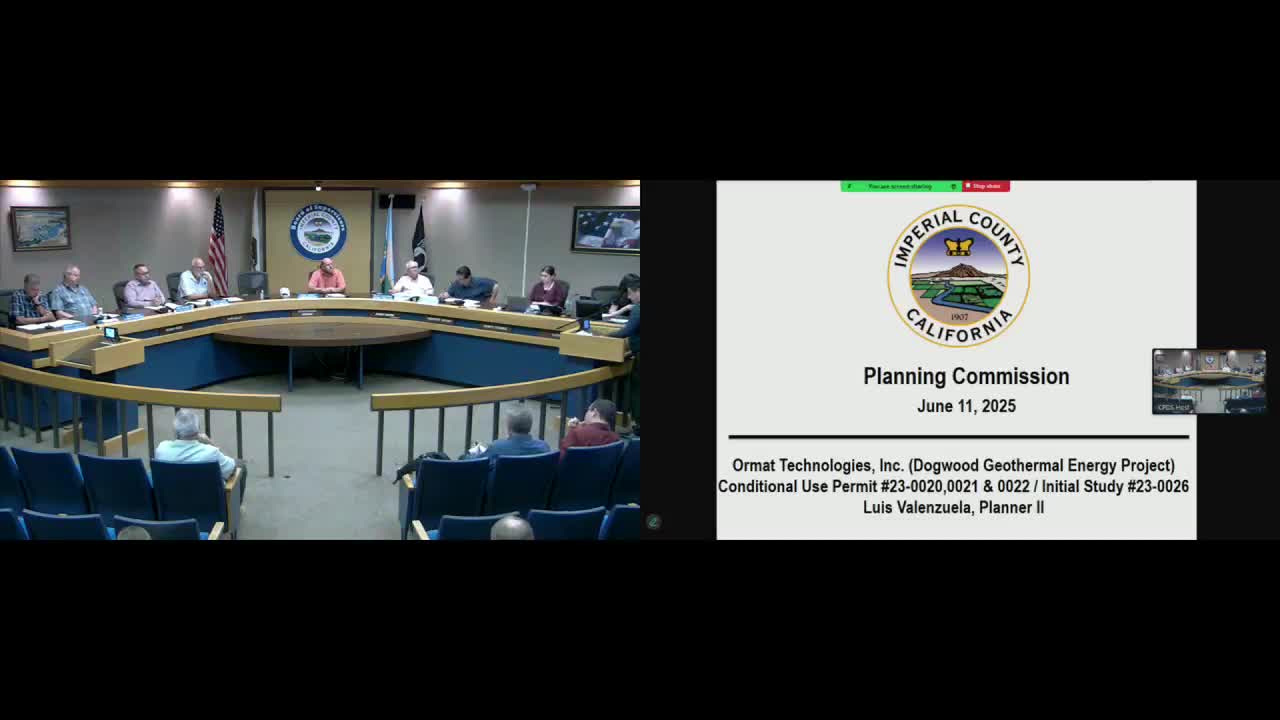
The Imperial County Planning Commission voted to recommend certification of a final environmental impact report and to forward three conditional use permits for an Ormat Technologies geothermal and solar project to the Board of Supervisors after a contested public hearing.
The Imperial County Planning Commission voted to recommend certification of a final environmental impact report and to forward three conditional use permits for a proposed Ormat Technologies geothermal and solar project to the Board of Supervisors after a public hearing that included objections from environmental consultants.
The final environmental impact report before the commission was dated May 2025, and planning staff and project consultants said it includes mitigation measures and responses to public comments submitted during the draft EIR review. Tim Yanivas of HDR Engineering, who presented the EIR on behalf of the applicant, said the draft EIR public review period ran from Aug. 14, 2024, to Jan. 13, 2025, and that the final EIR includes responses to comment letters from agencies including the California Department of Fish and Wildlife, Imperial Irrigation District and the Imperial County Air Pollution Control District.
The EIR identifies several environmental topics with potentially significant impacts — including agricultural resources, air quality, biology, cultural resources, geology/soils, hazards and hydrology/water quality — and prescribes mitigation measures that staff and the consultant said reduce those impacts to less-than-significant levels. “With review of all those comments, we've determined that recirculation of the draft EIR is not necessary,” Yanivas told the commission.
Citizens for Responsible Industry, represented by Lauren McGuire of Adams Broadwell, urged the commission to remand the project to staff for a revised and recirculated EIR. McGuire said the final document failed to quantify or mitigate hydrogen sulfide emissions from well drilling, omitted required elements of California Department of Fish and Wildlife burrowing-owl survey protocols, and therefore understates risks to air quality, noise and biological resources. “These comments demonstrate that the county failed to adequately address our draft EIR comments and provide substantial evidence that the project will result in potentially significant environmental impacts,” McGuire said.
A public commenter and legal counsel with Adams Broadwell, Elora McGuire, expanded on the burrowing-owl concern. She told the commission that the EIR did not follow CDFW’s 2012 minimum survey protocols (the transcript says the draft followed 13 of 20 minimum requirements) and that the absence of information about occupancy and pairs makes it impossible to ensure adequate protections. “Without that data, it’s impossible to ensure that the projects will be adequately protected as required by CEQA and the California Endangered Species Act,” she said.
Ormat’s representative, Alyssa Sanchez, director of business development for Ormat, said the company is bringing new clean-energy technology to the Imperial Valley that reduces water use through air-cooling technology. “It’s a real pleasure to propose this project,” Sanchez said. “It’s bringing new technology, sustainable clean energy, and employing air-cooled systems which reduces our water use.”
Commissioners asked staff and HDR about odor and health concerns raised by speakers. HDR noted that the existing facility operates with similar processes and that, according to project consultants and county records presented to the commission, the county has not received odor complaints connected to the existing operations. Staff and the project team also said mitigation measures were developed in consultation with CDFW and other trustee agencies.
After discussion, the commission voted to: recommend certification of the final EIR and the CEQA findings; recommend adoption of the mitigation monitoring and reporting program; and recommend approval of Conditional Use Permits 23-0020, 23-0021 and 23-0022, forwarding those items to the Board of Supervisors. Roll-call votes recorded on the transcript show unanimous “yes” votes by commissioners present on those motions.
The project package includes a final EIR, mitigation monitoring and reporting program and findings presented to the commission. Opponents asked the Board of Supervisors to require recirculation of the EIR; the supervisors will now receive the commission’s recommendations and public comments for their consideration.