Get Full Government Meeting Transcripts, Videos, & Alerts Forever!
Get email alerts on the Water Rates topic
No spam. Unsubscribe anytime.
Elsinore Valley Municipal Water District outlines rate increase drivers, schedules June 26 Proposition 218 hearing
Summary
District directors told the Lake Elsinore City Council the proposed water and sewer rate increases stem from higher imported water costs, PFAS compliance, rising energy costs and a large capital program; a Proposition 218 hearing is scheduled for June 26 at 4 p.m.
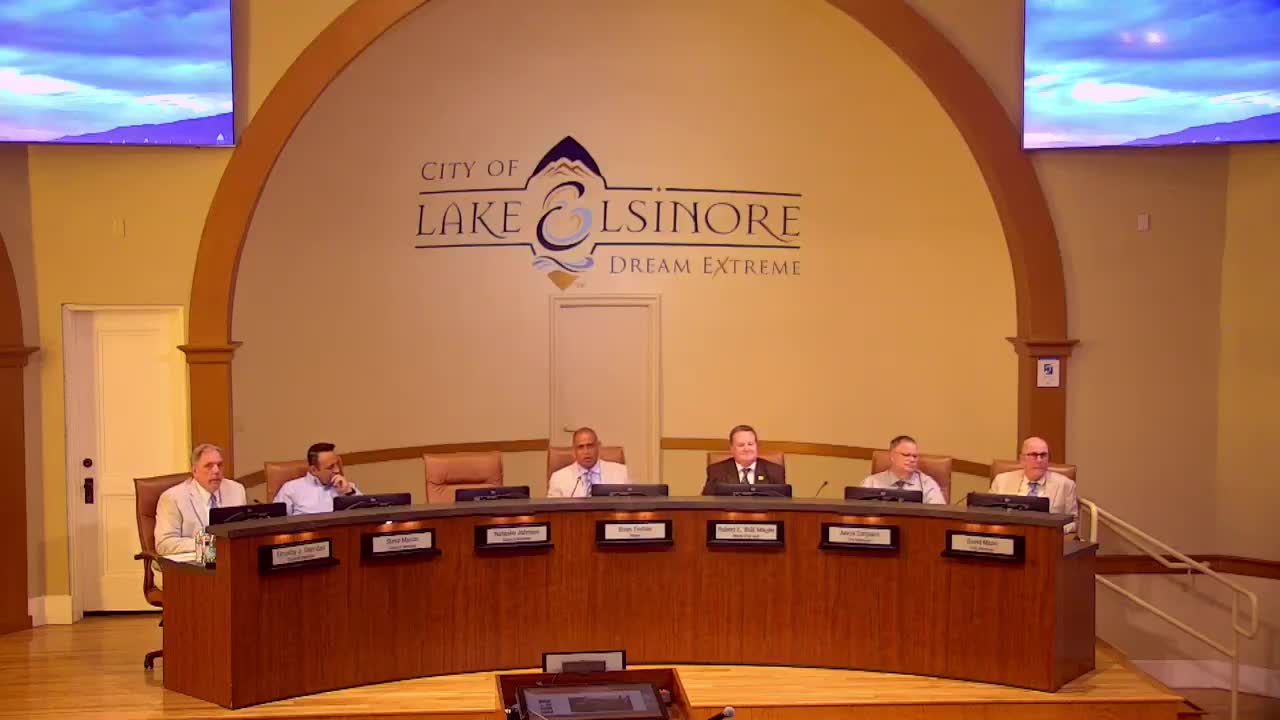
Harvey Ryan, a director on the Elsinore Valley Municipal Water District board, told the Lake Elsinore City Council that the district plans proposed rate adjustments under Proposition 218 to cover sharply higher operating and capital costs and to protect long-term financial stability.
Ryan said the district “doesn’t take raising rates lightly,” and described several drivers behind the proposal. He said roughly three-quarters of the district’s supply is purchased from the Metropolitan Water District, which has announced multi‑year increases that the district expects to pass through to customers. He also said electricity costs for pumping are rising — citing a recent projection of about a 17% increase from the local utility — and said state drinking-water regulations requiring treatment for PFAS/PFOA compounds have sidelined the Canyon Lake treatment plant and forced the district to consider a more than $100 million treatment facility to return that source to service.
Ryan described a five‑year capital improvement program estimated at roughly $600 million, paid in part by developer capital facility fees for new growth and in part by rate revenue for system upkeep. He said the district has drawn on reserves to smooth near‑term impacts and expects $15.1 million in non‑ratepayer revenues over four years to reduce immediate pressure on bills, but that reserves cannot be depleted without harming the district’s credit and increasing future borrowing costs.
To assist low‑income customers, Ryan described a rate assistance program (referred to in his remarks as “rare”) that can reduce qualifying households’ combined water and sewer bills by about $40 per month. He said staff and an independent rate consultant used a multi‑year financial model to develop a steady, phased approach to adjustments and that smaller, phased increases now would likely require steeper hikes later.
Ryan said the district is pursuing ways to reduce reliance on imported water but that Inland Empire alternatives are limited and costly to develop. He closed by inviting residents to a formal Proposition 218 hearing scheduled for June 26 at 4 p.m., and to a meeting between the district and the City Council on recently adopted capital facility fees.
The presentation named the district’s service area as Lake Elsinore Canyon, Lake Wildomar, parts of Murrieta and unincorporated Riverside County. No formal action was taken by the council during the presentation; the rate proposal will return to the district’s Proposition 218 hearing for public testimony and any formal protest process required under state law.
Council members did not ask follow‑up questions during the presentation but were invited to attend the district hearing and the joint meeting on facility fees.