Get Full Government Meeting Transcripts, Videos, & Alerts Forever!
Get email alerts on the Climate Resilience topic
No spam. Unsubscribe anytime.
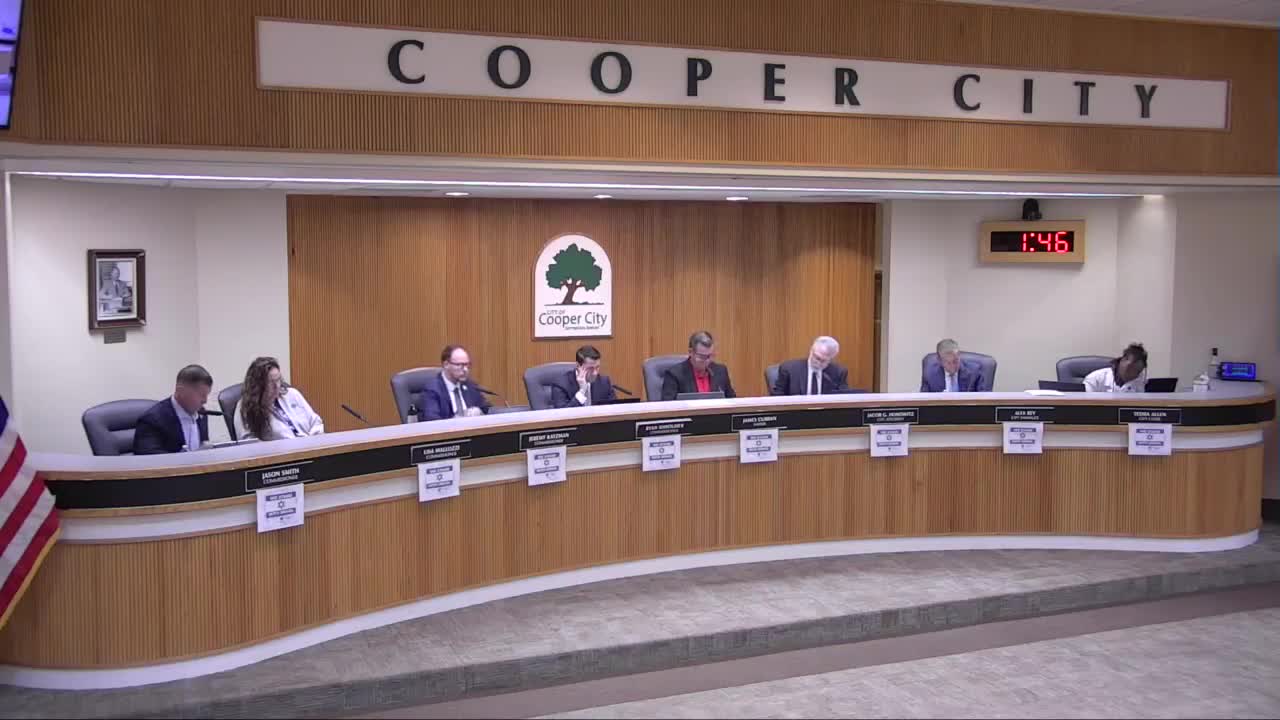
Commission adopts Cooper City flood vulnerability assessment to pursue resiliency grants
Summary
The commission adopted a flood vulnerability assessment prepared under the Resilient Florida Grant Program, identifying critical assets and two focus areas and authorizing staff to submit the report and pursue implementation funding.
The Cooper City Commission voted unanimously to adopt a flood vulnerability assessment prepared by Hazen and Sawyer and to submit the completed report to the state Resilient Florida Grant Program so the city can pursue funding for adaptation and mitigation projects.
Erin Goobie, project manager with Hazen and Sawyer, presented the study’s scope and results. The assessment inventoried critical assets (transportation, utility lift stations and treatment facilities, public safety buildings, parks and parcels), analyzed exposure across multiple flood scenarios (NOAA 2017 sea-level-rise projections combined with 100-year rainfall and some storm-surge scenarios) and applied a sensitivity analysis that weighted asset criticality, habitability and structural-damage potential.
Key technical details presented in the meeting record: - Planning horizons used: 2040 and 2070. - Flooding scenarios included intermediate-low and intermediate-high sea-level-rise projections (NOAA 2017) plus 100-year rainfall events; the team also incorporated a localized "water intrusion" factor to capture rainfall-driven indoor flooding that the modeled surface flooding might not reflect. - The team leveraged a Broward County stormwater model for scenario depths and then subtracted asset elevations to compute flood depths and exposure scores.
Results and recommendations - The assessment ranked the most vulnerable road segments, lift stations and parcels. The wastewater treatment plant, a set of lift stations and BSO facilities (Law/Cooper City District 16 Building and BSO Station 28) appeared among the highest sensitivity scores. - The consultants identified two geographic focus areas: one surrounding the water treatment facility and a central area that includes public safety buildings. - Next steps included submitting the final report to Florida’s Resilient Florida Grant Program and using the assessment to support grant applications for projects such as raising critical infrastructure, flood mitigation, drainage improvements and building-level defenses against water intrusion.
Commissioners asked whether school facilities were included; the consultant confirmed public assets across the city were assessed (including school properties), and staff said the city would share the assessment with the school board so the board could use the findings for its own grant work or shelter planning. Commissioner Katzmann asked whether sheltering and special-population considerations would be affected; staff said decisions about school shelter use are made by county emergency management and the school board but that the assessment should help inform those decisions.
The commission approved the resolution to adopt the vulnerability assessment and directed staff to submit it to the grant program so implementation funding can be pursued.