Get Full Government Meeting Transcripts, Videos, & Alerts Forever!
Get email alerts on the Opioid Response Funding topic
No spam. Unsubscribe anytime.
Committee debates allocation of opioid settlement funds; public health, sheriff and behavioral-health proposals advanced
Summary
The PECS committee reviewed proposals to spend opioid settlement funds on medication-assisted treatment, jail-based induction and an expanded naloxone distribution program, and directed staff to return with a substitute allocation that may include fire-rescue needs and geographic targeting.
The PECS committee reviewed proposals to deploy opioid settlement funds to local partners and debated whether allocations should shift to agencies serving high-overdose neighborhoods.
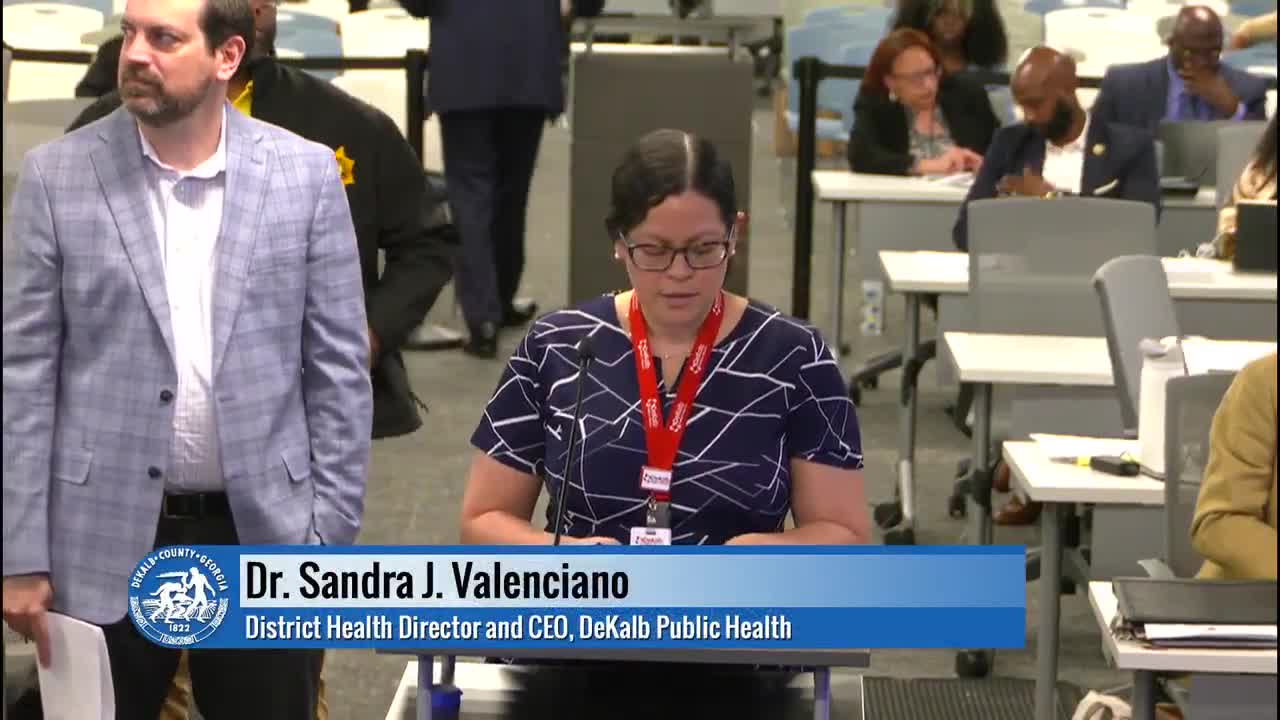
DeKalb Public Health presented data showing 371 opioid-related deaths from 2021–2023, an age-adjusted opioid mortality rate for DeKalb near the Georgia rate, and localized overdose hot spots in southern and southeastern DeKalb. The department reported it currently funds one full-time staffer for opioid work (about $106,892 in department funding) and proposed adding one full-time position plus three hourly community-health workers, distributing up to 3,000 naloxone kits and piloting a naloxone vending machine (Grady and national examples cited). The department requested $434,354 to expand naloxone distribution, training and outreach.
Claretel Behavioral Health proposed a medication-assisted treatment (MAT) program to purchase medications and provide services at outpatient clinics. Fabio (Claretel) said much of the proposal cost is medication; the plan budgets injectable naltrexone for up to 50 people (at roughly $1,600 per injection) and expects to provide multiple medication options and laboratory monitoring. Claretel requested $1,343,742 under the proposed allocation.
A DeKalb Sheriff's Office representative asked for $620,035 to begin an in-jail MAT program with nursing and clinician staffing and to ensure continuity of care on release, pointing to the high overdose risk after jail discharge. The sheriff—s office and Claretel described a handoff model linking jail induction to community-based follow-up.
Commissioners discussed geography and equity: several noted overdose fatalities clustered in southern and southeastern DeKalb and asked whether more funds should be directed to services within those neighborhoods. Commissioner Robert Patrick and others suggested mapping responses to hotspots and coordinating resources with fire, EMS and schools. Commissioner Terry proposed expanding the advisory membership to include academic, judicial and lived-experience members, matching the state—s Regional Advisory Council composition for future funding decisions.
After discussion, committee members agreed to proceed pending a substitute allocation and further coordination: the committee approved a motion that would move the item forward with an expectation a substitute would add fire-rescue considerations. The committee also discussed deferring further action briefly so county staff could refine allocations and confirm other lawsuit funds and trust disbursements.
Why it matters: The county will receive opioid abatement funds over many years; early allocations set program priorities for prevention, treatment and harm-reduction and affect who receives time-limited resources.
Ending: The committee endorsed moving the item forward while staff and agencies refine a substitute allocation that could add fire and EMS needs and provide more geographic targeting; commissioners requested additional comparative data and a clearer long-term governance structure for future tranches.