Get Full Government Meeting Transcripts, Videos, & Alerts Forever!
Get email alerts on the Muni Metro Capacity topic
No spam. Unsubscribe anytime.
SFMTA and TA outline Muni Metro core-capacity study and preparations for federal grant pipeline
Summary
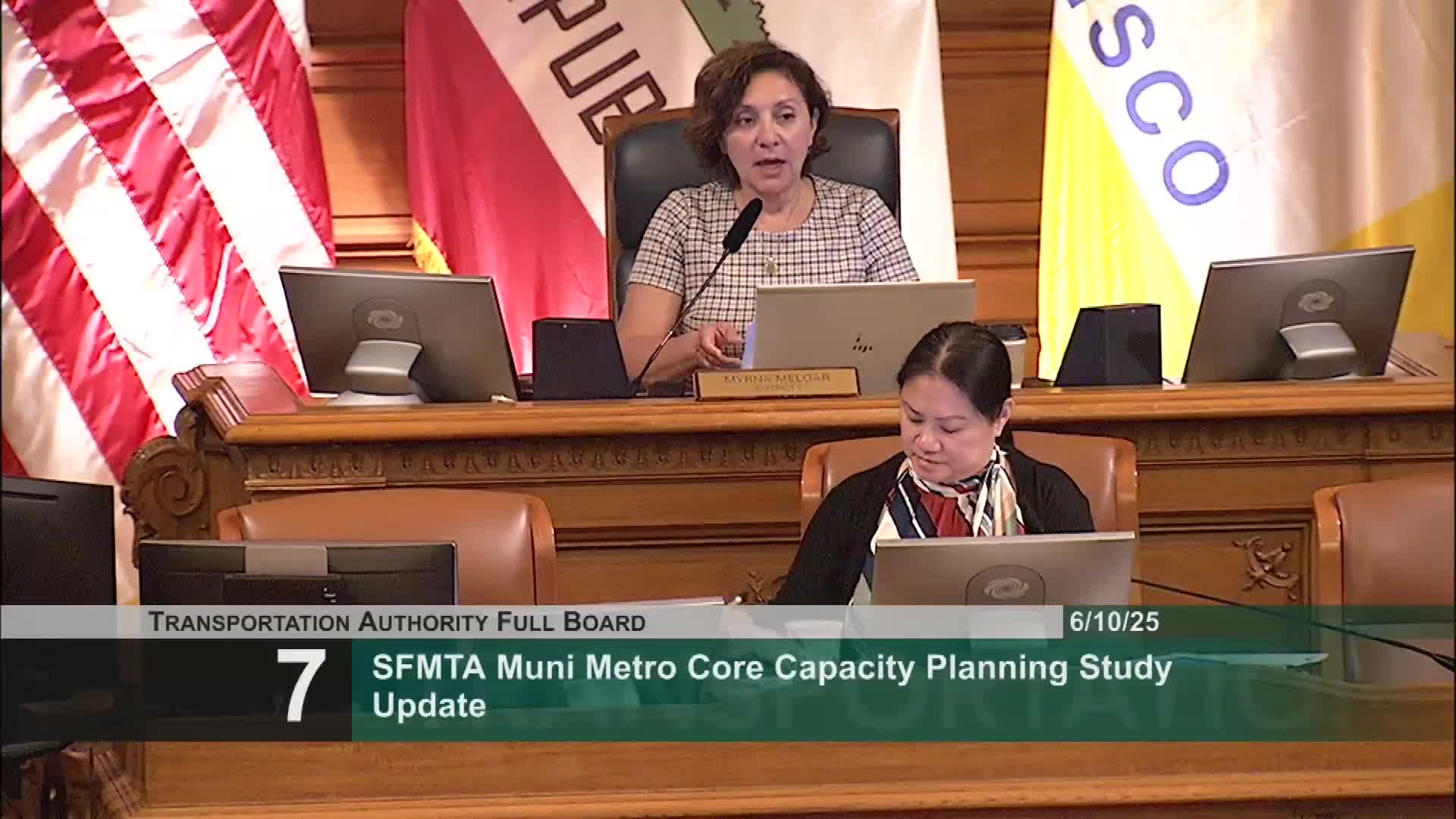
SFMTA and Transportation Authority staff on June 10 updated the board on a Muni Metro core capacity planning study intended to build a competitive capital program for an FTA core-capacity grant.
San Francisco Municipal Transportation Agency (SFMTA) and Transportation Authority staff on June 10 updated the board on the Muni Metro core capacity planning study, a multi-year effort intended to develop a capital program that could compete for Federal Transit Administration (FTA) core-capacity grants.
Jesse Koehler, rail program manager for the Transportation Authority, said the study was funded by Prop K sales-tax funds in combination with a Caltrans planning grant and that the board required an SFMTA presentation following the completion of this phase. Liz Bryson, planning manager at SFMTA and the study’s project manager, described the study’s objectives: address aging infrastructure in need of renewal, plan for future ridership growth, and develop capital projects that could be eligible for the FTA core capacity program. Bryson said the federal program targets fixed-guideway systems that will experience overcrowding within the next ten years and can fund up to 80% of eligible project costs; recent awards to other agencies have been in the high hundreds of millions to over a billion dollars.
Staff described several strategy categories under evaluation:
- Transit-priority street improvements (transit lanes, transit signal priority) to reduce street-level delays and better exploit available subway capacity. - Capacity-enhancing state-of-good-repair work (for example, upgrading traction power substations so they can support longer trains or higher frequencies). - Running three-car trains on selected segments (the presentation noted focused study of the N Judah and inner portions of the M Ocean View between SF State and downtown) because a three-car train provides about 50% more capacity than a two-car train. - Modern accessible stops that allow faster, more reliable boarding and thereby improve operational throughput. - Route restructuring (an operational approach with community impacts) was described as controversial; staff emphasized the study will document benefits and impacts and that the board will not make route-restructuring decisions as part of the capital-program recommendations. Bryson said route restructuring would only be further explored if ridership increases or subway performance declines materially and would include extensive outreach.
Bryson said the study team developed three ridership scenarios (low, medium, high) and both 10–15 year and 25-year horizons so recommendations reflect a range of possible futures rather than a single forecast. The study included outreach: a community working group representing riders and corridor stakeholders and four rider focus groups held in English, Chinese and Spanish. Draft recommendations are scheduled for release for public feedback later this summer, with the SFMTA board slated to consider the final report in the fall. Staff noted that entering the federal grant pipeline is a multi-year process: a typical timeline from entry to construction funding can take four to six years or longer, and project delivery for large state-of-good-repair/capacity work would likely occur in the 2030s.
Board members asked for clarification on which projects are funded; a commissioner noted the MTA’s FY25–29 capital program identified over $30,000,000 for an Outer/Inner N Judah transit-priority project but asked whether that item is fully funded; staff replied it is not fully funded and said they would follow up with details. Commissioners also asked whether the study considers network expansion versus internal capacity (the study is focused on existing Muni Metro capacity within the subway and near-term capital-era work), and about the potential role of route restructuring to respond to future constraints.
Public comment from Alita Dupree supported several of the study’s directions and urged modernization of train control systems and electrical capacity. Bryson and Koehler thanked staff, noted the importance of preparing strong grant-ready projects, and reiterated that any specific capital projects would later go through more-detailed corridor-level outreach and design review.
Why it matters: Muni Metro carries the city’s highest light-rail ridership and faces both aging assets and future demand from housing growth near rail corridors; pairing state-of-good-repair work with capacity upgrades is a strategy to make projects more competitive for large federal grants.
What’s next: draft recommendations and public comment later this summer; SFMTA board consideration of the final study in the fall and subsequent steps to enter the FTA core-capacity grant pipeline.