Get Full Government Meeting Transcripts, Videos, & Alerts Forever!
Get email alerts on the On Site Sewage Systems topic
No spam. Unsubscribe anytime.
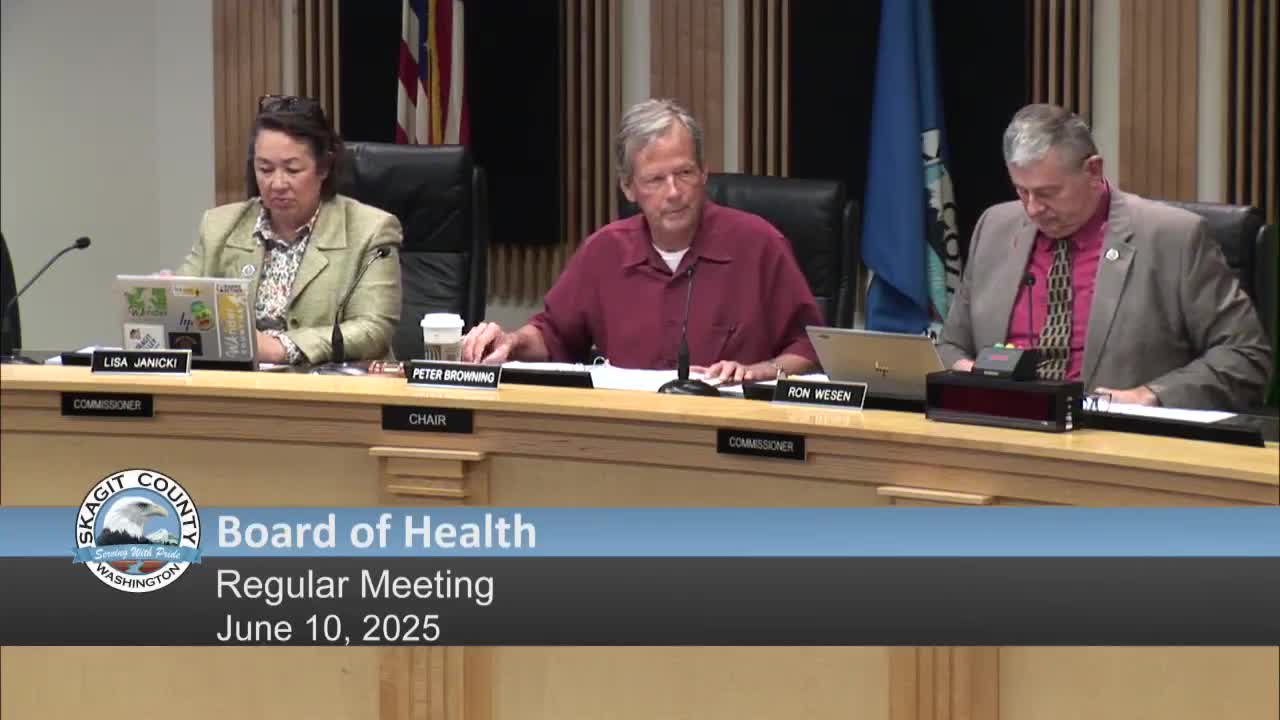
Skagit County Board of Health proposes broad revisions to on‑site sewage rules; public hearing set for July 28
Summary
Skagit County public‑health staff presented a comprehensive draft of amendments to county code 12.05 governing on‑site sewage (septic) systems, including new definitions, inspection schedules, operational permits, and minimum soils testing. The board voted to open a public comment period and scheduled a public hearing for July 28 at 2:30 p.m.
Skagit County Public Health staff on June 10 presented a consolidated draft of proposed amendments to Skagit County Code 12.05 (on‑site sewage systems), saying the changes align local rules with the Washington State Department of Health and clarify many long‑standing local practices.
"I am Sharice Gaynor, environmental health specialist with Public Health," Sharice Gaynor said as she opened the department's presentation, which listed a multi‑year drafting process, technical advisory group input and legal review with county counsel.
The proposed draft adopts the revised state standards (WAC chapter 246‑272), adds local definitions and procedural details, and introduces several requirements that county staff and some commissioners said are more stringent than the state minimum. Public Health Director Keith Hickman framed the update as a routine but important governance function for the local board of health.
Why it matters: The draft would change how septic systems are designed, installed, inspected and maintained across Skagit County and could affect homeowners, designers, installers, property transfers and certain businesses. Staff said the changes are intended to reduce public‑health risk, improve clarity for permit applicants and providers, and make local enforcement and recordkeeping more consistent.
Major proposed changes and clarifications
- Adoption of state standards and expanded definitions: The draft explicitly adopts Washington Department of Health standards and adds local definitions for terms such as record drawing, site or soil evaluation, waiver and variance and an operational permit.
- New and clarified timelines: As‑built record drawings would be required within 90 calendar days for repairs, expansions and new conventional gravity systems; other system types must submit record drawings before a building permit is issued, staff said.
- Operational permits and holding tanks: The draft defines an operational permit (one‑year term, renewed annually) and would require operational permits for holding tanks.
- Inspection schedules: Routine inspection frequency would remain every three years for conventional gravity systems but become annual for many alternative or electronic systems; staff also proposed annual routine inspections for certain nonresidential uses and transient accommodations (hotels, short‑term rentals), schools and group homes.
- Homeowner installation and education: Homeowners could remain eligible to perform some installations for simple conventional gravity systems but would first need documented education; homeowner installation eligibility would be limited (for example, systems must be at least 200 feet from marine waters and 100 feet from other surface waters). Staff proposed removing homeowner installation for pump‑to‑gravity systems and disallowing homeowner installations that require waivers or variances.
- Minimum soils testing and reserve areas: For new systems the draft proposes a minimum of three soil test pits (two in the proposed primary area and one in the reserve area) and clarifies how older soils data (pre‑1984) are treated relative to current design standards.
- Bedroom definition and sizing: The draft reintroduces an on‑site septic system bedroom definition and proposes minimum bedroom counts by floor area to better size tanks and drain fields; staff said the purpose is to avoid undersized systems when rooms are later used as sleeping quarters.
- Provider certification and continuing education: The proposed code would require providers to hold a valid Washington business license, define level‑1 and level‑2 provider scopes (based on education/experience) and clarify renewal and continuing education credit rules.
- Waiver and variance procedures: The draft distinguishes waivers (state guideline deviations supported by specific state provisions) from local variances and proposes standardized forms, timelines aligned with permit review (30 days for permit‑related waiver/variance reviews, 15 working days for stand‑alone requests) and clearer submittal requirements.
Staff and board discussion
Sharice Gaynor described a drafting timeline that began about a year earlier, with review by a technical advisory group of designers, installers and O&M providers in December 2024 and multiple board work sessions in March, April and May. "Those work sessions were very helpful in refining things and making sure that the proposed language met the intent and the goal," Keith Hickman said.
Commissioners pressed staff to highlight which local provisions would be more restrictive than the state and to ensure outreach to homeowners and others who may not participate in technical advisory meetings. Commissioner remarks noted the need for concrete examples to explain the difference between a waiver and a variance; in response, Britt Hageman (county staff) offered a plain‑language example distinguishing a state waiver (technical deviation tied to state guidance) from a local variance (an exception to county rule, such as allowing a homeowner to inspect a more complex system than normally permitted).
Public process and next steps
Staff recommended—and the board approved—opening a public comment period from June 10 through July 28 and scheduling a public hearing at 2:30 p.m. on July 28 to consider adoption of the amendments to Skagit County Code 12.05. Staff said they plan to publish the draft on the county website, advertise in the local newspaper, notify interested parties and accept written and verbal comments during the comment period.
Votes at a glance
- Approval of minutes (April 15, April 21 and May 29): Motion to approve the three sets of minutes was moved and seconded; the board voted in favor (vote recorded as "Aye").
- Call for public hearing on Skagit County Code 12.05 amendments: Motion to set a public comment period (June 10–July 28) and to hold a public hearing on July 28 at 2:30 p.m. was moved and seconded; the board voted in favor (vote recorded as "Aye").
What remains uncertain or to watch
Staff said they will accept written comments and will hold the July 28 public hearing (staff suggested scheduling the hearing in the afternoon to increase participation from providers who are in the field). The draft includes multiple provisions staff described as "more restrictive" than state minimums—inspection frequency for some systems and nonresidential uses, operational permits for holding tanks, mandatory record‑drawing timelines and the bedroom sizing definition—so the public comment period will be a primary venue for affected homeowners, designers and providers to offer input.
The board will reconvene on July 28 to hear public comments and consider final action on the code amendments.