Get Full Government Meeting Transcripts, Videos, & Alerts Forever!
Get email alerts on the Investments topic
No spam. Unsubscribe anytime.
Leesburg OpenEd Trust finance board hears first-quarter investment review; PFM reports slight underperformance, shifts allocation to core bonds
Summary
At its May 28 meeting the Town of Leesburg OpenEd Trust Finance Board received a first-quarter performance review from PFM showing modest underperformance vs. the blended benchmark, a portfolio market value near $19.7 million, and discretionary reallocation that reduced equity exposure and increased core fixed-income holdings.
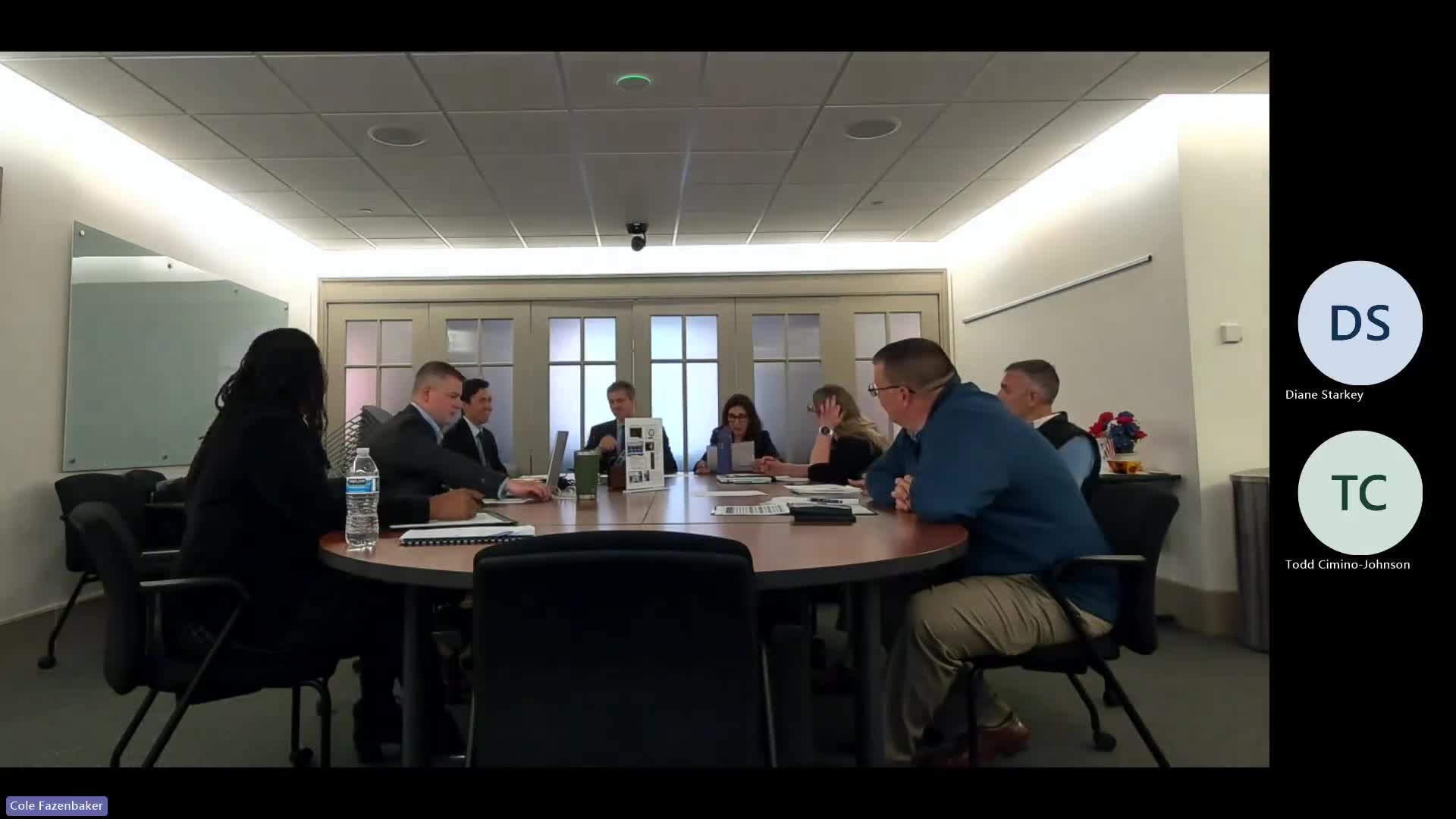
The Town of Leesburg OpenEd Trust Finance Board on May 28 heard a first-quarter investment review from PFM that showed the trust’s market value near $19.7 million and modest underperformance versus the board’s blended benchmark. PFM told the board it recently reduced the trust’s U.S. equity weight by about 2 percentage points and cut non-U.S. equity by about 1 percentage point, redeploying that allocation into core fixed-income funds.
PFM presenters described 2025 as a volatile period for markets: U.S. equities fell from an early-year high, non-U.S. equities outperformed in the quarter, and fixed-income returns benefited from falling yields even as corporate spreads widened. The firm said those factors, together with policy uncertainty tied to tariffs and a larger federal deficit, supported a more defensive stance in the trust’s tactical positioning.
PFM reported the trust’s market value as $19,200,000 at the close of March and $19,680,000 as of a recent update. For the first quarter the portfolio underperformed its blended benchmark by roughly 24 basis points, the presenters said, and the board’s annual estimated fees were shown at about 10 basis points. PFM explained the underperformance partly reflected removal of an out-of-benchmark high-yield exposure amid widening corporate spreads and concerns about credit risk.
The board’s blended benchmark, as presented in the meeting materials, uses the Russell 3,000 for U.S. equities, a Morgan Stanley country index for non-U.S. equities (as described in the presentation), and the Bloomberg U.S. Aggregate for fixed income. PFM said passive equity allocations have been largely unchanged since 2023 and that recent tactical moves were intended to preserve capital amid rising market uncertainty.
Board members asked clarifying questions about the calculations and benchmarks; presenters reiterated that the firm manages the portfolio on a discretionary basis and has been making tactical adjustments in real time rather than waiting for board approval for each trade. The meeting record shows no formal board vote authorizing the specific tactical trades; PFM characterized the adjustments as actions taken under its discretionary mandate on behalf of the trust.
The finance board approved the minutes of its Feb. 26, 2025 meeting and then adjourned. No other substantive agenda items or formal votes were recorded at the May 28 meeting.
Votes at a glance: - Approval of minutes, Feb. 26, 2025 finance board meeting — motion recorded “by Herman”; outcome: approved (all in favor). - Adjournment — motion moved and approved (all in favor).
Meeting context: PFM and board members framed the discussion as a routine quarterly review with heightened caution because of policy-driven market volatility (tariff uncertainty) and widening corporate credit spreads. Presenters described the portfolio as long-term, noting the trust has passive equity allocations and active management in fixed income.