Get Full Government Meeting Transcripts, Videos, & Alerts Forever!
Get email alerts on the School Facilities And Funding topic
No spam. Unsubscribe anytime.
Prince George’s County school board urges continued investment in aging buildings, seeks changes to Office of Integrity and Compliance
Summary
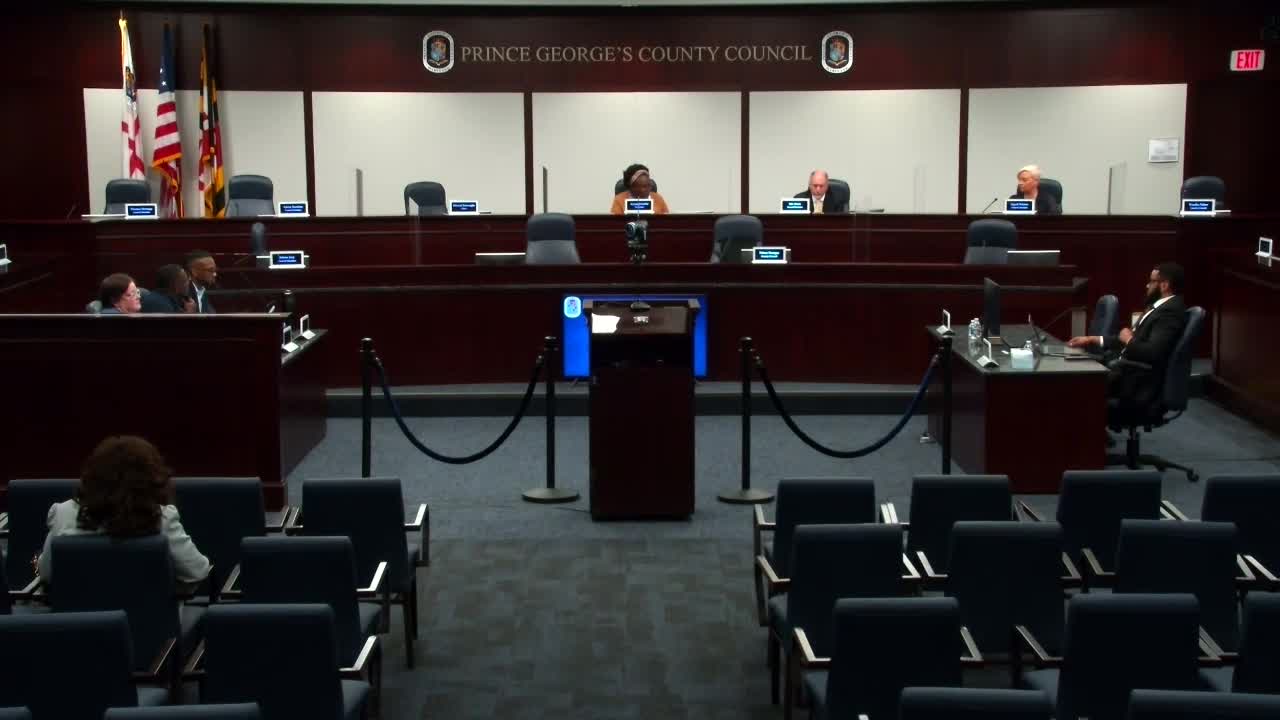
Councilwoman Orieva, chair of the Education, Workforce and Development Committee of the Prince George’s County Council, opened a roundtable with members of the Prince George’s County Board of Education on Sept. 12 to review the board’s legislative priorities and ask for continued county support.
Councilwoman Orieva, chair of the Education, Workforce and Development Committee of the Prince George’s County Council, opened a roundtable with members of the Prince George’s County Board of Education on Sept. 12 to review the board’s legislative priorities and ask for continued county support.
Dr. Felton Moss, chair of the board’s Policy and Governance Committee, said the presentation was intended to give the council “a little bit more line of sight” into the board’s legislative agenda and to seek collaboration ahead of the board’s legislative day in September. “We are here today to talk a little bit about, our line for impact, our work that we've been doing as a board with the Maryland General Assembly,” Moss said.
The board identified school facilities and capital improvements as its top priority. Board member Amy Olivo thanked the council for recent budget support and said the district faces extensive deferred maintenance: “The state of our schools has a negative impact on our educational outcomes, has a negative impact on our students, our teachers, and our staff who are there many hours every single day.” The board noted that 59% of county schools — 124 buildings — are over 50 years old and said continued and “creative” funding approaches are needed to modernize facilities, citing past public–private partnership work as a major step forward.
Board leaders also urged changes to HB 437, legislation connected to the Office of Integrity and Compliance (OIC). The board said the bill should increase the OIC’s independence, add mandatory public hearings on work plans and risk assessments, require annual reporting that quantifies recoveries, and include protections for employees and vendors who report concerns. Dr. Moss said the board wants the OIC to be an objective body and highlighted governance provisions that currently tie the office closely to the board’s leadership. “If we're, say for instance, expending $1,400,000 to stand this office up, 1 would hope that it would find $1,400,000 in fraud, waste, and abuse,” he said.
Jonathan Briggs, vice chair of the board’s Policy and Governance Committee, framed the board’s agenda around partnership: “1 of the things that we find to be really important, as a board is collaboration and how we choose to partner with various stakeholders in the community, including our elected officials.” Briggs and other board members described outreach to state legislators in Annapolis to prevent unfunded mandates this legislative session and to protect “blueprint” funding.
Board leaders and council members discussed board autonomy over superintendent hiring. The board described the current local process as a tripartite system: the county executive makes an appointment under state law and the elected board subsequently approves the superintendent’s contract and can negotiate contract terms. Dr. Moss said Prince George’s County Public Schools is the only district in Maryland where the elected school board does not have full autonomy to hire the superintendent and said the board plans to advance autonomy as a priority in the upcoming legislative session.
Safety and security also were discussed as an ongoing priority. The board described investments in security systems across middle and high schools and said safety planning should be balanced with investments in mental health and school climate. “We don't have a single right way that this has to look,” Briggs said, adding that the board seeks a multi‑pronged approach rather than relying solely on increased police presence or metal detectors.
Council members pressed for operational clarity and oversight. Council Chair Burrows proposed deeper cross‑agency partnerships (planning, libraries, community college, higher education) and suggested using existing county assets and rec center buildings as transportation or program hubs. Several council members asked for more public and fiscal transparency about how state and local funds are spent; Dr. Moss and other board members said the board is preparing more detailed reporting and noted the state “blueprint” requires that 75% of state education dollars go directly to schools. The board said the district currently directs about 70–72% of state funds to schools and must reach 75% next year to remain in compliance with the law.
The board requested continued council participation in the board’s legislative day (scheduled for Sept. 12) and said it will circulate a public survey to help refine priorities before finalizing its policy agenda in August. The meeting closed after roughly 50 minutes of discussion with commitments from both sides to continue work on facilities funding, OIC oversight, partnerships and clearer reporting on use of blueprint and other education dollars.
The roundtable produced no formal actions or votes; members agreed to follow up offline on specific operational and oversight matters.