Get Full Government Meeting Transcripts, Videos, & Alerts Forever!
Get email alerts on the Land Use Zoning topic
No spam. Unsubscribe anytime.
Council begins review of Woodstock’s ‘lot of record’ rules, seeks clearer standards for infill redevelopment
Summary
Community Development staff told Woodstock City Council on June 9 that the city’s lot-of-record ordinance has produced inconsistent outcomes in infill redevelopment and asked for policy guidance to make administration more predictable.
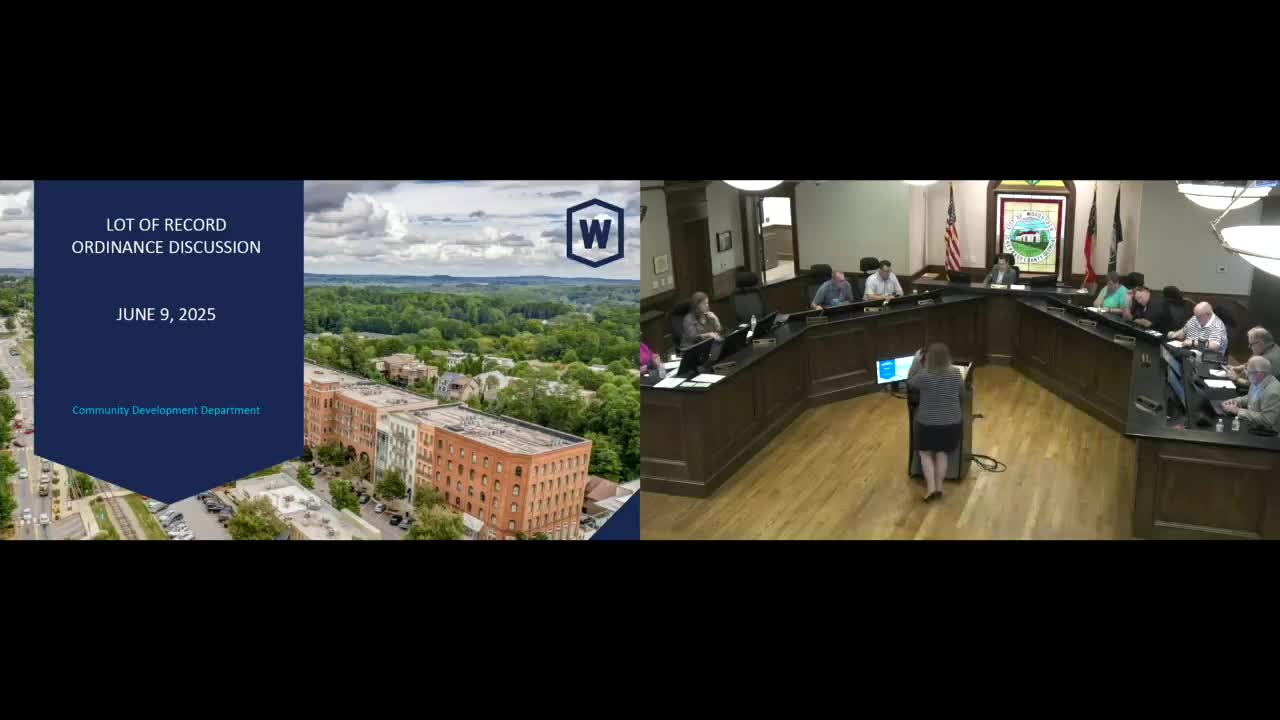
Woodstock Community Development staff opened a multi‑week discussion on June 9 about the city’s lot-of-record exemption and how it applies to infill redevelopment in and near downtown.
Tracey Albers of the Community Development Department said the lot-of-record ordinance (adopted in 2018 and updated in 2020) was intended to balance incentives for downtown residential development with preservation of neighborhood character. She told council the code’s administration has created unpredictability for staff and applicants and requested council policy direction.
Albers summarized how the exemption works: lots recorded before the ordinance may qualify for a “lot of record” exemption that generally allows a property owner to dedicate right-of-way rather than immediately constructing streetscape elements (parkway/landscape strip, sidewalk clear zone and parallel on‑street parking) required on D‑1 and D‑2 streets. “If you do not qualify for a lot of record, the installation of this infrastructure … is required of the developer or the homeowner,” she said. “If you do qualify, you give us the right of way, and it will eventually be on us. You do not have to install it.”
She said staff struggles most with several code provisions including the definition of new construction (which staff reads as applying to vacant lots), the “substantially similar” test for replacement structures, the replica provision that allows demolition and replacement if the new structure is substantially similar, a 30% threshold for renovations, and how lot splits are treated. Albers used several local examples — properties on Rotemill Road and Russ Street and subdivisions such as Cardinal Woods — to illustrate ambiguous outcomes where a new house might be significantly larger or more modern than the prior structure yet claim the lot-of-record exemption.
Councilmembers responded by urging simplification. Councilman Usher suggested removing the term “substantially similar,” calling it legally imprecise in this context. “I would build fences around what we want to have constructed on a lot,” he said, arguing for clearer, objective parameters instead of an ambiguous standard. Councilmember Collins said she would “lean in the direction of… if a single family lot is redeveloping, just donate the right of way,” while noting a distinction between an individual rebuilding for personal use and a developer splitting a lot into multiple sellable parcels.
Several councilmembers and staff also said parallel parking requirements create the most friction in administering the code, compared with parkway and sidewalk installation, and suggested a broader review of whether some streets should be reclassified from D‑1 to a lower standard. Mayor Michael Caldwell and other councilmembers asked staff to return with a draft revision and said they expected additional follow-up sessions; Albers said staff will provide the presentation materials and work with council to refine the ordinance language.
Why it matters: the lot-of-record rules determine whether single-family redevelopment must immediately install streetscape infrastructure or simply dedicate right-of-way for future public construction. Council direction could change redevelopment costs for homeowners and influence infill patterns in established neighborhoods and downtown.