Get Full Government Meeting Transcripts, Videos, & Alerts Forever!
Get email alerts on the Open Meetings Ipra topic
No spam. Unsubscribe anytime.
Deputy county attorney briefs health council on Open Meetings Act, public‑records rules and quorum requirements
Summary
Katie Twates, the county deputy attorney, gave a legal briefing on the Open Meetings Act and the Inspection of Public Records Act, covering quorum rules, notice and agenda posting, limits on "reply‑all" email discussions, minutes and potential misdemeanor liability for violations.
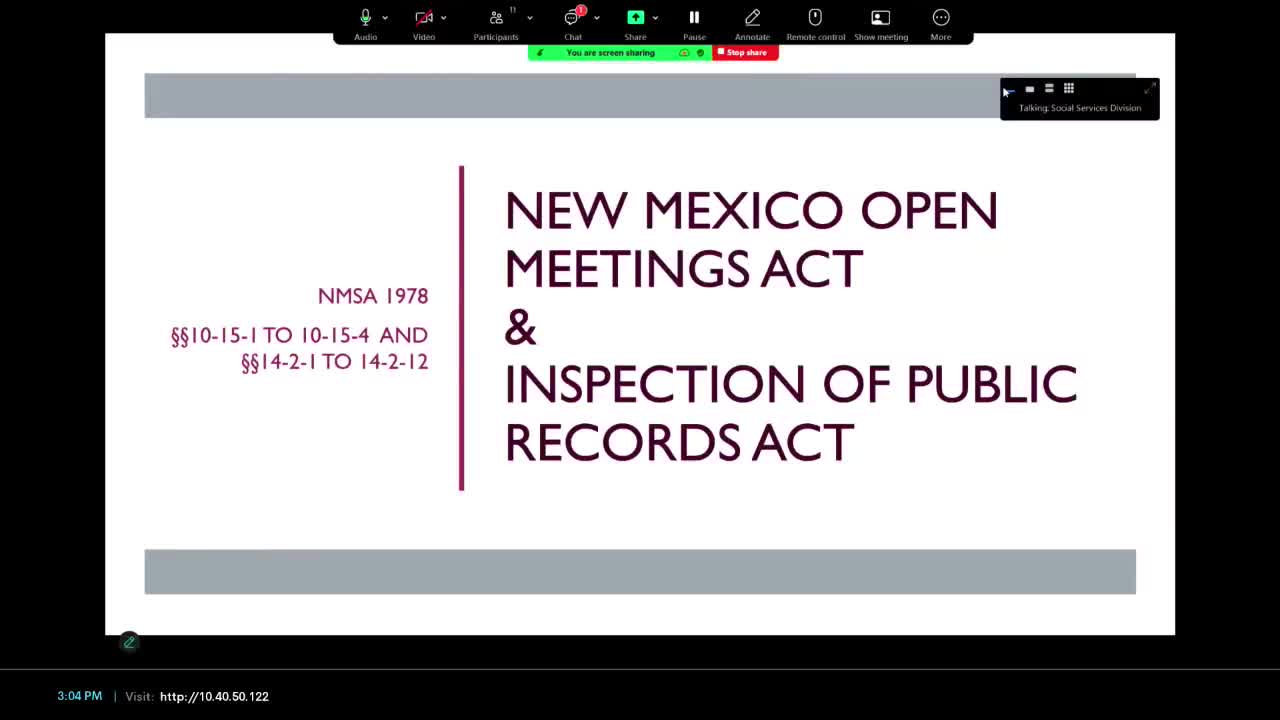
Deputy County Attorney Katie Twates gave a training to the Health Council outlining state open‑meetings and public‑records law and how those laws apply to the council’s operations.
Twates summarized the two statutes that govern public meetings and records: the Open Meetings Act and the Inspection of Public Records Act (IPRA), often described as the state’s “sunshine laws.” She told the council that four elements must be met for a lawful meeting: a quorum, public notice, an agenda with specific items and timely minutes.
Quorum and appointments: Twates said the Health Council may have up to 15 members under Resolution 19‑28. Under county code, a quorum is a simple majority of appointed voting members; if 15 are appointed a quorum would be eight. With nine appointed members at the time of the briefing, a simple majority is five; Twates said the group must stop any meeting if the quorum is lost except to set a date and time for reconvening.
Notice and agendas: Twates explained that regular meetings must be published at least 10 days in advance (the council’s annual calendar generally satisfies this). Special meetings require 72 hours’ notice and agendas must list specific items of business so the public can decide whether to attend; the public must be able to see posted agendas on the county website and at a conspicuous posting location near the municipal building’s west entrance.
Limits on informal communications: Twates warned that “reply‑all” email threads or sequential phone calls among a quorum of members about public business can constitute a prohibited “walking forum.” Likewise, subcommittees must be composed intentionally to avoid creating quorums outside public meetings. She recommended creating a separate email account for Health Council business to simplify responses to public‑records requests.
Minutes and records: Action minutes should be prepared by staff within 10 working days and must include meeting date, attendees, substance of proposals and vote records. Twates said that while videos and audio are archived, action minutes are the usual public record and that secret or anonymous ballots or undisclosed votes would conflict with the law.
Liability and enforcement: Twates told the council that the liability for Open Meetings Act violations lies with the individual members; conviction for a willful violation is a misdemeanor. She noted that actions taken in violation of the Open Meetings Act may be invalidated.
Charter and political‑balance rules: Twates pointed to Resolution 19‑28 and county code as the governing instruments; she said the council must adhere to applicable laws and county rules regarding member appointments and any political‑balance provisions embedded in the charter and county code.
The briefing ended with council members asking procedural questions about notices, minutes and public‑records requests; Twates said she would provide the presentation and related materials to staff for distribution.