Get Full Government Meeting Transcripts, Videos, & Alerts Forever!
Get email alerts on the Water Quality Plan topic
No spam. Unsubscribe anytime.
County updates model, stakeholder outreach as Reasonable Assurance Plan work continues
Summary
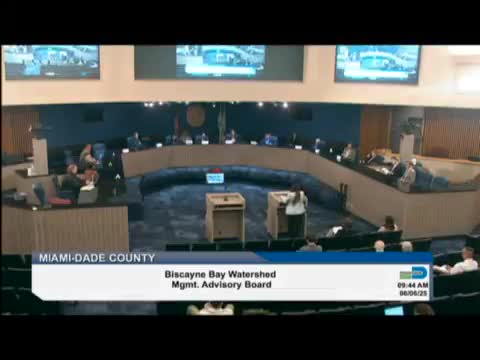
County staff reported hydrological and water-quality model construction, stakeholder engagement, a project verification tool and a summer deadline for municipalities to submit projects as part of the Reasonable Assurance Plan (RAP) to reduce nutrients in Biscayne Bay. Staff said a draft RAP is on track for summer 2026 submission to the state.
County staff presented technical progress on the Biscayne Bay Reasonable Assurance Plan (RAP), reporting that the hydrologic and coupled water-quality model has been constructed, calibration and validation are underway, and project verification tools have been created to help municipalities submit candidates for credit under the RAP.
Pamela (county project lead) told the advisory board that the model integrates groundwater and surface water — a configuration the team said fits Miami‑Dade’s porous limestone hydrogeology — and that the modeling team (GHD with ESA coordination) will run calibration and validation over the coming months. A dashboard has been produced to visualize historical conditions and to help staff explore potential target conditions that could represent a healthier Biscayne Bay.
The county said project identification work is advancing with assistance from Tetra Tech and other consultants. Staff has circulated a “project verification” checklist based on state guidance; municipalities and other stakeholders were asked to submit projects dating back to 2017 and to include near-term (5–10 year) plans. Staff emphasized that the state may award credit for certain past projects and that municipalities should think broadly about stormwater and wastewater improvements, including catch basin maintenance, street sweeping, and oversight of industrial and construction activities when those actions can be demonstrated to reduce nutrient loading.
Pamela also described the RAP timeline: an internal county draft to be completed in 2025 and a final submission to the state in 2026, with ongoing coordination with the Florida Department of Environmental Protection and the U.S. EPA. Board members asked about enforcement, municipal compliance, the role of the South Florida Water Management District, and near-term budget implications; staff said the plan would become an order of the DEP secretary and that integration with stormwater permitting and municipal ordinances was being explored.
Staff said the RAP will include monitoring and adaptive management provisions, and that staff plans to convene regular stormwater roundtables to share data and address implementation barriers such as funding or contracting delays. A summer deadline for municipal project lists was noted; staff said they will present more technical detail at a subsequent meeting when consultants are available.