Get Full Government Meeting Transcripts, Videos, & Alerts Forever!
Get email alerts on the Public Arts topic
No spam. Unsubscribe anytime.
Public pushes Austin council to favor local artists for AUS airport art; multiple art contracts approved on consent
Summary
Public commenters urged the council to reject or rethink several art contracts for the Austin-Bergstrom International Airport expansion, saying the selections favored out-of-state artists and failed to prioritize Texas-based creators; the council approved multiple airport art contracts on the consent agenda.
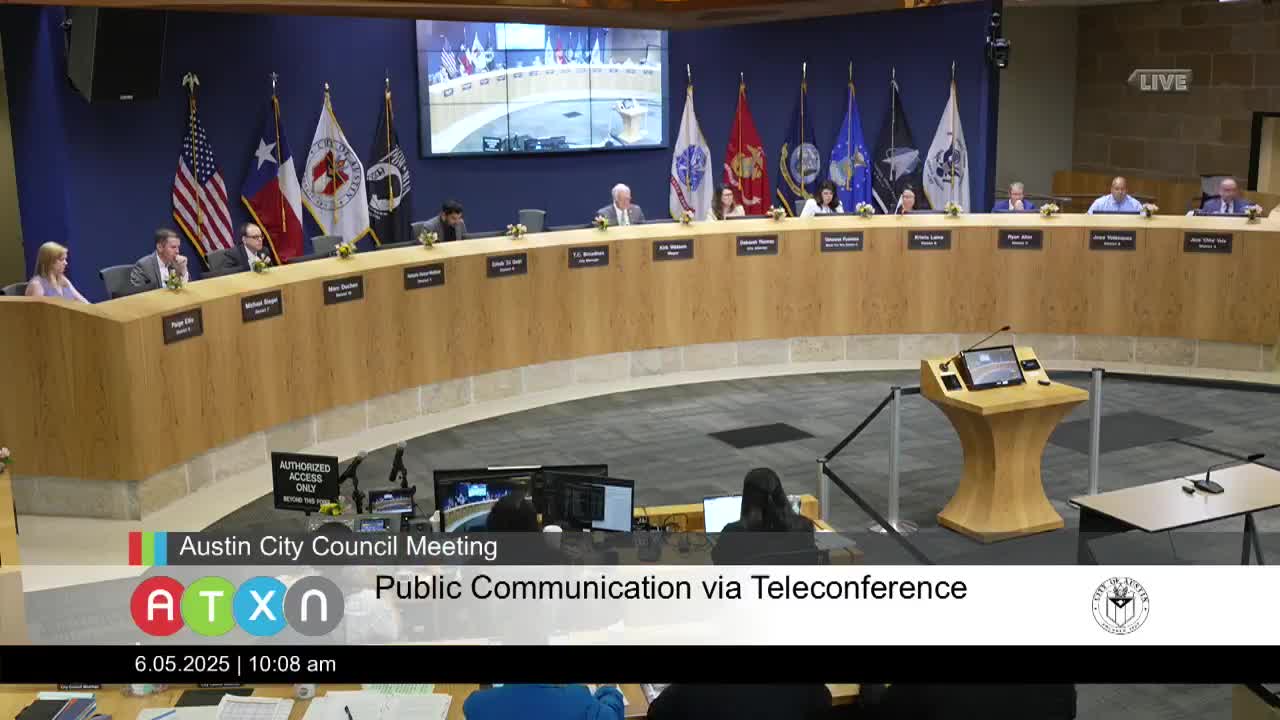
Several residents and arts advocates urged the Austin City Council on June 5 to prioritize Texas-based artists for a set of airport art contracts tied to the ABIA expansion. Public testimony focused on multiple consent items that award art contracts for the airport tunnel and pedestrian areas (agenda items 1–10 and related items).
Jennifer Robichow, who called in remotely, told council: “I speak for thousands of Austinites opposing the $5,800,000 contract to Saya Wolfolk, a New York–based artist, for the ABIA tunnel art project. I urge you to reject this contract and prioritize local artists to reflect our city’s values and keep taxpayer dollars here.” Robichow and several other speakers argued that selection panels used limited-entry procedures that produced out-of-state winners and that the city should follow the Art in Public Places master plan and prioritize Texas residents, especially for high-profile permanent installations that will greet millions of travelers.
Other speakers urged support for locally based artists in phase‑specific contracts: one commenter supported a Texas-based artist (Gil Rocha) for the $1,000,000 departures ticketing installation, while criticizing other selections. Speakers also raised process questions — suggesting more public input and transparency in open-call procedures for high-visibility public art.
Council action: the related art and contract items were part of the consent agenda and were approved as part of the council’s consent vote earlier in the meeting. No council member placed the items on the regular agenda for separate debate; several speakers urged the council to ask staff and the Arts Commission to prioritize local artists in future procurements.
Why it matters: The airport art program is a high-profile use of public funds that shapes visitors’ first impression of the city and distributes public-art contracting dollars. Commenters framed their request as both cultural (keeping “Austin’s identity” through local creators) and economic (keeping public dollars local to support Texas artists and arts jobs).
Ending: Council approved the airport art contract items on consent; several public commenters asked the council to revisit procurement rules and the Art in Public Places review process so future airport artwork better reflects and benefits Texas-based artists.