Get Full Government Meeting Transcripts, Videos, & Alerts Forever!
Get email alerts on the Land Use Zoning topic
No spam. Unsubscribe anytime.
Howard County Board of Appeals finds it has jurisdiction to consider Charles Saperico’s go‑kart track conditional‑use application
Summary
The Howard County Board of Appeals voted unanimously on June 10 to proceed to a full conditional‑use hearing on a privately built go‑kart track, finding the board has jurisdiction to consider whether the track qualifies as an "outdoor athletic facility."
The Howard County Board of Appeals voted unanimously on June 10 to proceed to a full conditional‑use hearing on a privately built go‑kart track, finding the board has jurisdiction to consider whether the track qualifies as an "outdoor athletic facility." The board’s decision clears a single legal threshold that will let parties present evidence on the merits at a later date.
The vote matters because it decides whether the panel can hear the applicant’s request that the paved go‑kart course on an 11‑acre property be approved under the zoning regulation that permits outdoor athletic facilities as a conditional use in rural/residential districts.
At a hearing that lasted several hours, the board focused on the narrow legal question: does the proposed track qualify as an “athletic field” or other listed outdoor athletic facility under Howard County’s zoning code? The petitioner, Charles Saperico, and his witnesses argued that karting is a sporting activity and that the prepared track is the kind of land an athletic facility definition is meant to cover. Opponents and county staff argued that the zoning list of permitted conditional uses does not explicitly include motorized tracks and that prior county decisions treated similar uses as non‑accessory or regulated commercially.
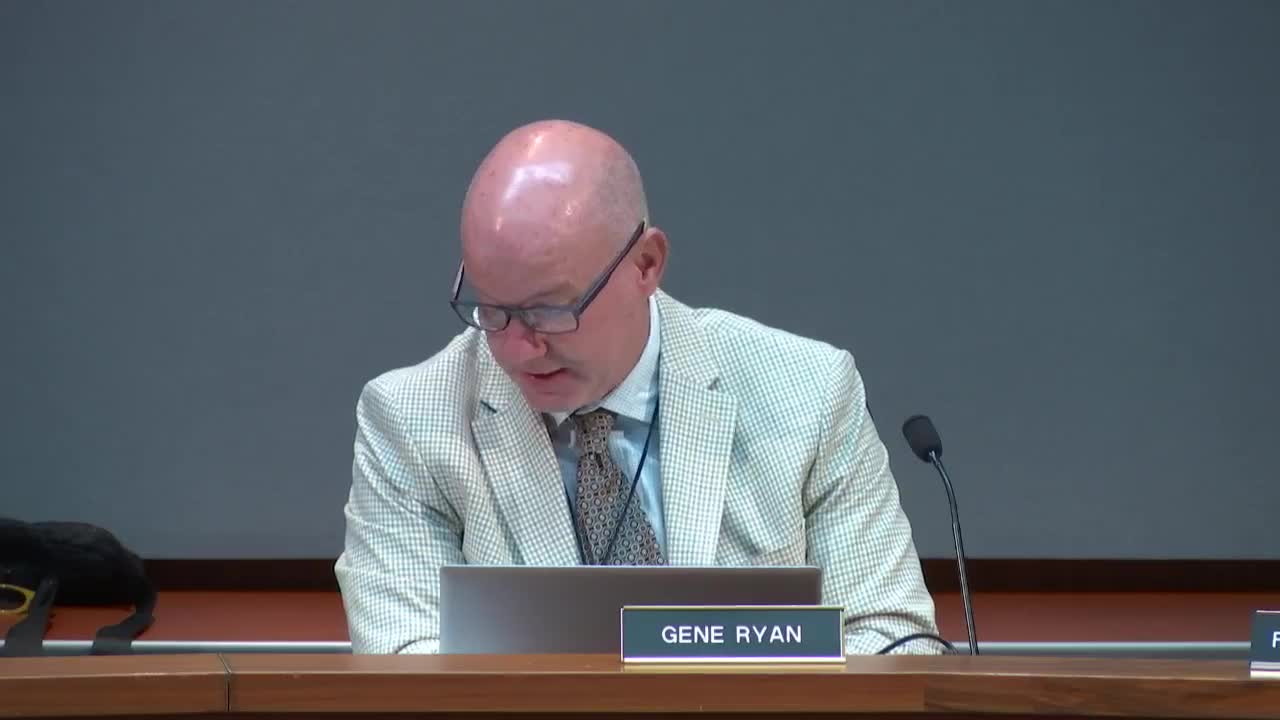
“Good morning. Today is 06/10/2024. This is a scheduled session of the Howard County Board of Appeals,” Chair Gene Ryan began the session, and he framed the day as a continuation of BA‑24‑022‑C, the Saperico conditional‑use matter. The hearing included sworn testimony from Joseph Rudder, a planning consultant and former director of Howard County Planning and Zoning, who told the board that in his view go‑kart racing “is very clear ... any kind of racing is a sporting activity.” Rudder said the proposed track — a paved loop occupying roughly a little over an acre of an 11‑acre parcel — could be considered an outdoor athletic facility subject to conditions the board could impose.
Petitioner Charles Saperico told the panel his son is training to be a professional racing driver and that he built the facility because there were no local practice options: “My son wants to be a professional driver, so there's nowhere local to practice,” Saperico said. Saperico acknowledged he did not obtain a grading permit before construction and that county enforcement issued a notice and court citations for grading and related violations; the court deferred one zoning question to the Board of Appeals.
Opponents, represented by counsel Mason Nelson, urged the board to dismiss the appeal on the legal ground that the proposed use is not eligible for the conditional‑use category listed in the code. “The hearing examiner’s decision and order is contrary to law. The Board of Appeals has original jurisdiction for the proposed conditional use,” Nelson said, arguing that the zoning text lists specific examples after the phrase “outdoor athletic facilities” and that a motorized go‑kart track was not among them.
Board members spent extended time addressing legal standards for interpreting zoning text. The panel considered whether the phrase “athletic fields” and the accompanying list in section 131.N.6 of the zoning code is broad enough to include a paved go‑kart training track. Petitioners offered a dictionary‑style definition admitted into the record, and three racing professionals called as witnesses — including Rafael Matos and Zachary Clayman DeMello — described karting as a physically demanding, competitive sport and explained how karting functions as driver training for higher‑level auto racing.
After deliberation, the board voted 4‑0 that it does have jurisdiction to hear the conditional‑use application — a finding that allows a full evidentiary hearing on the merits. The roll call recorded Chair Gene Ryan, Ms. Faircup, Ms. Phillips and Ms. Harris voting yes.
Votes at a glance: The board approved two formal items during the meeting. First, members approved the prior meeting minutes by motion (moved by Ms. Faircup; seconded by Ms. Phillips). Second, the board voted 4‑0 to find it has jurisdiction to consider BA‑24‑022‑C (yes: Chair Gene Ryan; Ms. Faircup; Ms. Phillips; Ms. Harris).
What happens next: Because the panel has found it has jurisdiction, the case will return for a full conditional‑use hearing limited to the zoning criteria listed in section 131.N.6, including the board’s ability to impose conditions addressing hours, vehicle type, noise, and other impacts. The board set the next hearing date to continue the matter (scheduled in the record for June 26). If the board ultimately finds the track meets the conditional‑use criteria for an outdoor athletic facility, the board may grant approval with conditions intended to limit offsite impacts; if it finds the criteria are not met, the application will fail.
The hearing repeatedly returned to two practical points: (1) the county code section governing operation of certain vehicles on private property (Howard County Code §21.313) permits operators to run minibikes or go‑karts on property they own, subject to noise limits and neighboring consent when required; and (2) separate technical and safety regulations for commercial karting facilities (COMAR provisions) apply to commercial, public operations and differ from a private, family‑use track. Those distinctions framed witness testimony and the board’s line of questioning.
The June 10 session leaves several unsettled items to be developed at the merits hearing: precise noise modeling and mitigation, whether the proposed conditions will be adequate to limit offsite disturbance, and whether the board’s interpretation of “athletic field” under the county code is satisfied by the specific layout, scale and use restrictions the petitioner offers. The board’s jurisdictional vote means those questions will be considered at the next hearing, where the parties may offer additional evidence and live testimony.