Get Full Government Meeting Transcripts, Videos, & Alerts Forever!
Get email alerts on the Budget Deficit topic
No spam. Unsubscribe anytime.
National City projects $8.2 million general‑fund shortfall; officials press choices on reserves and pension costs
Summary
City finance staff told a budget workshop the city faces a roughly $8.2 million deficit for the coming fiscal year driven by rising pension UAL payments, higher insurance and transfers out; staff outlined one‑time options and warned reserves are finite.
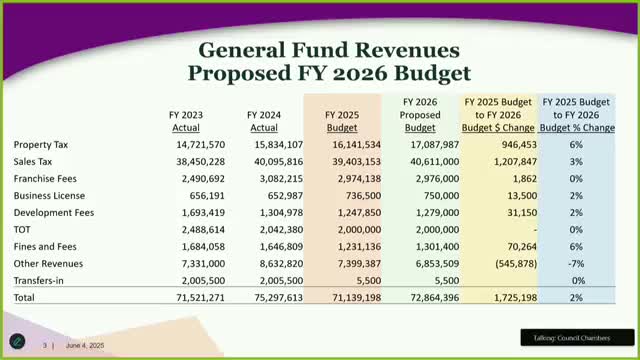
National City finance staff told the council during a lengthy budget workshop that the city faces a projected general‑fund deficit of about $8.2 million for the next fiscal year, driven primarily by rising pension unfunded actuarial liability payments, increases in insurance premiums and larger transfers to other city funds.
Finance Director Bruce said the city is "looking at a deficit of 8,200,000.0 for next fiscal year." He told the council that several structural items are increasing operating costs: CalPERS unfunded actuarial liability (UAL) payments are rising, the city’s general liability and workers' compensation premiums are growing, and planned transfers out — including a new transfer to a capital‑improvement fund — are larger than in prior years.
The projected shortfall follows a multi‑year revenue pattern that included temporary federal ARPA transfers in 2023–24 that are no longer available. "We have never recovered from the revenue that we were receiving in 2024," Bruce said, describing how ARPA inflows boosted past years' general‑fund totals. The proposed 2026 budget includes a new $1.0 million transfer from the general fund to a capital improvement project (CIP) fund and $4.8 million in transfers to cover pension obligation bond (POB) debt service previously embedded elsewhere in the budget.
Why it matters: staff framed most of the shortfall as an outcome of one‑time revenue changes and unavoidable recurring cost increases. The city’s pension contributions, set by CalPERS actuarial valuations, are expected to rise substantially over the coming years — Bruce said citywide UAL payments will be roughly $3.0 million and the general‑fund portion is roughly $2.5 million in the next fiscal year — and those obligations will grow in subsequent years. At the same time, other funds that historically received subsidies from the general fund are asking for continued support.
Budget detail and tradeoffs: staff presented a multi‑year outlook showing revenue gains of roughly $1.7 million next year from property and sales taxes but explained those increases do not offset the larger structural costs. Other revenue items highlighted included an expected $500,000 from new cannabis receipts and a projected $200,000 decline in interest income due to lower rates and smaller investable balances. Franchise fees fluctuated with SDG&E energy prices; staff noted 2024 was an anomaly when energy prices were high.
Reserves and policy options: the finance presentation showed the city would remain above its 10% minimum unassigned fund balance under current projections but warned that using reserves to fill ongoing operating gaps would be imprudent. Staff recommended considering targeted one‑time uses (for example, seed money for predevelopment work) while preserving reserves for unforeseen shocks and for planned pension trust contributions. Bruce described a $2.5 million proposed transfer to the pension trust to help cover near‑term pension risk; if that transfer and the projected deficits materialize the city’s unassigned balance would fall substantially by the end of the next fiscal year.
Council reaction and next steps: councilmembers pressed staff for detail on vacancy savings, prior mid‑year CIP reductions, and the timeline for updated CalPERS numbers (actuarial valuations arrive with a two‑year delay). City staff said they aim to return with a refined budget for adoption at the second June council meeting if possible and urged caution about relying on one‑time reserves for ongoing costs. City manager Scott told the workshop staff hopes to bring a final proposal to the council for adoption in mid‑June.
Ending: Finance staff emphasized the options are difficult but finite: either find ongoing new revenue, cut ongoing services, or use one‑time balances while pursuing revenue‑generating projects and efficiency changes. "This money is one‑time money," a finance presenter warned when discussing reserves and ARPA proceeds.