Get Full Government Meeting Transcripts, Videos, & Alerts Forever!
Get email alerts on the Curriculum topic
No spam. Unsubscribe anytime.
Darien curriculum team outlines spring revisions, expands EduPlanet access and UDL work
Summary
District curriculum leaders presented a spring update on June 4, outlining a seven-year curriculum revision cycle, an EduPlanet expansion to broaden access, and continued work to embed Universal Design for Learning across grades K–12.
District curriculum leaders told the Darien Board of Education curriculum committee on June 4 that the district is advancing a multi-year curriculum revision schedule, expanding the EduPlanet platform to make curricular documents widely accessible, and integrating Universal Design for Learning (UDL) principles into stage-based curriculum development.
The update, led by district curriculum staff with department chairs present, summarized work completed in fiscal year 2025 and outlined priorities for the 2025–26 cycle, including stage 1 (big-picture design), stage 2 (daily learning activities) and stage 3 (assessments). “We set as a priority for our new budget cycle for FY26 an expansion of EduPlanet,” a district leader said, noting that previously only curriculum writers had access and that broader access will support consistent instruction across schools.
Why it matters: District staff said the combination of a seven-year revision cycle, an accessible curriculum platform and embedded UDL signals the district’s intent to make curriculum documents living resources, improve alignment across grades K–12 and provide teachers with clearer guidance and shared resources.
Key takeaways from departments - World Language: Scott Webster said the department established four national language honor societies this year, had pending Seal of Biliteracy results (42% of seniors), and is expanding Mandarin sections at the high school. The department also reported strong AP language results and proposed cultural trips for students. - Mathematics: Ronnie Rogier and the math team emphasized deeper-thinking routines, co-teaching models and task-based assessments. The department highlighted student successes at math competitions and an expanded bridge program between MMS and DHS. - Science: Christian Dockum described expanded performance-based assessments (e.g., patient-facing explanations of mitotic disorders, calorimetry escape rooms) and increased STEM outreach; the ASR independent research program and Science Olympiad participation grew this year. - Career & Technical Education (CTE): Frank Darren described growth tied to a newly awarded Perkins V grant, expanded experiential field trips, DECA and TSA competitive successes, and hands-on industry projects in the woodworking, automotive and sports-marketing classes. - Visual and Performing Arts and Library Media: Leaders reported festival awards, exhibitions, and stronger library programming and resources to support literacy and digital tools.
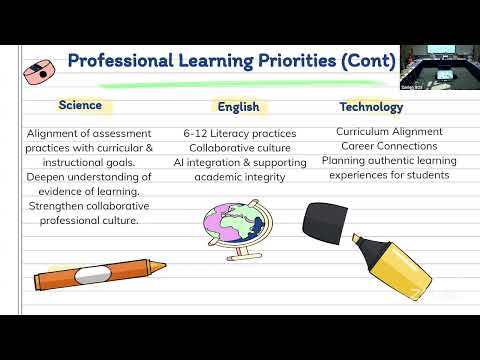
Platform, UDL and professional learning District leaders said EduPlanet will be used to publish stage 1 curriculum blueprints to the public and provide teachers and administrators inside access to stage 2 and 3 materials. The platform will also be customized to highlight UDL standards and support systematic professional learning so teachers can collaborate throughout the year rather than concentrating writing in a four-week period.
Implementation and continuity Staff said most departments draft materials in Google Docs before publishing to EduPlanet; the district retains department-level PDFs as backups. Department chairs described summer work plans to advance stage 2 and stage 3 items and to continue cross-grade articulation.
Next steps Staff will continue curriculum writing through June and remain active over the summer, with the board to receive follow-ups on specific departmental plans and implementation data in the year ahead.
Ending note: The presentation emphasized systemwide alignment—K–12 standards, performance tasks and professional learning—while noting continued work on UDL implementation and AI guidance for classroom use.