Get Full Government Meeting Transcripts, Videos, & Alerts Forever!
Get email alerts on the Public Safety Police Fleet topic
No spam. Unsubscribe anytime.
San Marcos council hears presentation on police take-home vehicle program and proposed fleet surcharge for secondary jobs
Summary
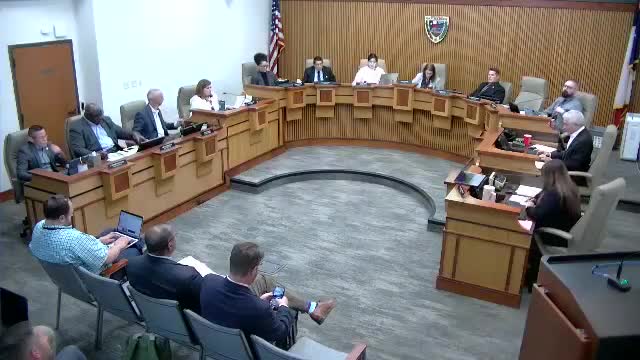
San Marcos Mayor Jane Heesen and the City Council heard a staff presentation June 3 on the police department's take-home vehicle program and a proposed surcharge for use of city vehicles during officers' secondary employment.
San Marcos Mayor Jane Heesen and the City Council heard a staff presentation June 3 on the police department's take-home vehicle program and a proposed surcharge for use of city vehicles during officers' secondary employment.
The presentation, led by Police Chief Stan Standridge, reviewed the department's long-standing take-home policy (in use since 1983), examples of officers responding while in assigned vehicles, operational benefits such as faster response to in-progress incidents, and financial and parking constraints if the council were to end the program. Standridge told the council there are currently 108 assigned take-home vehicles and 164 parking spaces at the department; after accounting for disabled spaces, reserved public spaces and special-purpose stalls, staff calculated a shortfall if all vehicles were required to remain at the department.
Chief Standridge described callout and ancillary responsibilities that rely on rapid officer availability, including SWAT, crisis negotiation, drones, robotics and K-9, and gave multiple officer accounts in which an officer in a take-home car responded immediately to in-progress incidents. He also described periodic costs and operational impacts such as an increased need for vehicle replacement under a hot-swap (shared-vehicle) model and a change in hail-coverage terms that now would require the city to pay a separate deductible per damaged vehicle.
As a fiscal measure, staff proposed a fleet surcharge to recoup wear, idling and replacement costs for vehicles used in secondary employment. The proposed rates presented to council were $6.80 per hour when a city vehicle is actively used for secondary employment (modeled on a full‑size rental-SUV rate with a government discount) and $3.40 as a one‑time commute fee when the officer uses the vehicle only to travel to a secondary shift but the vehicle is not required during the assignment.
Staff explained administrative implementation would be built into payroll so officers would remit the surcharge via their pay entries. Chief Standridge and finance staff said existing vehicle fuel and mileage logs (fuel transactions recorded via the WEX system and mileage captured at fueling, and Cradlepoint GPS when vehicles are powered on) would allow complaint-driven audits and retrospective verification of vehicle location and usage.
Council members asked detailed questions about mutual-aid arrangements (Hays County's joint staffing of SWAT, negotiators and shared CAPCOG assets such as a regional robot), whether drones and robotics are city-owned or shared, policy cross-references for vehicle use (staff cited city policy 7.14 for vehicle operations and policy 4.6 for secondary employment), and insurance exposure. City staff and the city attorney said liability and workers' compensation depend on whether an officer takes official law-enforcement action; staff stated that when an officer takes official action they are covered as on-duty and that the department communicates that officers must prioritize city duties over secondary employment.
Council reaction was mixed in the discussion: several members said they supported adopting a surcharge and asked staff to prepare a formal operational policy; at least one council member expressed opposition to charging officers. Council consensus at the end of the discussion was to instruct staff to draft a specific secondary-employment/take-home-vehicle operational policy that: (1) codifies the proposed $6.80/$3.40 surcharge with annual review, (2) incorporates clearer rules about officers' obligations when they are working secondary employment, (3) uses Cradlepoint/AVL and fuel/mileage logs for complaint-based audits, and (4) returns to council in a future work session for review. Staff said they would circulate the draft to council when ready and return it for a work session review (staff indicated the policy would be reviewed annually for fee adjustments and that the implementation mechanism would be via payroll entries).
No formal ordinance or fee was adopted at the meeting; council members provided direction to staff to draft and circulate the policy for council review and to bring it back at a future work session.
Ending: Council directed staff to prepare a formal operational policy and fee process, circulate the draft to council for review, and return with the draft policy at a future work session for possible adoption and implementation.