Get Full Government Meeting Transcripts, Videos, & Alerts Forever!
Get email alerts on the Telecom Small Wireless topic
No spam. Unsubscribe anytime.
Council adopts design standards and ordinance for small wireless facilities, adds 75-foot spacing condition
Summary
Saratoga Springs adopted amendments to City Code Title 8.05 to add small wireless facility design standards, application procedures and installation specifications. Council added a condition requiring freestanding multi-carrier poles to be at least 75 feet from existing light posts; the ordinance passed unanimously.
Saratoga Springs City Council on Tuesday adopted amendments to the city code (Title 8.05) establishing design standards and an application process for small wireless facilities in the public right-of-way, and approved Ordinance 25-45 with an additional spacing condition for freestanding poles.
Sarah, a city staff presenter, told the council the amendment implements small wireless facility design standards to align the municipal code with state law and to set local aesthetic standards. The staff presentation defined four installation types: Type 1 (attachments to existing wooden utility poles in the public right-of-way), Type 2 (co‑located 4G/5G antennae on streetlight poles), Type 3 (freestanding single-carrier poles in areas where utilities are required to be underground), and Type 4 (larger multi-carrier freestanding poles).
Council members discussed the limits imposed by state law, circumstances when the city can require equipment be placed on an existing light pole rather than a new freestanding pole, and minimum separation standards. Staff outlined specific distances included in the design standards: 15 feet from trees, 15 feet from fire hydrants, and a 25-foot (city standard) radial separation from certain poles; more significant separations apply to freestanding multi‑carrier poles (250 feet radial separation from other type‑3 installations) and a requirement that providers not add more than one additional such installation per 200 feet. Staff also said the state statutory provisions apply only on qualifying roadways (the presentation cited a 62‑foot curb‑to‑curb roadway threshold to qualify under state law).
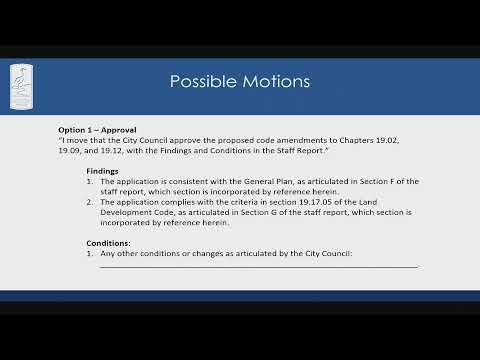
During the council discussion, one councilmember moved approval of the amendments and added a condition increasing the minimum separation between a freestanding pole and existing light posts from 25 feet to 75 feet; Councilman Karn seconded that motion. The council voted and the ordinance (identified in the meeting as City Ordinance 25‑45 dated the day of the meeting) with staff findings and the additional 75‑foot spacing condition passed unanimously.
Staff said an accompanying master lease agreement with any provider will be required under state law; staff told the council that the lease would give the city authority to remove equipment if the provider fails to maintain service or allows equipment to fall into disrepair. The staff presentation noted that design guidelines (to be posted on the city website under standards and specifications) will follow adoption and that a separate provider agreement will be negotiated and recorded.
No litigation, budget figures or implementation timetable were attached to the ordinance in the meeting record; staff indicated there will be a future step to execute provider agreements and master leases.