Get Full Government Meeting Transcripts, Videos, & Alerts Forever!
Get email alerts on the City Budget topic
No spam. Unsubscribe anytime.
Carmel-by-the-Sea council adopts $34.9 million budget, approves $45 million appropriations limit
Summary
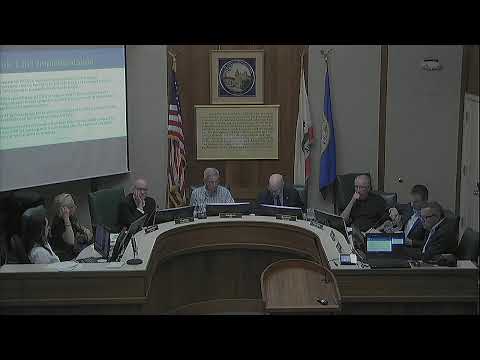
After extended discussion about deferred maintenance, capital projects and reserves, the Carmel-by-the-Sea City Council adopted the FY2025–26 operating and capital budget and approved the city's annual appropriations (Gann) limit.
The Carmel-by-the-Sea City Council on June 3 approved a fiscal 2025–26 operating and capital budget that projects $34.9 million in revenue and adopts an appropriations limit of $45,000,081,158.
City Finance staff and council members spent more than two hours discussing the city's capital-improvement plan (CIP), fund balance and how to deliver a long list of deferred maintenance and projects without overstretching reserves. Staff recommended using $4.9 million of fund balance to cover CIP spending this year and noted the proposed operating budget of $31.9 million represents roughly 91.6% of projected revenues, slightly over the city policy target of 90%.
The adopted budget includes $7.8 million in CIP for the coming year, on top of roughly $3.9 million carried forward from prior years. Staff and council highlighted the beach and facilities packages, street repairs and a multi-year tree maintenance and stump-removal program as top items. Staff said combined CIP carryover and new projects could produce total CIP spending near $11.4 million this fiscal year if everything is completed.
Council members and staff flagged three practical risks: (1) capacity to manage and deliver a long CIP list with a limited project-management team; (2) the size of liabilities and deferred maintenance that have not yet been fully quantified; and (3) the potential for rapid erosion of reserves if multi-year capital needs are fully funded without new ongoing revenue sources.
City Administrator Chip and department directors told council they plan to add a second project manager or use outside consultants to increase delivery capacity. Finance staff said the city's ``rainy day" reserve will be roughly $15.7 million at year-end, with about $14 million of unassigned fund balance available for CIP or other priorities after required and restricted balances are set aside.
Council members pressed staff to return with a clearer delivery plan, more frequent project-status reporting and to prioritize urgent safety-related projects such as the Fourth Avenue outfall and key drainage work. Several council members also urged attention to the long-term estimate for unidentified facility and infrastructure needs, which staff earlier estimated could be in a broad range that would require additional multi-year planning.
Votes at a glance
- Resolution adopting FY2025–26 appropriations limit (Gann limit): motion carried; roll-call vote recorded as Yes from Councilmembers Barron, Bueter, Delves, Germov and Mayor Byrne.
- Resolution adopting FY2025–26 operating and capital budget: motion carried; roll-call vote recorded as Yes from Councilmembers Barron, Bueter, Delves, Germov and Mayor Byrne.
What happens next
Staff will return with quarterly financial reports and more detailed CIP delivery schedules, and council directed staff to proceed with the adopted budget while monitoring revenues and project progress. Council members also asked that staff present options to reduce or defer lower-priority CIP items if delivery capacity or revenues fall short.
Context
Finance Director Jamie and project staff said the city relies on three major revenue sources '1 sales tax, property tax and transient-occupancy tax '1 for roughly 82% of general revenue. Staff reiterated the city is budgeting conservatively on revenue forecasts and continuing work to better quantify long-term liabilities and deferred maintenance so future budgets can be balanced with ongoing revenues.