Get Full Government Meeting Transcripts, Videos, & Alerts Forever!
Get email alerts on the Budget Fy2026 topic
No spam. Unsubscribe anytime.
Territory’s FY2026 executive budget: proposed $936.4 million general fund, officials warn federal uncertainty could alter plans
Summary
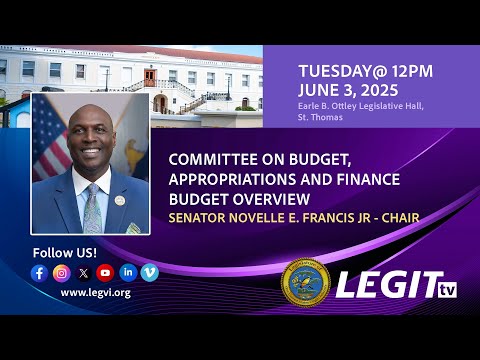
The government’s financial team presented the proposed fiscal year 2026 executive budget on June 3, 2025, proposing a $936.4 million general fund and flagging large federal disaster grants, fiscal uncertainty from Washington and conservative revenue assumptions.
The Committee on Budget, Appropriations and Finance heard an overview of the Government of the U.S. Virgin Islands’ proposed fiscal year 2026 executive budget on June 3, 2025. Julio Reimer, director of the Office of Management and Budget, told the committee the proposal includes a general fund of $936,426,140 and takes a conservative approach because of federal and global uncertainties.
The budget matters because federal grant rules and disaster recovery funding will drive large swings in territory revenue and spending. “This is not a quick or easy process. It’s a marathon and not a sprint,” Julio Reimer said, urging caution as the territory calibrates revenues and allotments amid shifting federal rules.
Key projections in the administration’s presentation: individual income tax collections are projected to decline roughly 2% (from about $423.4 million in FY25 projections to about $414.1 million for FY26); corporate collections are projected to fall about 5% (from about $78.8 million to $74.8 million); real property tax receipts are forecast to rise about 2.5% (from $64.0 million to $65.6 million); gross receipts tax collections are forecast to increase about 3% (from $213.8 million to $220.2 million); and excise taxes are forecast to rise about 1.5% (from $36.4 million to $37.0 million). The administration reported gross-revenue collections of roughly $1,028,803,846 in its FY26 outlook.
Reimer’s presentation flagged a substantial projected increase in federal grant availability compared with FY25, driven by disaster recovery and mitigation dollars. The Office of Disaster Recovery expects a sizable amount of those funds to be obligated and spent in FY26, and OMB counted those federal flows in its all-funds outlook. The administration also described an all-funds spending plan in the mid-to-high billions range and characterized the FY26 plan as conservative to avoid overstating revenue.
Several other figures highlighted by the administration: a government-wide net available cash balance of roughly $75 million (about $59.7 million in the general fund and $15.3 million in special funds), an outstanding line-of-credit balance of about $89.8 million as of April 30, 2025, and a budget stabilization fund balance of $11 million. The administration said it aims to add at least $5 million annually to the stabilization fund going forward.
Why this matters now: Reimer and other witnesses repeatedly emphasized that the territorial budget is exposed to shifts in federal grant eligibility and federal agency pauses or rule changes. “Overall, due to the uncertainty, we must remain adaptable both to the challenges and opportunity in a federal grant environment with an aggressive approach to expend all funds in a compliant and timely manner,” Reimer said at the end of his overview.
The committee asked departmental and agency leaders to return with additional detail and documentation; lawmakers and the administration signaled multiple follow-up hearings this summer to refine revenue assumptions and review implementation plans for federal awards.