Get Full Government Meeting Transcripts, Videos, & Alerts Forever!
Get email alerts on the Homelessness And Public Safety topic
No spam. Unsubscribe anytime.
Village interagency task force coordinates agencies and community groups to address Washington Square Park 'red zone'
Summary
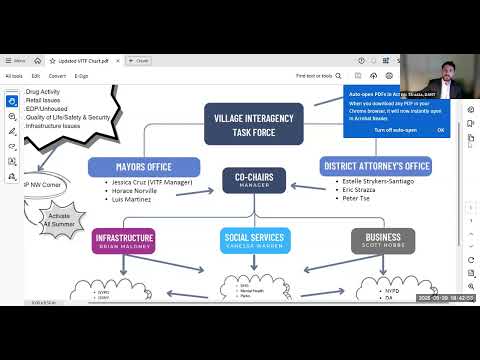
The Village Interagency Task Force (VITF), a neighborhood-level interagency "hub" supported by the Mayor's Office and the Manhattan District Attorney's Office, told the Community Board 2 Human Services Committee at its May meeting that it is coordinating agencies, outreach providers and resident co-chairs to address concentrated drug use, discarded needles and encampments around Washington Square Park.
The Village Interagency Task Force (VITF), a neighborhood-level interagency "hub" supported by the Mayor's Office and the Manhattan District Attorney's Office, told the Community Board 2 Human Services Committee at its May meeting that it is coordinating agencies, outreach providers and resident co-chairs to address concentrated drug use, discarded needles and encampments around Washington Square Park.
VITF co-chairs and the Manhattan DA's community engagement team described a two‑track meeting structure that separates infrastructure problems (scaffolding, sanitation, street furniture) from individual-level outreach (mental health, substance use, homelessness) and said the model is intended to reduce agency "siloing." "My name is Eric Sjrazza. I am the supervisor of community engagement for the Manhattan DA's office," said Eric Sjrazza, describing the model's origins and how it is run in practice. Community co-chairs Brian Maloney and Vanessa Warren introduced themselves and the community-driven aspects of the effort: "I'm Brian Maloney. I'm a cochair for what we call VITF for short," and "I'm Vanessa Warren. I'm also a cochair," they told the committee.
Why it matters: committee members and VITF leaders said the intersection of substance use, mental-health conditions and homelessness has produced concentrated public-safety and quality-of-life impacts for nearby residents and businesses. VITF co-chairs reported targeted, place-based work in a so-called "red zone" centered on the northwest corner of Washington Square Park and extending into adjacent blocks. Committee members pressed for clarity on scope, accountability, data sharing and how residents can report problems and see follow-up.
How the hub works: VITF members said the model grew from an earlier pilot on 120 Fifth Street and midtown efforts. The task force meets frequently (co-chairs described biweekly or "every two weeks" meetings for different topic tracks), and meetings are closed to the public so agency leaders and outreach teams can discuss confidential individual cases and operational solutions. VITF leaders said the Mayor's Office brings higher-ranking agency staff to meetings so participants can make and test operational decisions quickly; they emphasized that the task force is not a line item in the mayor's budget and is primarily a coordination mechanism that sometimes surfaces potential funding needs.
Scope and priorities: co-chairs and DA staff described two regular meeting tracks: infrastructure (DOT, DOB, DEP, building/scaffolding issues and sanitation) and human services (outreach, shelter placement, treatment referrals). The task force maintains a granular punch list of infrastructure items assigned to agencies for follow-up and, in social-services meetings, confidential lists of individuals who are the focus of outreach. VITF members described the geographic footprint as roughly the Washington Square Park area and adjacent blocks (streets mentioned in committee discussion included Third, Fourth, Washington Place, Waverly Place, Eighth Street and Ninth Street). The group said it has designated a core "red zone" around the park and a surrounding "yellow zone" where displacement can produce spillover effects.
Reported results and limits: VITF co-chairs and city representatives described some measurable results and remaining constraints. The task force reported removing large amounts of drug-related debris in the park and said approximately 2,800 needles have been collected in the park area since January, according to the community co-chairs. Members also told the committee that the Department of Homeless Services and other outreach partners had placed about 42 people into shelter or housing through task-force efforts in recent months. At the same time, VITF participants cautioned that inpatient detox capacity, intake requirements (photo ID, Medicaid coverage) and the limited number of long‑term safe-haven beds constrain how many people can be connected to sustained services. Committee members and VITF staff emphasized that outreach and coordination can increase referrals and placements, but resource limits in the broader system remain a barrier.
Community input and reporting: co-chairs described neighborhood organizing as a central input into the task force. Community groups maintain WhatsApp "neighborhood action groups" (NAGs) to collect addresses, photos and 3‑1‑1 complaint details; VITF leaders said they aggregate those community reports and put high‑priority items on the task-force punch list. The co-chairs said they have multiple NAGs across the village and a central mailing list (the co-chairs reported "about 303" addresses on their email list and a larger set of block-level NAG groups). Committee members asked whether 3‑1‑1 reports made outside the NAG channels receive equal attention; VITF and city staff said 3‑1‑1 remains an important pipeline but that the task force seeks to supplement ordinary 3‑1‑1 handling by surfacing specific complaints directly in meetings.
Transparency and public involvement: VITF leaders said meetings are intentionally closed to the public because participants frequently discuss sensitive individual-level information and confidential outreach case details; community input is funneled into the task force through the community co-chairs, Village Alliance and block-level NAG reporting. Committee members asked VITF to return to the board with periodic public updates; VITF co-chairs and DA staff agreed to provide regular reports and said they welcome the board's assistance in disseminating information about how residents can report problems.
Next steps: committee members suggested rotating board representation, periodic public briefings and broader outreach so residents who are not on WhatsApp lists can contribute 3‑1‑1 complaints and see follow-up. VITF leaders said they would continue their biweekly meetings, refine data flows with 3‑1‑1, and pursue extensions of pilot programs (for example, outreach partnerships between DHS and NYPD that the task force said had been piloted). The committee did not take a formal vote or pass a resolution at the meeting; members instead invited VITF to return to brief the board in a few months.
No formal motions or votes were recorded during the discussion.