Get Full Government Meeting Transcripts, Videos, & Alerts Forever!
Get email alerts on the Outdoor Dining Regulation topic
No spam. Unsubscribe anytime.
Manhattan CB2 panel presses DOT on ADA rules, issues conditional feedback on multiple outdoor-dining applications
Summary
At its May 28 meeting the Manhattan Community Board 2 Outdoor Dining Working Group heard public comment about sidewalk- and roadway-cafe applications, pressed DOT and FDNY on unclear clearance rules and voted to issue conditional approvals or denials for multiple sidewalk- and roadway-cafe applications pending plan revisions.
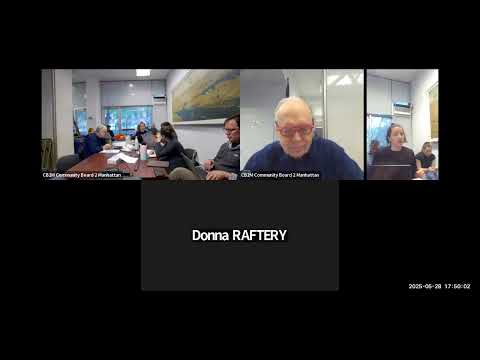
Valerie Delarosa, chair of the Outdoor Dining Working Group of Manhattan Community Board 2, opened the meeting May 28 by calling the group to order and reviewing the agenda of sidewalk- and roadway-cafe applications referred by the NYC Department of Transportation (DOT).
The meeting drew owners, lawyers and dozens of neighbors to question site plans submitted under the city’s newer outdoor-dining rules. Neighbors repeatedly flagged persistent obstructions, seating placed too close to residential building entrances and unclear measurement standards used by DOT, while applicants said temporary pandemic-era layouts and enforcement gaps have created confusion.
Why this matters
The working group’s opinions are advisory to DOT; nevertheless the group’s feedback matters because it documents neighborhood concerns, flags safety and ADA issues for DOT and FDNY reviewers, and can speed or delay applicants’ ability to open outdoor seating. Several applicants said that without clear written guidance from DOT they face added costs and uncertain timelines.
What the meeting covered
Public comments centered on pedestrian clearance, accessibility and enforcement. Pete Davies, a neighborhood commenter, told the committee he was “confused by the site plan” for Lucky Soho and said plans did not appear to show the required 5-foot clearance at adjacent residential doorways. Amanda, the general manager of Lucky Soho, told the committee outdoor dining was “really, really important to us” and said she would supply missing barrier photos and amend drawings.
Several long‑standing neighborhood concerns recurred. Kathy Arntzen, representing the Central Village Block Association, opposed a Bandits sidewalk cafe application, saying the small corner sidewalk “gets very chaotic” and noting the temporary program had led to recurring noise and crowding complaints. David Rosenberg and Susan Ginsberg, both residents, described repeated, on‑the‑ground violations at several locations and urged stronger enforcement.
Applicants described the practical challenges of meeting multiple agencies’ requirements. Rakesh Shandy Ramani, owner/operator of Vastia by Wine Bar (West Village), said he had removed tables that conflicted with residential entrances and that DOT was reviewing an updated plan. Harry Callahan, attorney for an applicant, told the committee the plans had been filed with DOT and were under review but acknowledged that site plans can change during agency review.
Committee discussion and direction
Board members focused on two recurring, technical disputes: (1) how DOT measures required clear pedestrian space — whether corridors should be 10 feet, 8 feet or, in constrained regional corridors, reduced — and (2) the 5-foot horizontal clearance DOT requires at primary residential entrances. Stella Fitzgerald and other members said DOT has sometimes provided inconsistent answers, leaving applicants and residents uncertain about what layout will meet agency review.
Members repeatedly urged clearer written guidance from DOT and FDNY about measurement points (e.g., to the back of curb versus curb joint), how to treat tree pits and subway grates in the required clear path, and whether certain temporary platform or rail structures used in the early pandemic program meet the new permanent rules.
Public-safety and enforcement themes
Committee members and public commenters said enforcement remains complaint-driven: DOT and other agencies have limited staff and rely on residents to file 311 or other complaints. Carter Booth said the working group should not be asked to “police” operators but suggested the city must improve proactive review and clear criteria to avoid gamesmanship by operators who test ambiguous limits.
Votes at a glance (committee referrals / final advisory recommendations recorded in the meeting)
Note: the working group issues advisory recommendations to DOT; DOT retains review and final permitting authority. The committee recorded motions and votes during business session; each line below lists the application, the committee motion and the requested plan change as recorded in the meeting minutes.
- Montes Trattoria, 97 McDougal St. — Committee approved a motion for a conditional denial with modifications: reduce roadway width where necessary, reflect manhole locations on the plan and supply trash/clearance plan; do not extend seating beyond stair/egress lines. (Committee vote: in favor)
- Lucky Soho (Little Lucky’s LLC), 224 Lafayette St. — Committee approved a conditional denial requiring applicants to show the 5-foot horizontal clear path at adjacent residential entrances, add the perimeter demarcation (lightweight removable barriers), and add or correct barrier photos. (Committee vote: in favor)
- GBI West Village LLC (Vastia / Wine Bar), 192 Seventh Ave S. — Committee requested revised drawing removing a round table that extended beyond the storefront corner, clarifying perimeter demarcation, and labeling the bike racks/manholes; applicants were asked to resubmit to DOT with corrected dimensions. (Committee vote: in favor of modifications)
- Bandits (Den NoHo LLC), 44 Bedford St. — Committee recorded substantial neighborhood opposition and voted to deny the sidewalk-cafe application in its current form because of repeated noncompliance and pedestrian clearance concerns; committee recommended the applicant refile with a compliant layout and barriers that meet the city standard. (Committee vote: in favor of denial)
- Turks and Frogs (roadway + sidewalk elements), 323 W. 11th St. — Committee asked applicants to confirm which storefront(s) the application covers (applicant indicated two adjacent businesses under the same ownership but separate food-service licenses) and to add standard ADA and demarcation items; committee recorded conditional approval pending corrected site plans. (Committee motion: modifications requested; committee vote: in favor)
- Shuka, 38 McDougal St. — Committee asked for corrected certificate‑holder name on application materials, to clearly show umbrella limits (no overhang beyond café perimeter), add a north arrow and confirm hours alignment with SLA where applicable; committee approved conditional feedback to DOT. (Committee vote: in favor)
- Mother’s Ruin, 18 Front St. (roadway + sidewalk) — Committee requested the applicant show the manhole on the site plan, provide the exact roadway dimensions and confirm clearance from the adjacent residential doorway; committee approved conditional modifications. (Committee vote: in favor)
- Other sidewalk/roadway applications (Rosetta Pizza, Sula Luna, Café Panino/Mucho Gusto, Papa D’Amore and others on the agenda) — the committee issued a mix of conditional approvals and denials tied to the same recurring items: correct marking of primary building entrances, ensure 5-foot clearances, remove tables that block egress or would intrude past the defined perimeter, annotate hydrants/manholes/Siamese connections and add boilerplate ADA compliance notes. (Committee motions: conditional approvals/denials; committee votes: in favor)
What the committee asked DOT and FDNY to clarify
- Exactly how DOT measures the required clear pedestrian path (to curb joint vs. curb face) and when regional corridor minimums allow an 8-foot or 10-foot path; committee members said written, consistent guidance is necessary. - Whether platforms and certain temporary or wooden barriers from the pandemic-era program meet the new permanent standards and what documentation (engineer sign-offs, weights, ballast specs) DOT will accept. - How FDNY is treating waivers for roadway dining where fire access and hydrant/Siamese connections are near proposed seating.
Quotes
- “This is the May 28, if you can believe it, outdoor dining working group meeting for Manhattan Community Board 2,” said Valerie Delarosa, chair of the working group, as the public hearing opened. - “I’m confused by the site plan,” neighborhood commenter Pete Davies told the committee about Lucky Soho’s submission. - “Outdoor dining is really, really important to us,” Amanda, general manager of Lucky Soho, said when describing the restaurant’s small interior and reliance on sidewalk seating. - “CVBA must oppose,” Kathy Arntzen said for the Central Village Block Association, citing lack of clear path and neighborhood disturbance at Bandits on Leroy Street.
Ending
The working group closed the public hearing after three hours of testimony and moved to its business session, where members voted to send DOT a mix of conditional approvals and denials. Committee members said they will continue to press DOT and FDNY for clearer, written measurement standards and urged neighbors to document violations with photos and the city’s complaint system so enforcement can follow. DOT remains the final approver on all sidewalk- and roadway-cafe applications and is expected to continue plan review and rulemaking work on contentious measurement questions.
The committee scheduled no further public hearings that evening and closed after final votes on the applications on the agenda.