Get Full Government Meeting Transcripts, Videos, & Alerts Forever!
Get email alerts on the School Budget topic
No spam. Unsubscribe anytime.
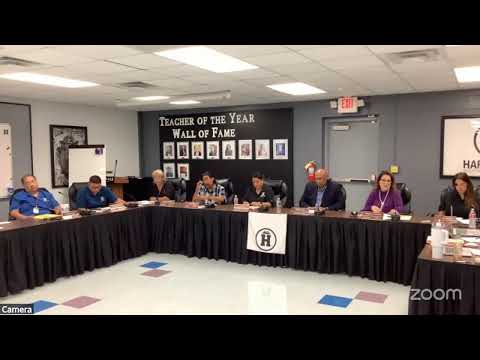
Harlandale ISD trustees review 2025–26 budget projections, consider new pay incentives tied to campus ratings and attendance
Summary
At a May 28 special meeting, Harlandale ISD staff presented 2025–26 budget projections showing a projected $13.0 million deficit under current law and proposed replacing the teacher attendance incentive with a campus-level attendance and accountability stipend; trustees scheduled follow-up workshops pending final state action on school finance.
HARLANDALE, Texas — Harlandale ISD trustees held a special meeting on May 28 to review the district’s first 2025–26 budget workshop, hearing staff projections that show a potential $13,014,037 deficit under current law and discussing proposed changes to compensation and retention pay tied to campus ratings and student attendance.
Assistant Superintendent for Business and Finance Francisco Flores led the presentation, telling the board that “the ink has not hit the paper yet” on state legislation that could change district revenue projections. Flores said the district is planning for current-law funding until bills are finalized but expects updated figures after the Texas Legislature’s decisions in early June.
The board heard detailed budget figures and several policy recommendations that district staff said are intended to improve retention and classroom supports if legislative funding materializes. Flores presented projected 2025–26 general fund revenues of $125,343,675 and projected expenses of roughly $130,350,712, and he said payroll (salaries, substitutes, benefits and stipends) is projected at $117,360,655. “So the overall projected deficit right now as is in the current law would be $13,014,037,” Flores said.
Board context: why this matters
The district’s budget assumptions remain contingent on pending state action. Flores and other staff repeatedly noted that House Bill 2 and Senate Bill 2 were still subject to change; the presentation used current-law estimates and flagged that the board would revisit figures once the Legislature’s work is finalized. Trustees set follow-up workshops for the coming weeks to adopt a budget before the district’s fiscal year begins.
Key proposals and figures discussed
- Compensation and incentives: Staff proposed eliminating the existing individual teacher attendance incentive (which paid up to $1,000 for perfect attendance) and replacing it with a campus-level “attendance and accountability incentive” tied to campus performance and student attendance rates. Under the proposal, all staff at campuses rated A with at least 93% student attendance would receive $750; staff at rated B campuses meeting the same attendance threshold would receive $500. The proposal would apply “to every single individual that’s tied to that campus,” Flores said, naming custodians, nutrition staff, teachers, principals and administrators among eligible employees.
- Costs and alternatives: Flores provided cost estimates for several alternatives: a 1% general pay increase would cost the district about $1,558,000; a 2% increase would be about $2,300,000. A $1,000 retention stipend for all employees was estimated at approximately $1,858,000. Flores also said last year’s teacher attendance payouts totaled $114,800 distributed among 263 staff; projected payout for the current year (if maintained) was shown as $168,100 for roughly 400 staff.
- Federal and grant funding: The district reported receiving $1,034,000 from Stronger Foundations planning and implementation grants. District staff proposed using part of that funding for Bluebonnet curriculum summer professional development at a recommended hourly rate of $20.25; staff also proposed a $1,000 campus team-lead stipend funded through the grant, with selection tied to implementation walk-through criteria.
- Other program costs: Trustees and staff highlighted local programs and services that increase district costs, including the district’s Communities in Schools (CIS) program (the district contribution noted in discussion was approximately $486,000 plus matching funds) and campus social workers. Trustees emphasized that some specialized offerings — for example, Frank Tejeda Academy and early-college programming — are funded from local dollars and carry ongoing staffing costs.
State revenue uncertainty and timeline
Flores summarized the district’s reliance on the Legislature’s actions for any additional revenue. He said the latest conference estimates for the two competing bills were converging toward roughly $8.5 billion statewide in new school funding but that the district would not run final numbers until the bills were signed or otherwise finalized. Flores said June 2 was a likely day for final legislative action and that the district planned an additional budget workshop on June 5; the board scheduled further work sessions June 11 and a possible budget adoption vote on June 16. Staff reminded the board that the district must adopt a budget before July 1.
Trustee and public comments
Maricruz Martinez, president of HEA TSDA local, spoke during the public-comment portion, urging the board to prioritize pay raises and retention stipends if state funding is provided. “We deserve the recognition and money and so does our district,” Martinez said, noting recent legislative discussion of raises for teachers and support staff.
Trustees asked staff for clarifying details about campus ratings, the number of campuses that currently meet or approach the proposed 93% student attendance threshold, and how incentives would be distributed. Staff said one campus had recently met the attendance target and that six campuses were above 92% in preliminary counts; final numbers would be verified when year-end data are complete.
Decisions and next steps
No final budget or compensation decisions were made at the May 28 workshop. Trustees directed staff to return with updated runs once state legislation is finalized and with additional details requested during the discussion. Flores said the board would receive revised information at the June 5 workshop if legislative action is finalized.
Votes at a glance
- Motion to adjourn the special meeting: moved by Trustee R. Moreno and seconded by Trustee Reese; voting opened and the meeting was adjourned at 6:59 p.m. (roll-call vote totals not specified in the transcript.)
Ending
Trustees emphasized that the presentation was based on preliminary numbers and that final actions will depend on confirmed state funding and certified local property values from the Bexar County Appraisal District, which are not due until mid-July. Staff and trustees scheduled follow-up workshops and pledged to provide updated runs to the board after the Legislature’s action and after certified tax values are available.