Wake County commissioners adopt amended FY2026 budget, raise property tax rate by 0.11 cents; 6-1 vote
Loading...
Summary
The Wake County Board of Commissioners approved an amended fiscal year 2026 budget and a package of related ordinances after debate over cuts to a new housing land-acquisition fund and EMS frontline positions. The board also approved a commissioner recusal on a separate Smart Start funding item.
The Wake County Board of Commissioners adopted an amended fiscal year 2026 budget and a set of related ordinances by a 6-1 recorded vote, approving a small property tax increase to fully fund an additional local school operating allocation.
Michelle Venditto, Wake County's budget management services director, introduced the FY2026 recommended budget, saying the manager's recommendation totaled $2,165,555,000 and included a 51.6¢ property tax rate split between 36.6¢ for operating expenses and 15¢ for long-term debt and capital. Venditto told commissioners they would be asked to approve a set of ordinances connected to the budget adoption.
The board acted on an amended motion offered by Commissioner Adamson to adopt the county's operating and capital budgets and related ordinances “except for appropriations for Wake County Smart Start,” and to make several adjustments: reduce the general fund transfer to the housing capital improvement projects (CIP) acquisition fund by $1,000,000; reduce the EMS frontline staffing expansion by $780,000 (12 FTEs); increase the recommended property tax rate by 0.11 cents to an overall FY2026 rate of 51.71¢; and increase the Wake County Public School System operating appropriation by $5,300,000 to $742,907,316, producing a FY2026 general fund budget figure the motion cited as $2,168,946,000.
The motion listed, and the board adopted, a package of ordinances that included the general fund operating budget; debt service fund; fire tax district fund; major facilities fund; solid waste operating fund; South Wake Landfill Partnership Fund; corporate fleet fund; health and dental fund; Wake County Public School System fines and forfeitures fund; human services client trust fund; capital improvement projects funds (county capital, fire tax district capital, major facilities capital, solid waste capital, housing capital, Wake Technical Community College capital, and Wake County Public School System capital); and several special revenue project ordinances (housing affordability and community revitalization fund, human services transportation fund, capital area workforce development fund, grants and donations fund). The board also adopted the personnel authorization, classification and compensation ordinance included in the motion.
Commissioners debated the trade-offs behind the amendment, centering on whether the county should shift revenue and reduce new housing and EMS investments to increase support for Wake County Public Schools. Commissioner Waters said she supported the school funding increase and described the decision as a values choice: “This doesn't require a tax increase that I see as an investment. It is a statement of our values,” she said. Commissioner Thomas opposed the amendment, arguing the changes would undercut housing and emergency services and that repeatedly using local funds to fill state operating shortfalls is unsustainable.
Several commissioners described the board's recent pattern of increasing local support for school operations after state funding shortfalls. Commissioner Stallings and others said the board had worked for days to find areas to trim and reached consensus on pausing a new $1,000,000 land-acquisition commitment and delaying 12 EMS positions that staff said likely could not be hired and trained within the next year.
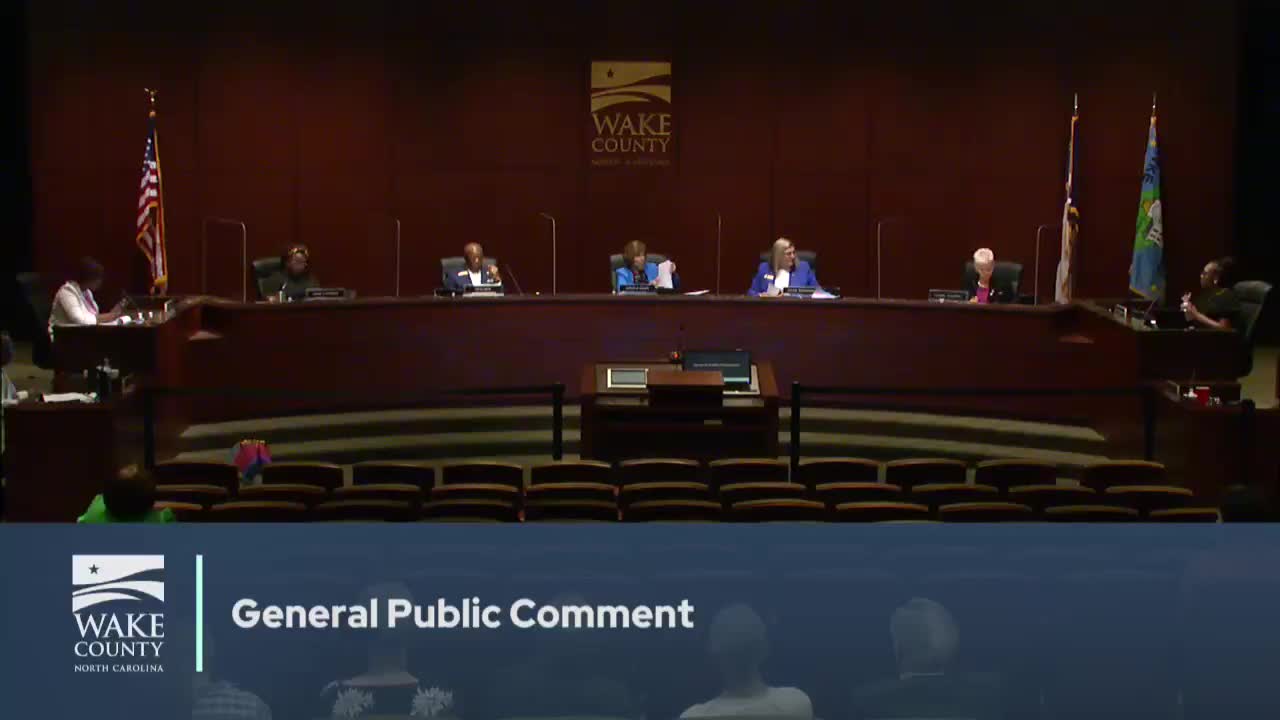
Commissioner Adamson moved the bundled ordinance adoption and amendment; the record does not identify a formal second for that motion in the transcript. Clerk Gildior then administered a roll-call vote: Commissioners Waters, Vice Chair Miao, Chair Evans, Commissioner Adamson, Commissioner Stallings and Commissioner Jackson voted in favor; Commissioner Thomas voted no. The board adopted the amended budget and associated ordinances by a 6-1 vote.
Separately, Commissioner Jackson disclosed a potential conflict of interest related to Wake County Smart Start—explaining she works for the North Carolina Partnership for Children, which helps facilitate contracts for local Smart Start partnerships—and requested to be recused from a vote only on county funding for Wake County Smart Start. A motion to recuse Commissioner Jackson, moved by Vice Chair Mile and seconded by Commissioner Thomas, passed on a voice vote.
The board and county manager acknowledged ongoing uncertainty from potential federal and state policy changes that could affect county costs—speakers cited proposed SNAP and Medicaid reforms currently under consideration at the federal level as possible sources of additional county expenses. Several commissioners urged the state legislature to fulfill what they described as its constitutional responsibility to fund school operating costs so local governments are not repeatedly asked to fill gaps.
The board indicated an intention to revisit housing and EMS funding during the fiscal year if unanticipated revenue becomes available, and some members said they would prioritize restoring the delayed positions and the housing acquisition funding if circumstances change.
Votes at a glance: the amended FY2026 budget and the package of ordinances passed 6-1 (Commissioner Thomas opposed). A separate motion to recuse Commissioner Jackson from voting on Wake County Smart Start funding passed by voice vote.