Get Full Government Meeting Transcripts, Videos, & Alerts Forever!
Get email alerts on the Recycling Arr topic
No spam. Unsubscribe anytime.
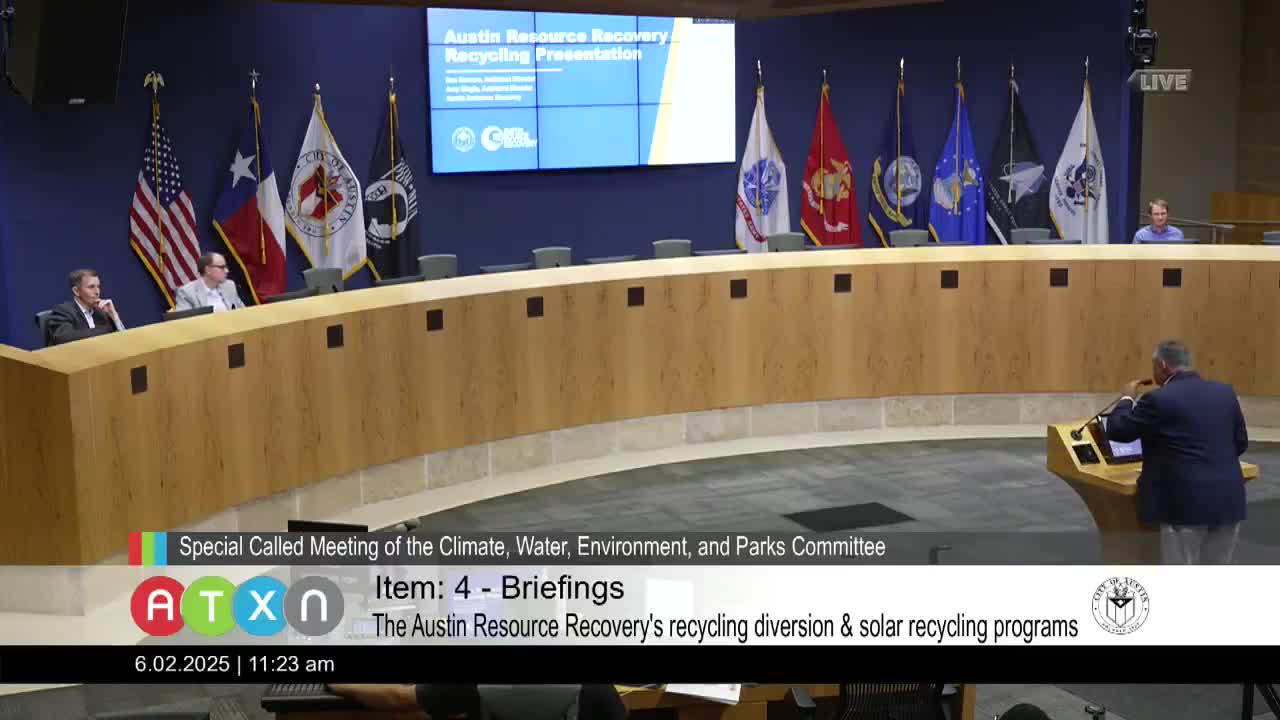
Austin Resource Recovery updates committee on curbside recycling trends and solar panel recycling operations
Summary
ARR reported a small decline from recent peak recycling tonnages, plans to add aseptic packaging to curbside collection, and described a residential solar panel acceptance program that diverted about 10 tons last year.
Austin Resource Recovery (ARR) briefed the committee on curbside recycling trends, contamination challenges and the department’s residential solar panel recycling program.
Assistant Director Ron Romero summarized curbside recycling history and operations, noting the city’s move to single‑stream cart collection and that ARR partners with Balcones Recycling and Texas Disposal Systems to process residential tonnage. Romero said curbside recycling tonnages peaked in 2022 and 2023 (about 63,000–64,000 tons) and that ARR collected roughly 59,000 tons in fiscal 2024. He said the department attributes earlier peaks in part to COVID‑era household changes and that April and October 2024 set‑out studies showed overall set‑out rates near the mid‑80s percent range across audited council districts (examples: District 7 had one of the higher set‑out rates near 94%). Romero cited contamination as a concern and said program audits reported contamination rates that have ranged from about 15% to 22%; ARR staff said targeted education and school outreach (Generation Zero program) are part of efforts to reduce contamination.
Romero also said ARR will accept aseptic packaging and poly‑coated paper (juice boxes and wine boxes) in the residential recycling stream beginning this summer, following coordination with processing partners.
Assistant Director Amy Slagle described ARR’s solar panel recycling intake. ARR accepts small quantities of solar panels (one to two panels) at no cost from residents in the city’s full‑purpose jurisdiction; larger commercial collections incur fees. Slagle said ARR diverted about 10 tons of solar panels in the last fiscal year and ships collected panels to a vendor in Fort Worth for initial processing; further downstream processing occurs in Wisconsin. Panels are dismantled for recoverable materials (aluminum, silver) and glass and wafers are shredded and separated. Slagle noted solar panels are among the most expensive items in ARR’s electronics contract (roughly $0.50 per pound under current vendor arrangements) and that ARR’s electronics contract requires e‑Steward certification to ensure responsible handling and no export of toxic waste to developing countries.
Councilmembers asked about program capacity and whether larger installations could be recycled locally; staff said ARR’s program is designed for residential and small commercial quantities and that larger commercial recycling may require different partnerships or vendor arrangements. ARR staff said they will provide more data on capture rates and what remains landfilled in follow‑up materials.