Get Full Government Meeting Transcripts, Videos, & Alerts Forever!
Get email alerts on the Records Retention topic
No spam. Unsubscribe anytime.
Bartlesville City Council sets two‑year retention for emails and electronic messages after public comment
Summary
The council approved updates to the city's records‑retention approach, setting a two‑year retention period for email, texts and other electronic messages; the decision follows public comment calling for Open Records Act compliance and hours of staff work responding to requests.
Bartlesville — The Bartlesville City Council on June 2 approved a change to the city’s records‑retention approach that sets a two‑year retention period for emails, text messages and other electronic communications generated as city records. The vote was unanimous.
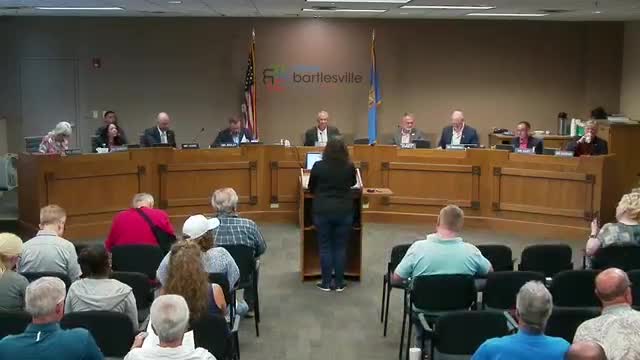
The change was discussed in the context of a public comment from Sarah Burnett, who urged clearer retention rules to improve transparency under Oklahoma’s Open Records Act. Jason Munninger, the city’s chief financial officer, presented a draft update to the accounting policies and procedures manual that lists retention minimums for electronic file types and clarifies that the city manager can set additional procedures.
Munninger and council members described practical challenges: an increasing number of formal open‑records requests this year and a wide variety of message platforms (email, text, social messaging, body‑worn camera recordings). Staff noted that without a set retention schedule some electronic records were effectively retained indefinitely, which increases storage costs and staff time for records retrieval.
Council members discussed several options including one‑year and two‑year retention periods and whether to distinguish staff versus elected officials. After discussion the council moved to adopt the draft policy with the specific change that email, text and other electronic messages listed under the “none” category would instead have a two‑year retention period before eligible deletion. Police department body‑worn camera retention will continue to follow departmental policy and state law exceptions for evidence and active investigations.
Council members said the change is intended to balance transparency and cost and to reduce repeated, broad or “fishing” open‑records requests that have required many staff hours to fulfill. Staff said they will post the updated policy and begin implementing the retention settings in cooperation with the city’s IT department, and that the city will ask requesters to clarify overly broad requests when necessary.
Vote: Councilman Mister Sherrick moved for the change; the motion passed unanimously (5‑0). The council directed staff to return any additional needed policy clarifications and to coordinate with department heads (police, planning, finance) on the technical implementation.
Background: Burnett had asked the council during public comment to treat email, text, electronic messages, audio files and social media activity as subject to the state Open Records Act and to set clear minimum retention periods so citizens can access the records that document government decision‑making.