Get Full Government Meeting Transcripts, Videos, & Alerts Forever!
Get email alerts on the Water And Development Moratorium topic
No spam. Unsubscribe anytime.
Conroe council votes to deny citywide development moratorium amid water-capacity dispute
Summary
After public comment from builders and developers, Conroe City Council voted to reject a proposed citywide moratorium on development and directed staff to continue issuing permits where water capacity is sufficient; council cited new state funding and ongoing TCEQ review as factors in the decision.
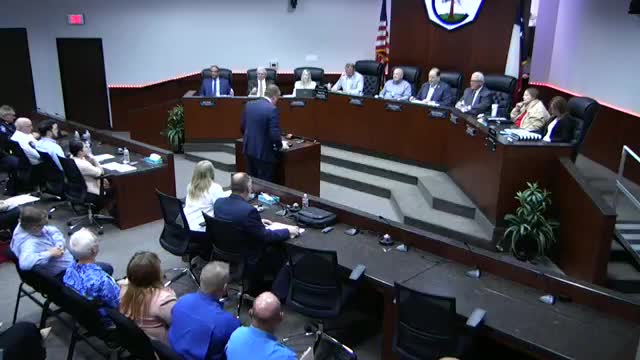
Conroe—The Conroe City Council on May 30 voted to deny a proposed citywide moratorium on development related to the city's water-capacity shortfall, after residents, builders and developers urged the council to delay or reject the restriction while state reviews and funding negotiations continue.
Councilwoman Porter moved to deny the moratorium, and the motion carried after a voice vote. Council members also directed city staff to continue issuing permits in parts of the city that have sufficient water capacity while longer-term solutions are pursued.
The vote followed a public hearing in which industry and local business representatives said a citywide moratorium would cause significant economic harm. Dan Miller, chief financial officer of Camillo Company and a representative of Legend Homes, told the council that developers were prepared to "add infrastructure and water connections that go above and beyond what's required" and asked the council to delay any moratorium on new residential permits.
"Completing homes protects the investment while maintaining the character integrity of Conroe's neighborhoods," Miller said.
Speakers representing property owners, builders and real-estate firms echoed that request. Jeff Duis of the Signorelli Company urged the council to "pause, gather all the facts" and let the Texas Commission on Environmental Quality (TCEQ) finish its review of the city's Alternative Capacity Request (ACR). John Sellers, who identified himself as a resident, urged a delay and questioned whether the engineering reports recommended a citywide moratorium.
Jordan Watson, representing the Howard Hughes Corporation, said the council should seek "a reasonable and timely solution to its water infrastructure issues, not a complete citywide shutdown of all commercial and residential development," saying a moratorium could depress assessed value and shift costs to existing taxpayers.
Council discussion cited both operational problems and legal/regulatory constraints. Council members and staff reported that of the city's 19 active wells, seven had gone down since the moratorium discussion began and five remained offline; well 17 was damaged by lightning and could take about 120 days to repair, and well 21 was under emergency repair beginning May 30, according to city remarks made during the meeting. Council members warned that greater reliance on surface water has already pushed Conroe closer to its contractual limits with the San Jacinto River Authority (SJRA).
Council members noted new state support and an outstanding TCEQ review in framing their decision. Councilwoman Porter referenced recent outreach by Representative Will Metcalfe and Senator Brandon Creighton, saying they had helped secure $15,000,000 aimed at water infrastructure. Porter initially proposed tabling the moratorium for 45 days to allow for the TCEQ investigation and for state officials to work toward a waiver; a procedural reminder from staff noted that a temporary moratorium that went into effect the prior Friday required the council to vote to affirm or reject it by June 3.
The council also discussed an SJRA offer to increase its system capacity from 13,000,000 gallons per day to 15,000,000 gallons per day and a potential incremental allocation of about 1,500,000 gallons per day for Conroe (from roughly 3,800,000 to 5,300,000 gallons per day) if the city agreed to certain contract and litigation-related conditions. City speakers said that while the incremental supply would help, it was not a complete solution.
Developers said they were willing to collaborate on interim infrastructure fixes. Nate Newman of Newman Development Corporation and Cody Miller of the Greater Houston Builders Association asked the council to wait for the TCEQ ACR determination and to work with industry on targeted solutions that would allow low-demand commercial projects and other developments to proceed.
City staff and council members emphasized the financial stakes. One speaker said the moratorium could create an estimated $6.5 million shortfall in permit revenue and that roughly 1,000 permit applications were waiting for processing; council members said those figures were part of their calculus in denying a blanket moratorium.
The council's action was limited: it denied a citywide moratorium but left in place staff discretion to approve permits in areas confirmed to have sufficient capacity and to continue negotiations with SJRA and TCEQ as the city pursues both emergency repairs and longer-term infrastructure investments.
Council members closed the meeting by thanking state officials for the new funding prospect and asking developers to partner on solutions; no additional formal actions or ordinances were adopted during the session.
The council adjourned following the vote.