Get Full Government Meeting Transcripts, Videos, & Alerts Forever!
Get email alerts on the Fleet Electrification topic
No spam. Unsubscribe anytime.
City briefs committee on fleet electrification plan, site-by-site charging study and electric landscaping pilot
Summary
City staff told the committee the municipal fleet has 373 battery-electric vehicles, drove about 1.8 million electric miles in 2024, and outlined near-term charging-port build plans and a Parks pilot to assess electric landscaping equipment.
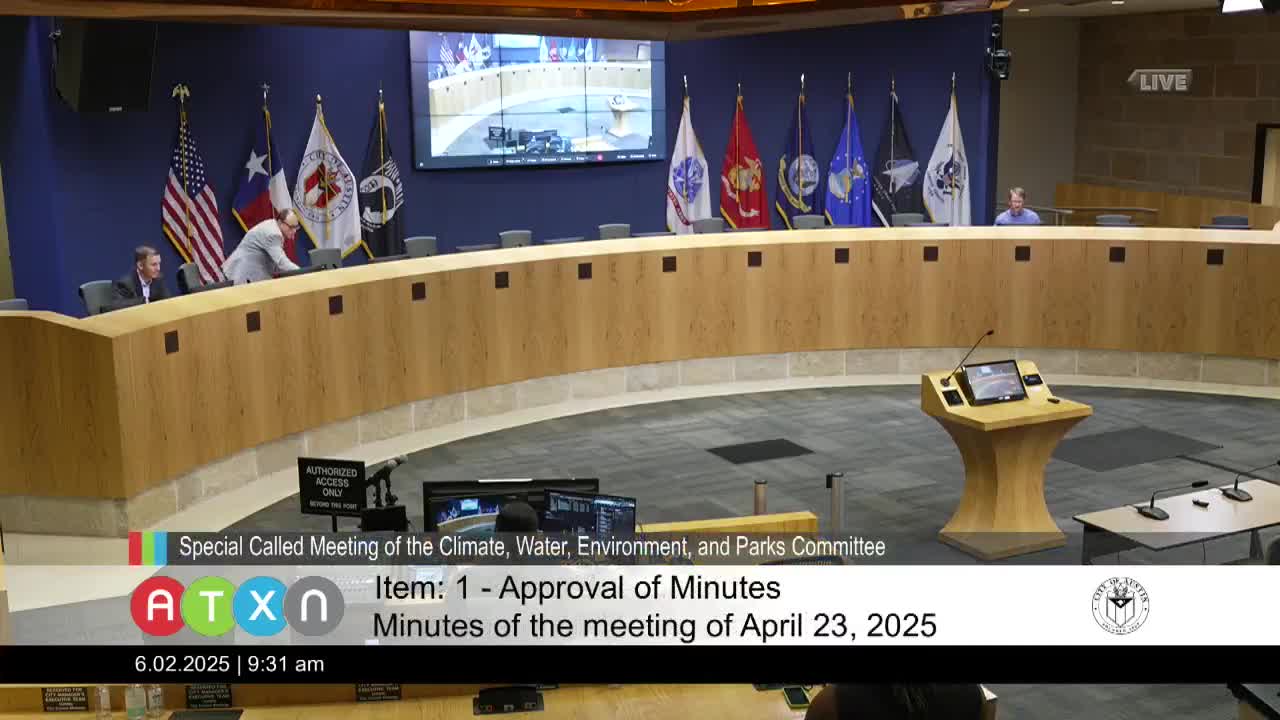
The Climate, Water, Environment & Parks Committee heard a briefing on city fleet electrification, charging infrastructure planning, and a parks department study and pilot for electric landscaping equipment on June 1.
Zach Bomber, director of the Office of Climate Action and Resilience, said the city’s goal from the Climate Equity Plan is to electrify 40% of viable fleet vehicle miles traveled by 2030 and to support the city’s long‑term net‑zero greenhouse gas target. Bomber said the city currently has 373 battery-electric vehicles and that “last year, they drove 1,800,000 electric vehicle miles.” He added the city expects to grow to “right at 400” battery-electric vehicles by the end of the year and to over 700 by 2030, prioritizing high‑usage units and departmental readiness.
Rick Harlan, assistant director of Fleet Mobility Services, summarized the fleet profile and the program’s staged strategy. Harlan said only about 29% of the fleet currently has viable battery-electric vehicle (BEV) options and the department targets that “29%” first. He described pilots already under way, including a battery‑electric police pursuit vehicle pilot and electric refuse trucks, saying fleet’s approach is “Prove it first, scale it second.” Harlan said the battery‑electric vehicle fleet logged roughly 1.8 million miles in 2024 and that BEV purchases have averaged about 10% of new vehicle purchases since 2017; in 2024 BEV purchases were 8.2% of new vehicle purchases, slightly above the national consumer market share reported in the presentation.
On infrastructure, Cameron Freeberg, manager of Electric Vehicles and Emerging Technologies at Austin Energy, said the city will have roughly 282 dedicated fleet charging ports at city facilities by the end of the year and plans to reach nearly 500 ports by 2030. Freeberg described a citywide “build once” approach: a consultant-led study to map existing equipment, identify future expansion needs by facility and use case (fleet, employee workplace, public), and produce an Excel inventory and a cost analysis by the end of the calendar year. He outlined a citywide EV charging parking policy to manage competing uses and signage, time limits and enforcement to keep fleet, employee and public needs balanced.
Sarah Talkington, consulting engineer for Parks and Recreation, described a new citywide market assessment and a Parks pilot to evaluate electric lawn and landscape maintenance equipment. Talkington said Parks will survey in‑house crews, contracted vendors and local commercial landscape firms to assess operational fitness, liability and market readiness, with the department preparing a pilot program manual in November. She said the work will focus on commercially viable equipment categories such as mowers, blowers, hedgers and chainsaws; earlier piecemeal adoptions informed the broader study because crews found some tools workable while others raised battery‑life or weight concerns.
Council members asked for additional analysis. Councilmember Siegel requested the fleet’s cost and carbon analyses — Harlan said fleet had run net‑present‑value modeling and estimated that electrifying the remaining 29% of viable units today would produce an approximately $35 million net present value loss over eight years while saving roughly 21,000 metric tons of CO2 over that period (about 2,700 metric tons per year). Councilmember Duchin asked for mileage‑weighted pie charts (share by vehicle miles traveled rather than share of vehicles), and Harlan and Freeberg agreed to provide those. The police‑pursuit BEV pilot will have a 12‑month operational evaluation; final deployment decisions would be made in coordination with the Austin Police Department.
Staff emphasized a staged deployment: select vehicles where technology and service cycles align, expand charging where grid access and site readiness allow, and use pilots to guide larger procurements. City staff said scaling heavier duty and public‑safety electrification depends on market advances in vehicle models and battery technology and on ongoing coordination with manufacturers and Austin Energy.
No formal committee action or vote was taken on policy changes during the briefing; the presentation was informational and councilmembers requested follow‑up materials and analyses to inform future budget and procurement decisions.