Get Full Government Meeting Transcripts, Videos, & Alerts Forever!
Get email alerts on the Convention Center Hot Tax topic
No spam. Unsubscribe anytime.
Speakers urge Austin leaders to halt convention center plan, warn HOT funds would be tied up for decades
Summary
Multiple public speakers told the Austin Music Commission that a proposed convention center expansion would lock up hotel occupancy tax revenue for 30 years and divert money from local music, parks and community cultural programs.
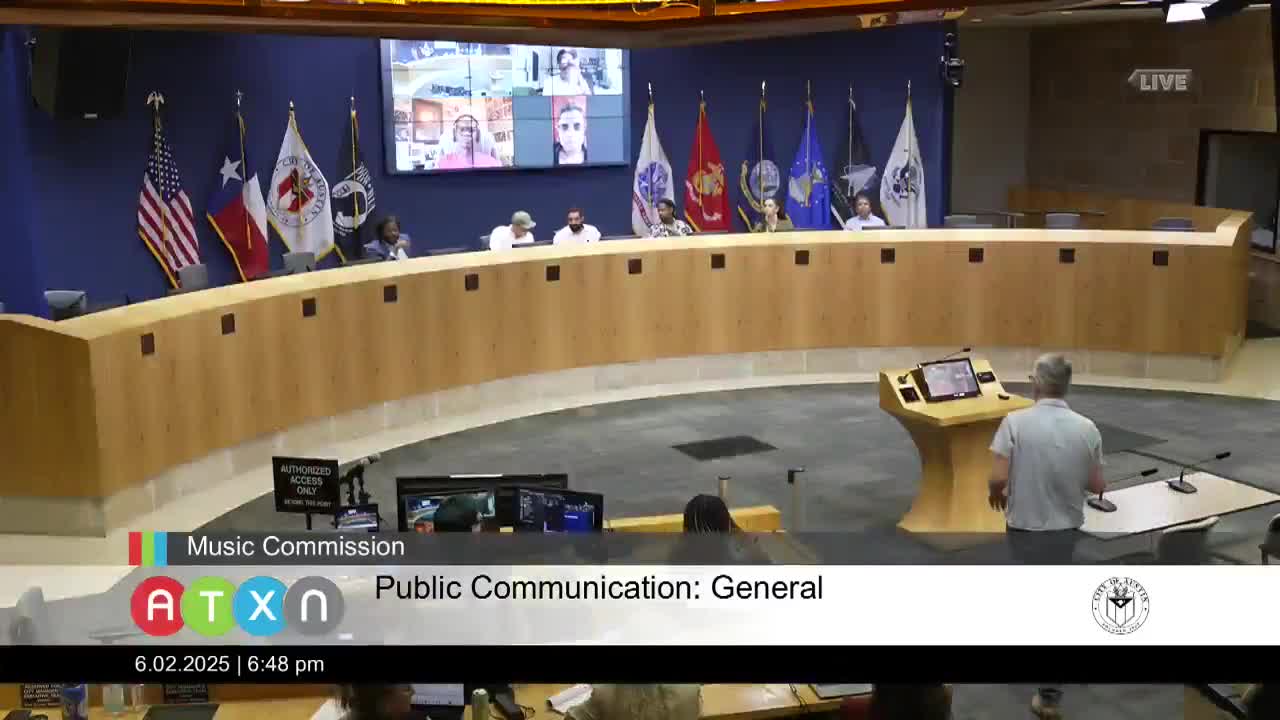
Several members of the public used the Music Commission’s public-communications period on June 2 to urge commissioners to oppose the proposed downtown convention center expansion and to back a petition to give voters a say.
Those speakers told the commission that the hotel occupancy tax — often called HOT — is already the city’s largest tourism revenue stream and that an expansion would tie most HOT revenue to debt service and operating costs for decades. “If this convention center goes forward, city staff has told us in writing they have to set aside $5,600,000,000 of revenue over the next 30 years,” said Bill Bynes, identifying himself with Save Our Springs Alliance, charging that the project would divert money from cultural and natural assets.
Why it matters: Speakers argued the HOT is the primary municipal funding source for tourism promotion, parks and arts programs that directly benefit Austin musicians and venues. They said locking that revenue into long-term debt would reduce grants and support for the local creative economy.
What speakers told the commission: Lauren Bruno, director of 3 Dollars Shows and co-founder of ProsperXO, framed the issue in terms of artist compensation and cultural equity, saying, “The data is already here. The problems are well known. What we're lacking now is action.” Bruno urged transparency and “public reporting on all city funded cultural programs” and asked the city to ensure more HOT funding flows directly to artists.
Mary Jane Nally, who described herself as a long-time Austin resident and preservation-oriented business owner, told commissioners the city should “lead with” authentic local culture rather than build large generic venues that she said would “tie up Austin’s hotel occupancy tax funds for 30 years.”
Neon artist Ben Livingston described having been paid this year to remove a city-owned neon sculpture ahead of demolition and said the city should invest HOT revenue in parks, artists and venues instead of a new center. He said a documentary produced by Austin Free Press argues the project could “siphon off over $130,000,000 a year” from local cultural funding.
Commission response and next steps: Commissioners thanked speakers and asked staff for follow-up. Commissioners asked staff to add the convention-center timeline and related updates to a future agenda so the commission can be informed and advise on cultural funding implications. No formal Commission vote on the convention center or an endorsement of the petition was taken during the meeting.
Ending: Public attendees urged the commission to use its public platform to preserve downtown cultural resources and to press for clearer accounting of how HOT dollars are spent.